
Confusion is mounting over the U.S. and Iranian ceasefire, with both sides offering differing accounts of the scope of the deal, whether the Strait of Hormuz is open and whether the U.S. and allies are keeping to the deal.
In a social media post Wednesday afternoon, the Iranian Parliament’s speaker accused Israel of violating the ceasefire by continuing attacks on Lebanon and drone incursions into Iran.
Meanwhile, White House Press Secretary Karoline Leavitt insisted to reporters that “Lebanon is not part of the ceasefire” and said that message has been “relayed to all parties involved.”
Still waiting: Amid the confusion, vessel movement in the Strait of Hormuz Wednesday was minimal. Two vessels were reported in the strait Wednesday morning, according to a vessel tracking service. But hundreds remain at a standstill in the region.
However, Leavitt and Vice President JD Vance continued to insist Wednesday that the strait is open, even as Iranian state media reported it had been closed.
A negotiating team made up of Vance, special envoy Steve Witkoff and the president’s son-in-law, Jared Kushner, will head to Pakistan this weekend for negotiations with Iranian officials, Leavitt also noted.
Mosaic idles two Brazilian phosphate mines
Mosaic says it will idle operations at two facilities in Brazil as part of an effort to “reduce costs and redeploy capital.” It will also try to sell one of the facilities.
In a statement Wednesday, the company said that it anticipates the move to reduce its phosphate production by around 1 million metric tons a year.
The decision “removes phosphate units from a marketplace that desperately needs more, not less, units globally,” StoneX’s Josh Linville told Agri-Pulse in an email.
Take note: Brazilian farmers are likely to be among the worst affected. The closure of the Araxá Mining and Chemical Complex “makes Brazil more dependent on imports if no other company purchases and runs the facility,” Linville added.
The other pause affects mining operations at the Patrocínio Complex.
Lawsuit over HHS staffing cuts can continue, judge rules
A federal judge has rejected the Trump administration’s motion to dismiss a lawsuit challenging staffing cuts at the Department of Health and Human Services.
State attorneys general suing the agency made “several plausible allegations regarding HHS’s extralegal conduct and constitutional violations,” U.S. District Judge Melissa DuBose in Rhode Island said in her ruling.
The lawsuit filed by 19 states and the District of Columbia alleges HHS violated the Constitution’s appropriations clause and its separation of powers doctrine when making staffing cuts last year. It also alleges violations of the Administrative Procedure Act.
Federal lawyers had argued that a March 27 agency directive calling for staffing reductions does not constitute a “final agency action” under the APA that the attorneys general lacked standing to pursue the case, and that the matter is not in the court’s jurisdiction. However, DuBose noted she had already rejected many of the same arguments earlier in the litigation.
Interested in more news on farm programs, trade and rural issues? Sign up for a four-week free trial to Agri-Pulse. You’ll receive our content - absolutely free - during the trial period.
Take note: Most of the National Institute for Occupational Safety and Health’s workforce last year received reduction-in-force notices and even after the lawsuit was filed, were placed on leave. However, the agency acknowledged in court filings earlier this year that it had "rescinded all remaining RIF notices, reinstating hundreds of employees to the agency.”
Rollins reschedules Ohio visit to meet with Trump
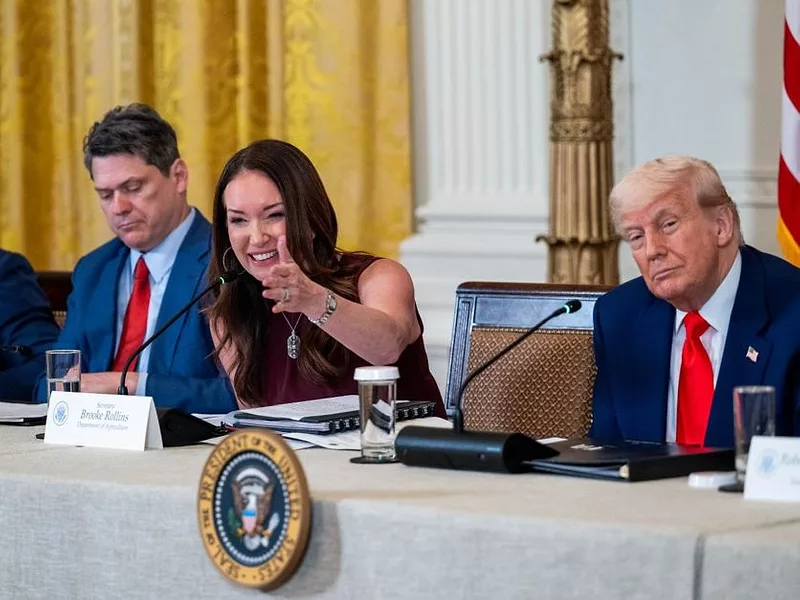
Agriculture Secretary Brooke Rollins met with President Donald Trump in the Oval Office Wednesday after abruptly rescheduling a tour of Majors Enterprises in Monroe, Ohio, and a roundtable event in the state.
White House spokesperson Anna Kelly told Agri-Pulse the pair “discussed topics of importance to America’s farmers and ranchers,” but did not provide specific information on the meeting.
Take note: As the war with Iran continues and confusion over the safety of the Strait of Hormuz clouds the fertilizer market outlook, Rollins has repeatedly been questioned on how the administration can stabilize input costs for farmers. She said Monday the U.S. has “got to build the infrastructure in this country” to spur domestic fertilizer production.
Green diesel output is poised to jump in 2027, EIA says
After a rocky couple of years, production of biomass-based diesel is forecast to rise in 2027, according to the U.S. Energy Information Administration.
Renewable diesel, prized for the ability to easily replace its petroleum counterpart, is seen climbing to 300,000 barrels a day next year, up from an expected 230,000 barrels in 2026.
EIA still sees output of biodiesel, a similar but chemically different fuel, at 100,000 barrels a day this year, but now sees 2027 production slightly higher at 110,000 barrels.
Both renewable diesel and biodiesel hit a recent slump. That’s partly due to policy uncertainty from Washington that led to lower production of the fuels used to power trucks, trains and other heavy vehicles.
Producers are hopeful that newly announced biomass-based diesel quotas for this year and next will lead to a profit turnaround for struggling biofuel makers and farmers who grow crops used to make the fuel.
“Good times ahead,” says Corey Lavinsky of Montana Renewables.
Nominations sought for Borlaug CAST Communication Award
Nominations are open for the 2026 Borlaug CAST Communication Award, sponsored by the Council for Agricultural Science and Technology.
“The award is presented annually to recognize outstanding achievement by a scientist, engineer, technologist, or other professional working in the agricultural, environmental, or food sectors for contributing to the advancement of science in the public policy arena,” CAST says in its announcement. Nominations are open through May 31.
The winner will be announced by June 30 and honored Dec. 10 at a ceremony at the Library of Congress in Washington, D.C.
Final word
“Ultimately, the Strait [of Hormuz] opening helps but it does not solve anything. There is a list of things still wrong with the global fertilizer market and there isn’t time to fix it.” – Josh Linville, Stone X’s vice president of fertilizer.
For more news, go to Agri-Pulse.com.
.webp?t=1762183428)


