
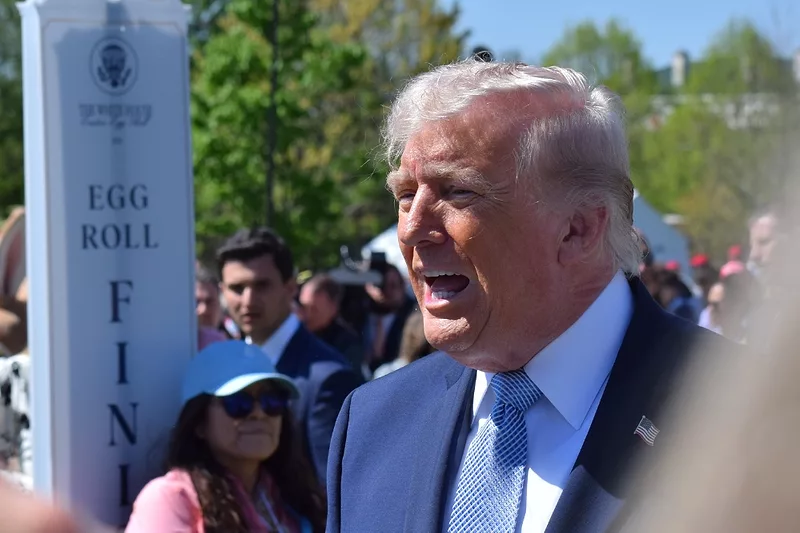
If Iranian and U.S. officials can’t come to a deal today, the U.S. will widen the scope and intensity of its strikes on the country, the administration says.
Over the weekend, President Donald Trump said Iran has until Tuesday to open the Strait of Hormuz or the country would be “living in hell.”
In comments to reporters Monday, the president doubled down on the threat, noting that by midnight, Iran could face “complete demolition.”
“Every bridge in Iran will be decimated by 12 o'clock tomorrow night, where every power plant in Iran will be out of business — burning, exploding, and never to be used again,” Trump said. He also noted that both sides are negotiating.
Defense Secretary Pete Hegseth suggested that the U.S. is already ratcheting up its aggression ahead of the deadline.
“Per the president's direction, today will be the largest volume of strikes since day one of this operation tomorrow, even more than today,” Hegseth said Monday.
Take note: StoneX’s Arlan Suderman said any damage to Iranian energy infrastructure could have long-term ramifications for fertilizer prices. Israel launched new strikes on Iran’s South Pars natural gas plant, which is a key supplier for global fertilizer producers.
“Any energy infrastructure damaged could take up to several years to repair after the war is over,” Suderman wrote Monday. India has also announced it intends to buy 2.5 million metric tons of urea, Suderman noted, adding to ongoing price pressures.
Meanwhile: Some are pulling back on fertilizer application over rising prices. Ben Steffen, a Nebraska corn farmer, told reporters Monday he has been scrutinizing field samples to work out where to pull back without hurting yields.
“We're using less fertilizer this year than last, and last year, less than the year before,” he said.
Fuel sellers double down on push for old tax credit
Diesel-selling trade groups aren’t giving up on their fight to revive the defunct biodiesel blenders’ tax credit.
Interested in more news on farm programs, trade and rural issues? Sign up for a four-week free trial to Agri-Pulse. You’ll receive our content - absolutely free - during the trial period.
In comments to the Treasury Department on how to deal with the old credit’s replacement, known as 45Z, the organizations say the best approach is for Congress to reinstate the two-decade old BTC that expired at the end of 2024.
It’s a “proven approach that can bolster soybean demand and help stabilize retail diesel prices,” NATSO, which represents truck stops, SIGMA, a fuel marketing group, and the National Association of Convenience Stores, said.
The blenders' credit was valued at a flat $1 a gallon, while the financial benefit of 45Z depends on the carbon-dioxide footprint of a biofuel's full production chain. The groups, which represent 90% of retail fuel sales, argue the latter is too complicated and lacks transparency.
USDA carbon calculator: Separately, the Iowa Biodiesel Board is asking Treasury to fold a USDA carbon calculator into 45Z and apply it retroactively to fuel made and sold last year.
"We are simply asking Treasury to make it work as intended, for the producers and farmers who depend on it most,” said IBB executive director Grant Kimberley.
‘This is about eggs’: Trump touts declining egg prices at White House Easter Egg Roll
Trump used his remarks at the White House Easter Egg Roll to thank farmers and highlight declining egg prices over last year.
“My second day in office I had a news conference and they [reporters] were screaming at me ‘what are you going to do about eggs?’ … Well that sounds like a problem, let me think about it. And Brooke Rollins, our great Secretary of Agriculture, she got involved,” Trump told attendees, explaining that 40,000 real, American-raised eggs were used in the event.
Egg prices skyrocketed after rampant highly pathogenic avian influenza infections and depopulation efforts. The American Farm Bureau Federation estimates egg prices are down 57% in the last year.
Trump said the White House was expecting between 30,000 and 50,000 attendees who could participate in the historic egg roll and visit booths, including the Hen to Home exhibit featuring chicks and American-grown soybeans. The International Fresh Produce Association also had a booth featuring fresh cut flowers, fruit and vegetables.
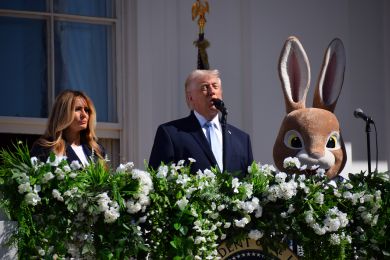 President Donald Trump speaks to attendees at the White House Easter Egg Roll alongside First Lady Melania Trump and the Easter Bunny. (Agri-Pulse photo)
 American Egg Board President and CEO Emily Metz joins Agri‑Pulse’s Lydia Johnson and Banana the chick in the White House James S. Brady Briefing Room. Banana was one of 150 chicks hatched on Good Friday in Georgia and available for attendees to meet in the Egg Board’s Hen to Home exhibit. (Agri-Pulse photo)
 The International Fresh Produce Association’s booth featured an American flag made from fresh produce and offered attendees fresh flowers, fruits and vegetables to take home. Senate Ag Committee Chairman John Boozman, R‑Ark., joins Mollie Van Lieu, IFPA’s vice president of nutrition and health, in the booth. (IFPA photo)
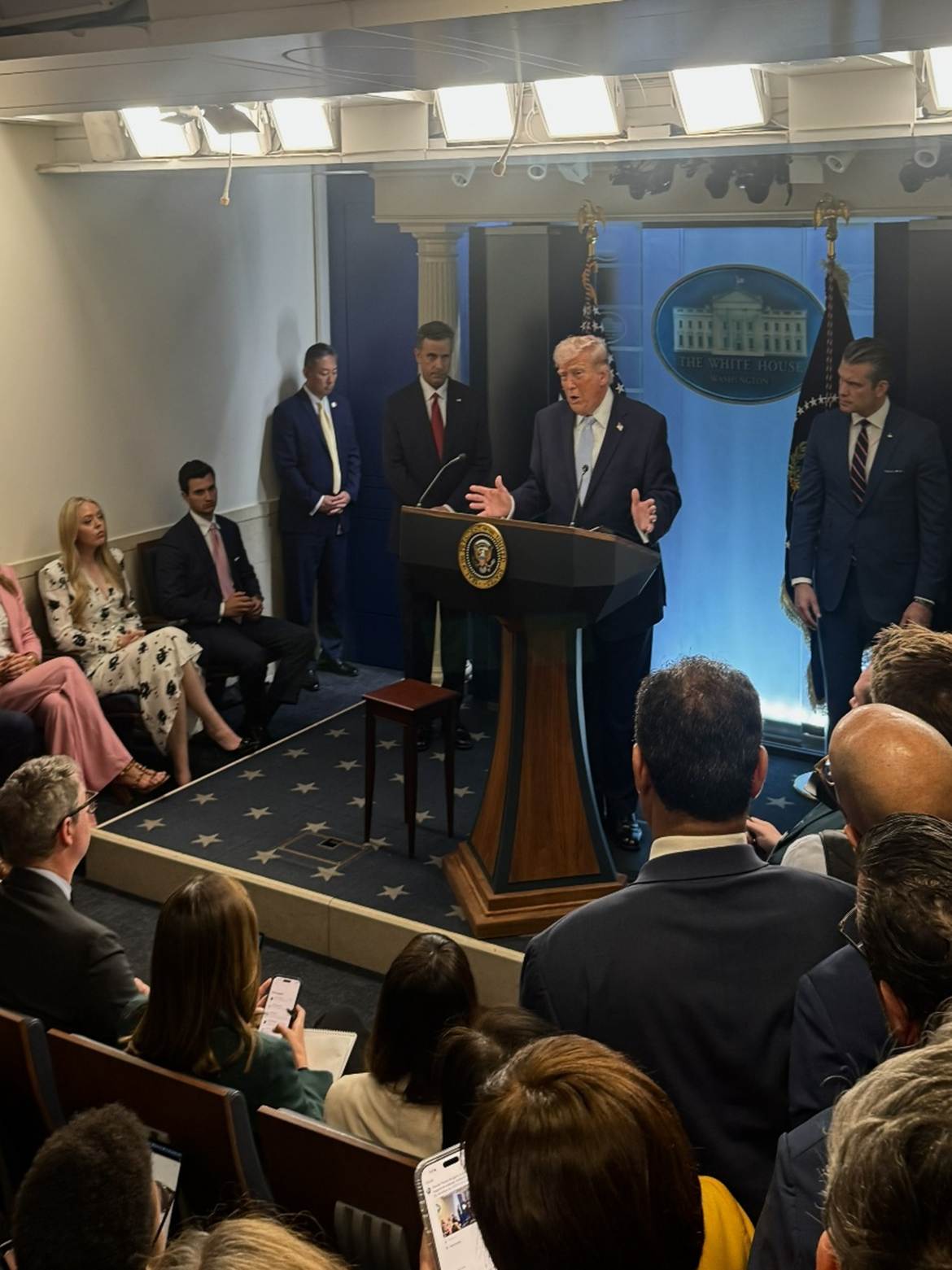 Trump briefs reporters on the mission to rescue a missing U.S. airman after a fighter jet was shot down over the Easter weekend in Iran. He warned he would “blow everything up” if no deal is reached by 8 p.m. ET Tuesday. (Agri-Pulse photo)
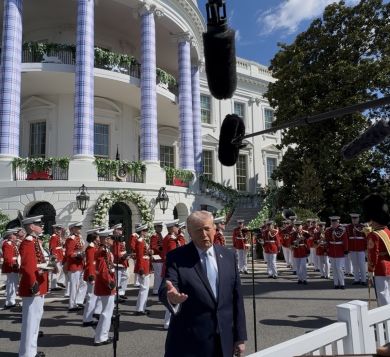 Trump takes questions from reporters in front of the White House. (Agri-Pulse photo)
 A few of the 40,000 American‑raised, hand‑dyed eggs used at the event. Many were colored in shades of red and blue to match the event’s “America 250” theme. (Agri-Pulse photo)
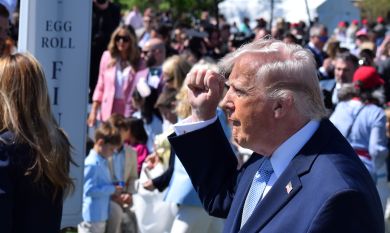 Trump raises his fist as the crowd cheers “four more years.” (Agri-Pulse photo)
USTR to speak on future of US trade policy
U.S. Trade Representative Jamieson Greer will give remarks on the future of U.S. trade policy this morning at the Hudson Institute in Washington.
Greer has been openly skeptical about the value of the World Trade Organization. He will be speaking after returning from the body’s ministerial conference in Cameroon last week where officials failed to agree on a path forward for several key issues, including agriculture talks.
The remarks also come as the administration pivots to alternate tariff tools in the wake of a Supreme Court decision and just days before a lower court considers a challenge to a new global tariff.
Trade negotiations are also still in the spotlight as parties gear up to review a North American free trade deal and officials prepare for an upcoming meeting between Trump and Chinese President Xi Jinping.
Klamath water users expect tough water year ahead
Water leaders throughout the Klamath Basin are warning users of a challenging water year to come amid limited snowpack and spring conditions arriving earlier than normal.
In a letter to farmers, leaders of the Klamath Water Users Association and six irrigation and drainage districts said an ongoing snow drought had led to snowpack in the Klamath watershed sitting at around 4% of the median. They warned that irrigators will likely see less than full deliveries of Klamath Project water in the upcoming year and said they expected the Bureau of Reclamation to make a “more specific” announcement on that “very soon.”
"We know this is not welcome news,” they wrote. "We share your concern and we wish it was different. This will be yet another year when you, your family, and other farmers and ranchers will be required to make tough decisions to ensure the survival, rather than the prosperity, of generational family operations."
Final word
“The long term of this, though, should sort of shine a light for every American: This is why the president’s ‘America First’ agenda and onshoring – whether it’s manufacturing, now fertilizer – is so important. … We’ve got to build the infrastructure in this country – more infrastructure, we’ve got some, but more – where we can take that [liquefied natural gas] and turn it into the nitrogen that farmers need.” – Agriculture Secretary Brooke Rollins at the White House Monday when asked how concerned the Trump administration is about fertilizer prices.
.webp?t=1762183428)


