
House and Senate ag leaders return from recess faced with a lengthy “to do” list. At the top is figuring out a path for E15 legislation.
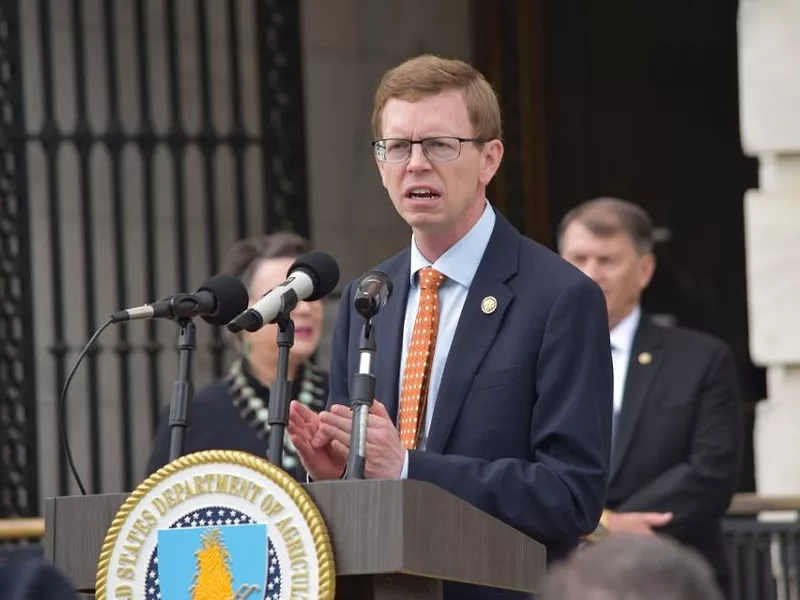
Republican Rep. Dusty Johnson of South Dakota and Democratic Sen. Elissa Slotkin of Michigan both stressed the need for year-round availability of higher ethanol fuel blends, known as E15, while in the Corn Belt during the two-week congressional break.
Johnson held an employee town hall at ethanol giant POET in Sioux Falls, South Dakota, to discuss E15 prospects. Slotkin, along with Democratic Rep. Greg Landsman, whose district includes Cincinnati, met with farmers last week in southwest Ohio.
“If we are going to do this, this is going to be the year,” Slotkin said of E15. “I need my fellow folks in the House to actually put up a vote, move this thing forward.”
President Trump late last month said he’s trusting House Speaker Mike Johnson, R-La., and Senate Majority Leader John Thune, R-S.D., to find a deal that works for farmers, consumers and both large and small oil refiners.
In early March, Rep. Randy Feenstra, co-chair of the House council tasked with crafting an E15 bill framework, said legislation should be unveiled shortly and that it likely can be considered as a stand-alone bill. Ag and energy interests are eager for an update.
Feenstra may need E15 in quiver for governor’s race
Feenstra is among lawmakers under increased pressure to deliver on E15. The Republican lawmaker’s race for Iowa governor was moved last week from a “lean Republican” rating to “toss up” by the nonpartisan Cook Political Report.
Democratic contender and state auditor Rob Sand has a whopping $13.2 million in cash on hand compared to Feenstra’s $3.2 million, according to Cook.
Iowa’s Democratic Party has been blasting Feenstra over allegedly “getting nothing done on E15.”
In South Dakota, Johnson is in a tight race in his bid to unseat South Dakota Governor Larry Rhoden, a fellow Republican.
Slotkin isn’t up for Senate reelection until 2030, though the former CIA analyst who served three tours in Iraq has been busy visiting potential presidential battlegrounds like Iowa, Wisconsin and Pennsylvania.
Slotkin last week told the Des Moines Register that her current objective is to help Democrats usher in a new generation of leaders. Still, she left the door open for a possible 2028 White House run.
“Midterms is what I’m focused on right now, but if it comes to the point afterwards that I think there’s not anyone else who’s on the right path, I guess I wouldn’t say no forever,” Slotkin said. “But I also don’t think it has to be me.”
Trump, Mosaic spar over cause of fertilizer price increases
The president and a leading fertilizer company are offering competing views on the cause of higher fertilizer prices.
The Trump administration has taken aim in recent months at what it sees as an overconcentration of market power in the fertilizer industry. In a post to his Truth Social platform on Saturday, Trump accused leading producers of “price gouging.”
Mosaic, the top U.S. fertilizer producer, hit back in its own post to X Saturday afternoon.
“Global fertilizer prices are shaped by a wide range of well-documented market factors, including global supply and demand dynamics, energy costs, weather and crop forecasts, transportation constraints, and geopolitical conditions,” the post reads. “These forces, not individual producers, drive the pricing of phosphate and potash fertilizer products.”
“In fact, U.S. prices are lower than in other key agricultural regions of the world,” Mosaic added.
Texas on alert after latest screwworm detection
Texas Agriculture Commissioner Sid Miller is urging ranchers to check their animals and report any signs of New World screwworm after the parasite was detected just 90 miles from the state’s border with Mexico.
“This is not a drill,” Miller said in a statement posted Friday. “While the USDA has taken steps to respond, the reality is the spread of the New World screwworm has not been successfully contained to date. That is a serious concern, and it underscores exactly why Texas must be proactive in dealing with this threat.”
Miller stressed that early detection is critical for stopping the spread of the pest that could ravage the rural economy.
“Texas has defeated screwworm before, and we will do it again — but it takes urgency, accountability, and immediate action across the board,” he said.
At the end of January, the northernmost detection of NWS was 200 miles south of the border. USDA released a “playbook” earlier this month to address the situation.
Interested in more news on farm programs, trade and rural issues? Sign up for a four-week free trial to Agri-Pulse. You’ll receive our content - absolutely free - during the trial period.
US-India trade talks back on track?
U.S. and Indian officials are set to meet for further trade talks later this month in a sign that progress on an interim deal could be within reach.
Indian Ambassador to the United States Sergio Gor met with U.S. Trade Representative Jamieson Greer last week for what he called a “highly productive” meeting.
The two sides issued a joint statement in February on a framework deal that would lower some trade barriers while discussions on a broader trade agreement play out. Several agricultural commodities are in line to see tariff reductions under the plan.
The Indian media reported, however, that progress had stalled following the U.S.’ launch of two new investigations targeting Indian trade practices last month.
“Negotiations might be back on track,” Mark Linscott, a senior adviser at the U.S.-India Strategic Partnership Forum, said in a post to LinkedIn. He added that Indian negotiators may be fighting against the clock to finalize the interim deal before fresh tariffs are applied.
“India can likely retain the previously agreed 18% tariffs if the interim agreement is concluded soon,” he said. “That may not be the case if the interim agreement is further delayed.”
Fordyce sees orderly rollout of base acre update
A top USDA official says the rollout of the 30-million-acre increase in base acres for producers will be done in an organized way.
“It's not first come, first served,” Farm Production and Conservation Undersecretary Richard Fordyce tells Jeff Nalley on Agri-Pulse Open Mic. “It's going to be an orderly distribution so folks aren't needing to camp out in the parking lot at FSA to make sure they get their additional base acres.”
Fordyce also speaks of the need to upgrade technology at the Farm Service Agency and Natural Resources Conservation Service, while at the same time keeping older systems up and running.
Nebraska legislature passes ag data privacy bill
Companies would not be allowed to sell agricultural data without written consent from producers under a bill passed by Nebraska lawmakers last week.
The Agricultural Data Privacy Act calls agricultural data a “proprietary business asset” and requires companies to seek consent through a “clear and conspicuous” system separate from their primary terms of service or data use agreements. It allows the Nebraska attorney general to seek $1,000 penalties from violators.
Take note: Republican Governor Jim Pillen, who has yet to sign the bill into law, supported similar legislation last year.
Final word
“Probably the agency that's going to see … more engagement with hardware technology, laptops and those sorts of things, will be NRCS – technicians, soil conservationists and others that are out on farms.” – Farm Production and Conservation Undersecretary Richard Fordyce on Agri-Pulse Open Mic. He foresees them being able to “literally create an agreement or a contract or a program eligibility sign-up, and the farmer sitting on the tailgate of the truck is going to be able to digitally sign that application and start the process.”
Kim Chipman, Oliver Ward and Noah Wicks contributed to today’s Daybreak
.webp?t=1762183428)


