
|
California farmers face a tightening and increasingly volatile water outlook this year, as state and federal officials warn that extreme heat — not just precipitation levels — is reshaping how and when water is available.
Department of Water Resources Director Karla Nemeth says the state is entering irrigation season with a largely fixed supply, after the snowpack peaked on February 24 — six weeks ahead of the typical schedule.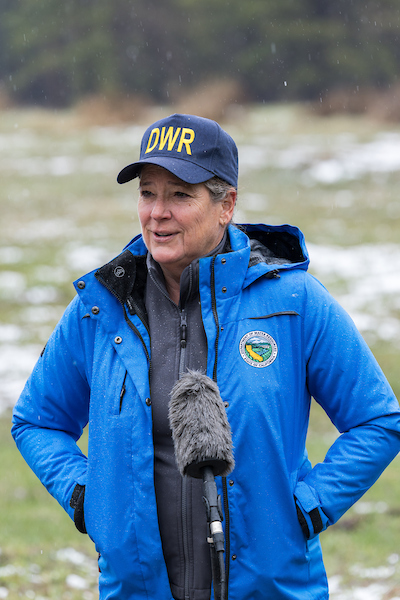 DWR Director Karla Nemeth (DWR photo)
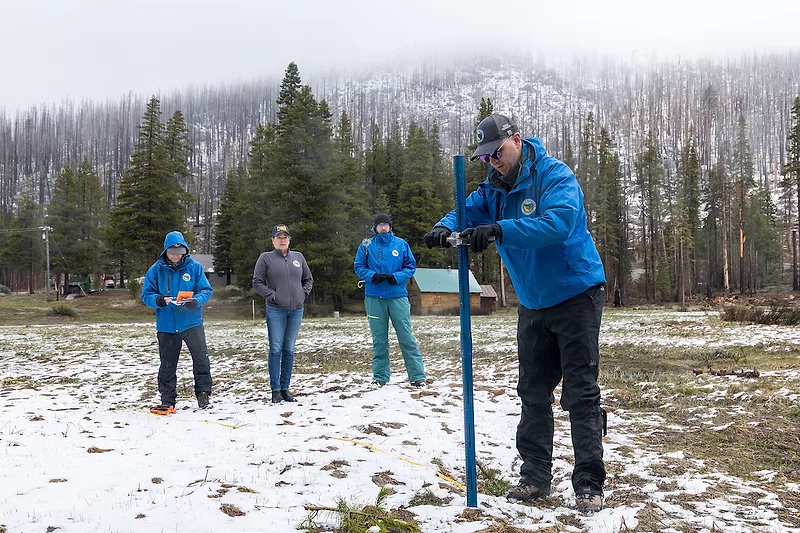
“What we have in our reservoirs is what we have,” said Nemeth during DWR’s April 1 snow survey at Phillips Station near Lake Tahoe. “We have to manage it for the next six months or so, until we hit October.”
Allocations locked in as runoff arrives early
For farmers relying on the State Water Project, allocations remain at 30% and will not increase, despite late winter storms. On the federal side, the Bureau of Reclamation is describing similarly constrained conditions for the Central Valley Project, with allocations shaped by limited runoff, regulatory requirements and reservoir operations.
Early-season inflows helped boost reservoir storage, but both state and federal officials are stressing that those gains reflect water that arrived too soon. Without sustained snowmelt, the system is now dependent on what has already been captured.
“There’s less flexibility this year because the water came earlier than normal, and that limits what we can deliver later in the season,” Reclamation’s Levi Johnson, who manages the Central Valley Operations Office, explained to the State Water Resources Control Board last week. “This is a storage-driven year.”
Compounding the challenge, pumping constraints and water quality standards in the Sacramento-San Joaquin Delta continue to limit how much water can be exported when it is available, further tightening supplies for farms in the Central Valley.
Heat-driven snowpack collapse rewrites water outlook
Daniel Swain, a climate scientist with the University of California Agriculture and Natural Resources, described the season as record shattering in terms of temperature anomalies, which have rapidly erased snowpack across the West.
In California, snow water equivalent has dropped to roughly 1.4 inches — far below the typical early-April average of more than 16 inches — and is now likely less than 2015, the lowest year on record.
Interested in more news on farm programs, trade and rural issues? Sign up for a four-week free trial to Agri-Pulse. You’ll receive our content - absolutely free - during the trial period.
Swain said in a press briefing last week that late-season storms have brought short-term relief.
“What it won't do is magically repair the snowpack,” he said. “That is toast at this point.”
At the same time, reservoir levels — currently about 120% of average for this time of year — mask underlying risk.
The situation extends beyond California. Swain noted that the Colorado River Basin is in even more extreme condition, with snowpack roughly 50% below the previous record low for this time of year, even after recent snows.
“We're still in uncharted waters, particularly in the Upper Colorado Basin,” said Swain. “We just have never seen a year like this one in recorded history.”
Climate extremes and El Niño signal shifting risks
State Climatologist Michael Anderson believes this year should be viewed as an early example of how climate change is reshaping water conditions in California.
“Our expectation is we start seeing it as an extreme. Then we start seeing it episodically — a couple times a decade,” he told the board. “By the time we reach those mid-century targets, this is the norm — this is every year.”
Years like this serve as “practice rounds” for water managers and farmers, forcing them to adapt to conditions where snowpack collapses, runoff arrives earlier and supplies become less predictable, he explained.
That shift reflects a broader pattern of increasing “weather whiplash,” with more dramatic swings between wet and dry conditions and between cooler and unusually warmer periods.
Climate change is amplifying both ends of that spectrum. Warmer storms are delivering more precipitation as rain, while hotter temperatures accelerate snowmelt and reduce the state’s ability to store water naturally.
At the same time, forecasters are tracking signs of an emerging El Niño in the Pacific, which could influence conditions heading into next winter.
While El Niño events are often associated with wetter conditions in Northern California, Anderson and Swain cautioned that warmer baseline temperatures mean even wet years may not translate into improved water storage if precipitation falls as rain instead of snow.

