
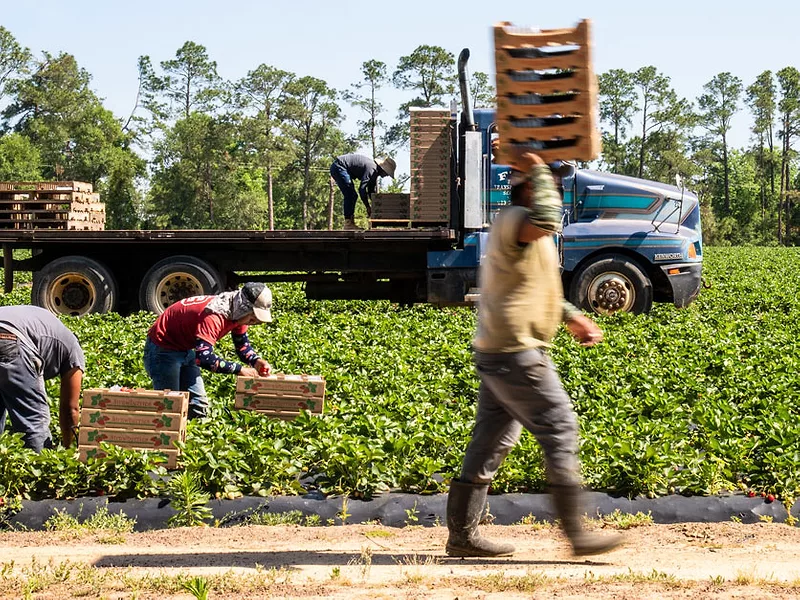
A new report from a coalition of farmworker advocacy groups argues that low wages in California agriculture are driving a broad public health crisis and calls on state leaders to establish an industry-wide living wage.
The report, Beyond the Cycle of Survival: Wages, Health, and Justice for Farmworkers, was released by the social justice group Health in Partnership, which is composed of several farmworker groups and organizations focused on social equity.
Drawing on interviews with 21 farmworkers, economic data and health research, the report finds that the state’s roughly 900,000 farmworkers are paid “poverty wages” despite underpinning a $60 billion agricultural industry.
Median crop worker wages hover around $17 per hour, with annual earnings often near $15,000 due to the seasonal nature of the work, far below what is needed to meet California’s cost of living, the authors argue. The report emphasizes that inconsistent hours — typically about 1,000 per year — further depress incomes.
The advocates frame the issue as more than economic, reasoning that “low wages are not just an economic issue — they are a public health crisis.” They link income instability to higher rates of chronic illness, workplace injury, stress and poor birth outcomes.
The analysis finds farmworkers experience disproportionately poor health outcomes compared to the general population, including higher rates of diabetes and worse self-reported health. Children in farmworker families are also affected, as limited income constrains access to food, housing and medical care.
At the same time, the report argues the industry has the capacity to raise wages. Large-scale farms generate most of California’s production value, and some already pay significantly higher wages — up to $30 per hour for H-2A guest workers in certain cases.
The report also highlights structural inequities, noting that Indigenous workers, women and those employed by farm labor contractors tend to earn the lowest wages and face higher rates of exploitation.
Beyond wages, the authors point to broader systemic pressures like hazardous working conditions, climate-related disruptions and immigration enforcement fears, all of which compound stress and health risks for workers.
The coalition concludes that establishing a statewide living wage would yield measurable benefits, including improved health outcomes, longer life expectancy and broader economic gains through increased local spending.
Interested in more news on farm programs, trade and rural issues? Sign up for a four-week free trial to Agri-Pulse. You’ll receive our content - absolutely free - during the trial period.
Opposition to raising farmworker wages has consistently centered on cost pressures and the unique structure of agricultural work. Grower groups have stressed that farming is seasonal and highly time-sensitive, with narrow harvest windows that limit flexibility to absorb higher labor costs.
Questions have also surfaced lately over whether higher wage mandates actually benefit workers. Research by University of California, Berkeley economist Alexandra Hill has found evidence that farmworkers worked fewer hours and saw declines in weekly earnings during the initial phase-in of overtime requirements. Western Growers and other trade groups have pointed to those findings as evidence of unintended consequences.
Employers also warn that higher wage floors could accelerate mechanization, increase reliance on the H-2A guest worker program and squeeze smaller operations with tighter margins. Similar concerns have emerged around Assembly Bill 2646, which would establish a $19.75 hourly wage for certain agricultural workers beginning in 2027.
Business groups opposing that proposal say it could raise consumer prices, reduce employment opportunities and weaken California’s competitiveness, while also increasing regulatory complexity for growers.

