
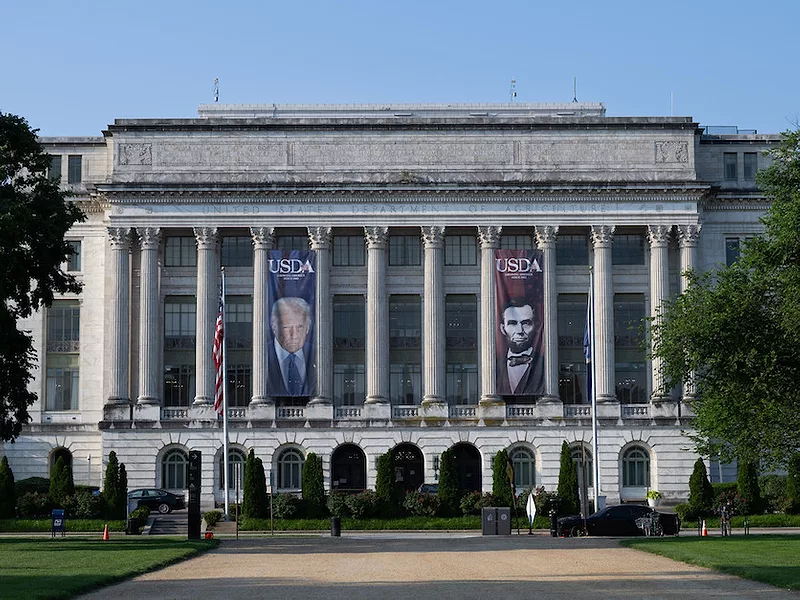
The House version of USDA’s budget would cut the department’s discretionary spending by $675 million, about 3% less than the current budget but still a much smaller cut than sought by the administration.
The total discretionary budget would be $22.5 billion; the administration’s budget seeks $20.7 billion, 19% below the enacted level.
“The bill prioritizes agencies and programs that protect our nation’s food and drug supply; support America’s farmers, ranchers, and rural communities; and ensure low-income Americans have access to nutrition programs,” a press release from the House Appropriations Committee says. “The legislation is fiscally responsible and refocuses programs on their core mission while putting the health, safety, and prosperity of American producers and consumers first.”
The bill proposes reducing the Farm Service Agency’s salaries and expenses account to $1.1 billion, a $19.1 million cut from 2026. Between FY2025 and FY2026, appropriators had cut the account $84 million last year, which means the bill’s proposed FY27 funding level for the account would be $103 million below two years ago.
However, the bill earmarks $15 million specifically for hiring staff to fill farm loan officer positions or vacancies at FSA county offices. It also would continue a prohibition on closing county offices and bars the agency from permanently relocating county-based employees without Appropriations Committee approval if doing so would leave an office with two or fewer employees.
In his budget request, Trump had proposed cuts of $172 million to FSA salaries and expenses.
The bill proposes $800 million for the conservation operations account at the Natural Resources Conservation Service, which helps fund much of the agency’s staff and technical assistance.
That’s a $50 million cut from FY26, but does not go as far as the $739 million cut to the account that President Donald Trump proposed in his budget request.
This would continue a trend in recent years of appropriators reducing funding for the conservation operations account. While conservation operations received around $895.75 million in FY2025, that number fell to roughly $850 million last year.
Interested in more news on farm programs, trade and rural issues? Sign up for a four-week free trial to Agri-Pulse. You’ll receive our content - absolutely free - during the trial period.
The draft bill replicates a proposal from last year to slash food assistance funding through the Food for Peace program to $900 million. The program, which was temporarily moved to USDA via an interagency agreement late last year, received $2 billion in fiscal 2025 and $1.2 billion last year. The House farm bill, which could come to the floor as soon as next week, includes a provision to make permanent Food for Peace's move from State to USDA.
The McGovern-Dole program for international food for education would see its funding stay at $240 million, however.
The president's budget proposal published earlier this month floated eliminating both assistance programs.
The office of the USDA undersecretary for trade and foreign agricultural affairs would also see its budget cut to $614,000 from $932,000 today.
The bill includes nearly $1.8 billion for the Agricultural Research Service, a decrease of about 7% from the current budget of $1.867 billion, but a smaller cut than the administration budget, which seeks $1.712 billion.
The Animal and Plant Health Inspection Service would be budgeted at $1.16 billion in the bill, essentially unchanged from the current fiscal year. USDA’s budget includes $1.148 billion for APHIS.
The bill also includes $1.046 billion for the National Institute of Food and Agriculture, about in line with the cut proposed by the administration, whose budget seeks $1.031 billion. The current budget is $1.675 billion.
The Economic Research Service would remain steady at about $91 million. The administration budget would cut it to $75 million. Rural Development would be cut from $312 million to $270 million and allocated $75 million of that for information technology. The cut is in line with the administration request of $265 million. The RD budget in fiscal 2025 was $387 million.
The Rural Business-Cooperative Service would see its budget shrink from $82 million this year to $63.6 million. The administration’s budget would zero out the RBCS.
The Office of the Chief Economist would receive $29.5 million, about the same as the current fiscal year. The USDA budget would cut the OCE budget in half, to $15 million.
The Office of the Secretary would receive $55.2 million, which includes $6 million for the immediate office. Of that amount, $500,000 would go to the newly created Office of Seafood.
Some other highlights from the bill:
- The bill would keep the Agriculture Secretary as a member of the Committee on Foreign Investment in the U.S. on a case-by-case basis and require the secretary to notify the committee of agricultural land transactions that they find may pose risks to the United States, including those involving China, North Korea, Russia and Iran.
- The Food and Drug Administration would receive $7.1 billion, about the same as the current fiscal year.
- It would retain “Buy American” provisions “that maximize the federal government’s use of services, goods, products, and materials produced and offered in the United States,” according to the House Appropriations Committee news release.
- It also would prevent use of funding to discriminate against Americans “based on traditional marriage beliefs,” the committee said. Specifically, that would bar discrimination against anyone who “speaks, or acts, in accordance with a sincerely held religious belief, or moral conviction, that marriage is, or should be recognized as, a union of one man and one woman."
For more news, go to www.Agri-Pulse.com.
This story has been corrected to reflect the right top-line numbers for USDA.


