
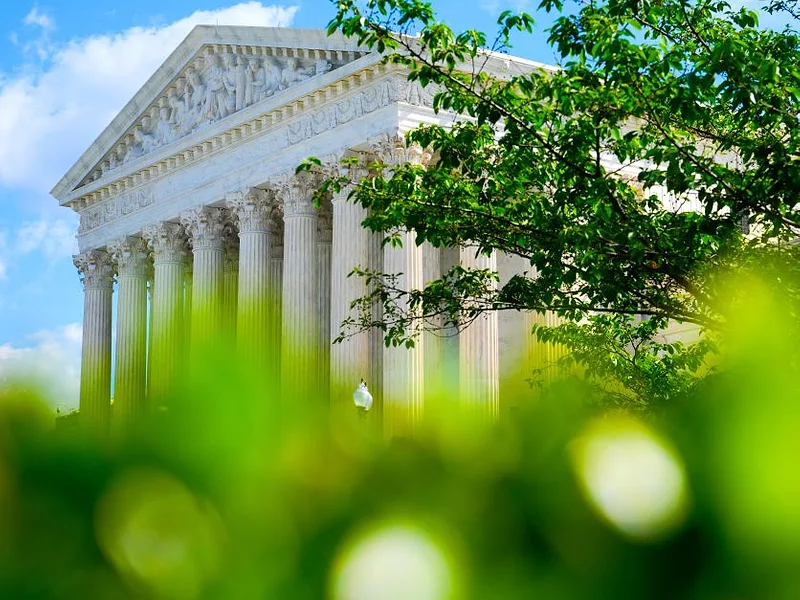
Supreme Court justices gave little hint at oral arguments Monday how they might rule in a blockbuster pesticide case involving the scope of federal authority over pesticide labeling.
Attorneys representing Monsanto and a Missouri man who won a $1.25 million jury verdict after alleging exposure to Roundup caused his non-Hodgkin lymphoma verdict squared off. The federal government, which backed Monsanto, was represented by Principal Deputy Solicitor General Sarah Harris.
At issue is whether plaintiffs can bring lawsuits in state courts alleging pesticide manufacturers failed to warn consumers of the hazards of using their product – even if the Enviromental Protection Agency did not require a warning.
“Congress plainly wanted uniformity when it came to the safety warnings on a pesticide’s label,” said Paul Clement, a former Solicitor General representing Monsanto, which is an indirect subsidiary of Bayer. “Ignoring Congress' clear direction here would open the door for crippling liability and undermine the interest of farmers who depend on federally registered pesticides for their livelihood.”
“EPA regulation and the government's brief here makes crystal clear that a registrant cannot change the safety warnings on a pesticide label without approval of the agency,” Clement said.
On the other side, Ashley Keller, the attorney for John Durnell, said Monsanto has tried to conflate registration and labeling. “After two briefs and a lot of podium time, Monsanto still hasn't pointed to one word in FIFRA’s text that says the agency's factual findings at registration create a requirement for labeling. That's because the text [of FIFRA] repudiates that proposition in no uncertain terms.”
The law, he said, says that “the agency's findings at registration are nothing more than prima facie evidence of compliance with the labeling requirements. Prima facie evidence is not a law of the United States. … It is a thumb on the evidentiary scales that can be rebutted, and a reasonable jury has rejected that evidence.”
Bayer has been trying for years to rid itself of a backlog of Roundup litigation. It paid about $11 billion in a settlement in 2020 and has recently proposed a $7.25 billion class-action settlement to try to take care of thousands of pending cases.
The two justices who seemed to express their views most clearly were Brett Kavanaugh, who appeared to be firmly on Monsanto and the government’s side, and Ketanji Brown Jackson, who appeared to be on the other.
Jackson asked whether it might be possible for a pesticide to become misbranded even while it is registered, due to new scientific information.
“Let's say a new research study comes out at some point between when the EPA is statutorily required to look at [the pesticide] again that casts doubt on the safety of this product,” she said to Clement.
Interested in more news on farm programs, trade and rural issues? Sign up for a four-week free trial to Agri-Pulse. You’ll receive our content - absolutely free - during the trial period.
Clement said he was “resisting” the idea that a pesticide could become misbranded due to “some subsequent development.”
Noting FIFRA’s desire for regulatory uniformity, Kavanaugh asked Keller, “You think it's uniformity when each state can require different things?”
Chief Justice John Roberts also told Clement he understood his concerns about a patchwork of state laws, but then said, "On the other hand, if it turns out that they were right, it might have been good if they had an opportunity to do something to call this danger to the attention of the people while the federal government was going through its process."
The case has attracted widespread attention. Before the arguments, a crowd gathered in front of the court to voice displeasure with the company’s efforts to beat back the product liability cases and the government’s support of Monsanto and parent company Bayer. Reps. Thomas Massie, R-Ky., and Chellie Pingree, D-Maine, spoke in favor of their amendment to remove federal preemption language from the farm bill. House Ag Committee ranking member Angie Craig, D-Minn., has called that provision a “poison pill” that could doom the legislation.
Vani Hari, an activist and social influencer known as the Food Babe, spoke of the galvanizing effect of the administration’s actions on glyphosate. “Let's be honest, we wouldn't be here right now if President Trump didn't sign that executive order. We wouldn't be here right now If they weren't inside this building arguing on Monsanto's behalf. We wouldn't be here right now if they didn't submit that amicus brief and that recommendation to the Supreme Court to look at this case.”
The executive order she cited was signed by President Donald Trump in February and aims to bolster domestic production of glyphosate, the active ingredient in Roundup, due to national security concerns.
The administration, through the Office of the Solicitor General, supported Monsanto’s petition to the Supreme Court and then filed an amicus brief backing the company. Monsanto also has gotten support from a slew of farm groups representing farmers, ag retailers, pesticide manufacturers and applicators.
States that filed amicus briefs were almost evenly split on the question, with three mostly red states – Florida, Texas and Ohio – siding with Durnell. Lawyers for plaintiffs who are in litigation against Monsanto over exposure to Roundup and against Syngenta for exposure to paraquat also filed a brief in support of Durnell, as did farmworker groups.
Thirty-six state legislators also filed a brief backing Durnell. “Congress did not make federal agency approval of a manufacturer-proposed label preemptive,” they argued in their brief. “The meaning and requirements of federal statutes are decided by courts, not the executive branch.”
For more news, go to www.Agri-Pulse.com.

