
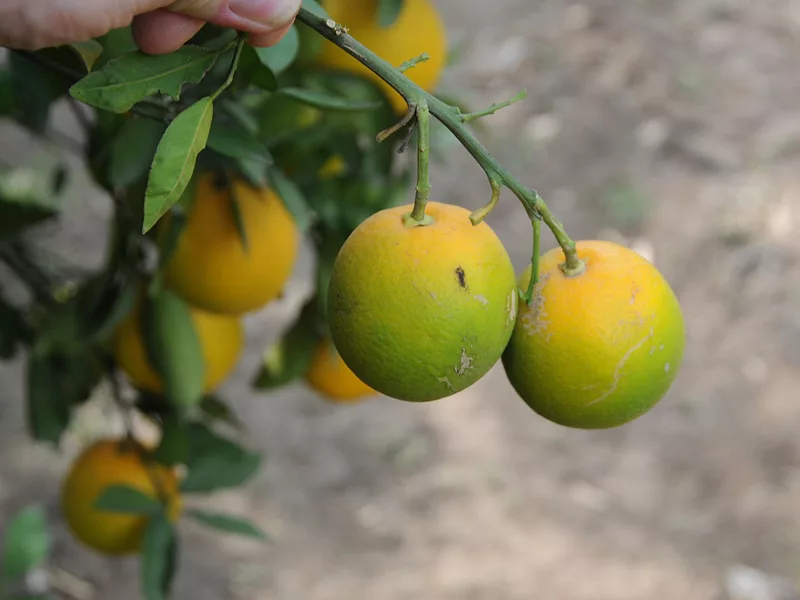
EPA has approved a gene-edited citrus rootstock designed to help protect trees from a bacterial infection that has devastated the U.S. citrus industry.
CarriCea T1, developed by Soilcea with support from USDA and the National Science Foundation’s Small Business Innovation Research programs, is resistant to Huanglongbing, or HLB, a disease spread by the Asian citrus psyllid. The bacterium damages a tree’s vascular tissue, reducing nutrient uptake and fruit quality.
First detected in Florida in 2005, citrus greening has killed an estimated 50 million trees, contributed to the loss of 47,000 jobs and caused $76.5 billion in economic damage, according to industry and government data. Florida citrus production has fallen from nearly 292 million boxes in 2003-04 to 14.6 million, a decline of about 95%. The disease has also spread to California, Texas, Alabama, Louisiana, Hawaii, Mississippi, South Carolina and Georgia.
EPA said CarriCea T1 works by making precise edits to existing citrus genes, disrupting how the bacteria interact with the plant. The rootstock does not introduce DNA from other organisms and could reduce reliance on conventional pesticide sprays.
Interested in more news on farm programs, trade and rural issues? Sign up for a four-week free trial to Agri-Pulse. You’ll receive our content - absolutely free - during the trial period.
“CarriCea T1 helps protect American citrus, supports a nutritious food supply, and lets growers rely less on conventional pesticide applications,” EPA Administrator Lee Zeldin said in an April 28 press release.
The approval comes as Florida’s citrus industry faces historic lows. USDA reported final 2024-25 production at 12.15 million boxes of oranges, 1.3 million boxes of grapefruit and 400,000 boxes of tangerines and tangelos — the state’s smallest harvest since the 1919-20 season.
Fruit from trees using the rootstock will be indistinguishable from other varieties, EPA said. The agency conducted a dietary safety assessment under its regulatory framework for plant-incorporated protectants, or PIPs, and concluded the product meets human health and environmental standards. While some PIPs introduce genes from other organisms, EPA said CarriCea T1 instead edits genes already present in citrus.
Registration details will be posted in docket EPA-HQ-OPP-2025-0211 on regulations.gov.
