
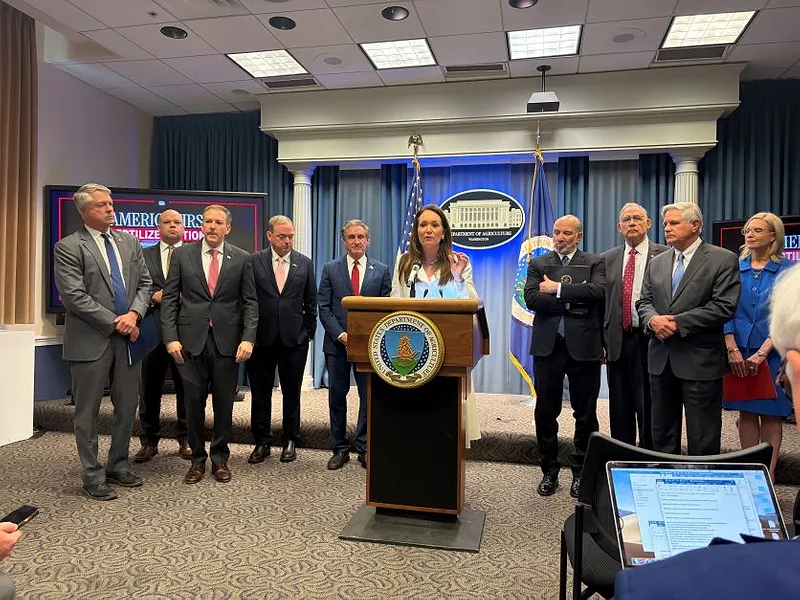
Agriculture Secretary Brooke Rollins said Tuesday that significant growth in domestic fertilizer production is possible in just two years. But even if triple-digit growth materializes, it may not be enough to completely insulate farmers from future price volatility, one analyst warns.
Speaking to reporters on the administration’s efforts so far to spur domestic production and shore up supply, Rollins said that nitrogen production could grow by more than 30%, phosphate by over 200% and potash by more than 100% as a result of the policy announcements in recent months.
Farmers are still reeling from high fertilizer prices stemming from supply chain disruptions in the Middle East. As of last week, urea prices had more than doubled since mid-December and diammonium phosphate prices were up almost 20%, according to a dashboard maintained by the UN Conference on Trade and Development.
The administration responded by easing shipping requirements on vessels moving products between U.S. ports and loosening restrictions on fertilizer imports from Venezuela, but neither has been sufficient to spur significant price reductions.
“We continue to be laser-focused and will not rest until this problem is solved,” Rollins said in comments to reporters.
Rollins was joined Tuesday by Environmental Protection Agency Administrator Lee Zeldin, Commerce Secretary Howard Lutnick, Secretary of the Interior Doug Burgum, and White House National Economic Council Director Kevin Hassett. Assistant Secretary of the Army for Civil Works Adam Telle as well as Deputy Secretary Stephen Vaden, and several lawmakers, including Senate Agriculture Committee Chair John Boozman, R-Ark., also attended.
The officials argued that the administration has pursued an “all-of-government” approach to boosting fertilizer supplies, pointing to relaxed requirements on diesel exhaust fluid systems they say will boost urea supplies, as well as efforts to look into competition in the sector, streamline permitting for projects, funding opportunities at USDA and Commerce for fertilizer production, and encouraging countries to avoid trade restrictions on fertilizer exports.
“This president remains resolute and convicted to do everything we possibly can to ensure that we are doing what we can to make sure that this doesn't happen again with our fertilizer prices,” Rollins said.
Interested in more news on farm programs, trade and rural issues? Sign up for a four-week free trial to Agri-Pulse. You’ll receive our content - absolutely free - during the trial period.
StoneX Vice President of Fertilizer Josh Linville told Agri-Pulse in an email following the event that expanding domestic fertilizer production alone may not provide the price relief the administration is looking for.
For nitrogen, he said, a handful of domestic producers have the bulk of the market share. Alleviating price pressures, he added, will mean boosting competition alongside expanding production.
U.S. phosphate reserves are also a concern, he noted. Increasing “production rates on a limited input like phosphate rock just means we as a nation run out of it sooner.” Fostering long-term supply stability, Linville said, will depend on the strength of U.S. relationships with producers like Morocco and Norway.
“Longer term supply agreements,” he said, “can help ensure supplies even when domestic production lines struggle.”
The U.S. currently subject imports of Moroccan and Russian phosphate fertilizer to steep countervailing duties, but Rollins confirmed reporting from Agri-Pulse that the administration is weighing lifting the duties, although she said there are “varying views” within the administration on what officials “could or should do.”
Potash, meanwhile, has not seen similar price spikes of other fertilizers, in part, because the U.S. gets the bulk of its supply from Canada.
“[D]oubling what we already produce is not that big of an increase,” Linville said, but said potash supply chains are unlikely to come under significant pressure, as “long as we can maintain solid relations with our neighbor to the north.”
For more news, go to www.Agri-Pulse.com

