

With the House passage of the 2026 farm bill Thursday, all eyes turn to the Senate, where lawmakers will have to find a path forward that secures enough Democratic votes to overcome the 60-vote filibuster.
In the aftermath of Thursday’s 224-200 House vote, senators previewed the forthcoming fights.
“Senate Democrats are committed to ensuring all states are treated equally by delaying the new SNAP cost shifts and addressing the needs of farm country,” Senate Ag Committee Democrats said in a statement. Senate Ag Committee Chair John Boozman, R-Ark., reiterated to Agri-Pulse Thursday that he is not open to rehashing that debate.
Sen. Cory Booker, D-N.J., expressed solidarity with House lawmakers who successfully voted to strip language from the farm bill on pesticide labeling.
The amendment was the “result of a movement of people that are trying to get pesticides off of our foods and chemicals out of our foods,” he told Agri-Pulse. “Now in the Senate, we're going to have a similar fight.”
Further, Boozman told reporters Wednesday that he is struggling to find a single Democrat to support language aimed at defanging California’s Proposition 12. If the provision is removed it could cause friction with House Ag Committee Chair Glenn “GT” Thompson, R-Pa., when both chambers work to reconcile their bills.
“I’m going to fight for that provision,” Thompson told reporters Thursday following the House vote.
Labor on deck: With the farm bill out of the House Agriculture Committee’s hands, for now, Thompson says it can turn to its next priority: legislation to strengthen the agricultural workforce.
Thompson said he plans to put out a discussion draft for an “agriculture workforce, food security bill.”
“I'll be shocked if it doesn't have strong, bipartisan signatures on the bill,” Thompson said.
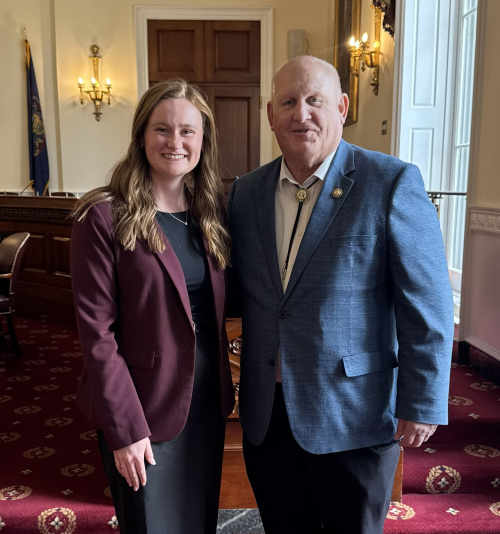
House Ag Committee Chairman Glenn “GT” Thompson meets with Agri‑Pulse’s Lydia Johnson after the House approved the farm bill. Their interview appears on today’s Newsmakers episode, which will be posted today.
Trump says he’ll lift tariffs on UK whisky
Britain’s King Charles III wrapped his U.S. visit Thursday, but he isn’t going home empty-handed. President Donald Trump said he would “honor” the royal by lifting tariffs on Scottish whisky.
“The King and Queen got me to do something that nobody else was able to do, without hardly even asking!” Trump wrote to Truth Social.
Scotch whisky is subject to a 10% duty under the terms of a U.S.-United Kingdom trade pact secured last year.
It’s easy to be “in the know” about what’s happening in Washington, D.C. Sign up for a FREE month of Agri-Pulse news! Simply click here
The move “would be a major victory for American hospitality businesses,” Distilled Spirits Council President Chris Swonger said in a statement.
“This action strengthens transatlantic ties, brings much‑needed certainty to our industry and allows spirits producers on both sides of the Atlantic to grow, invest and support jobs at a critical time,” he added.
Pseudorabies detected in Texas, Iowa swine herds
USDA’s Animal and Plant Health Inspection Service has detected pseudorabies in commercial swine for the first time in more than 20 years.
The agency confirmed antibodies to the virus in a small commercial swine facility in Iowa, which it traced to five affected boars that came from an outdoor facility in Texas. A press release says the agency is working with officials in both states to “expand traceback efforts and identify any additional potential exposures."
Keep in mind: Pseudorabies is a contagious disease that can cause abortion, stillbirths, respiratory problems, and occasional death in swine, according to an APHIS summary. Commercial swine in the U.S. had been free of the disease since 2004, though it can be found in feral hogs.
The detection "does not pose a risk to consumer health or affect the safety of the commercial pork supply,” according to APHIS. However, “there may be limited, short-term impacts on exports of U.S. swine and/or swine genetics.”
USTR puts EU on intellectual property ‘watch list’ over geographical indicators
The European Union is now on a USTR watch list over its protection and enforcement of intellectual property, in part because of its use of geographical indicators.
In its latest report on intellectual property, the Office of the U.S Trade Representative names six countries to a priority watch list and another 19 to its less severe watch list, including the EU.
Meanwhile, Argentina and Mexico were downgraded from the priority watch list to just the watch list, in part because of their latest efforts to protect some generic cheese and meat names.
“For too long, the EU has weaponized GI policy to crowd out American producers from markets they have served for decades,” the U.S. Dairy Export Council’s Krysta Harden said in a statement.
Merger would benefit shippers and workers, rail firms say
A merger between Union Pacific and Norfolk Southern would save shippers $3.5 billion a year and create “more high-paying union jobs,” the companies say.
In a news release Thursday, they say the savings would come from a shift in freight transportation from “higher-cost trucks to low-cost rail.”
The two rail firms filed a revised merger application at the request of the Surface Transportation Board. They said the analysis in their updated application “is the first in rail merger history to use 100% actual traffic data provided by all six North American Class I railroads, rather than the sample data available from the STB.”
The amended application increases the estimate of new union jobs by 33%, projecting 1,200 positions by the merger’s third year. “This growth is in addition to the unprecedented jobs-for-life guarantee – every union employee with a job at the time of the merger will continue to have one,” the news release says.
Worth noting: By linking an eastern and western Class I railroad, the merger would create the first transcontinental railroad under one company for the first time, according to the Eno Center for Transportation.
Organic retailers press USDA to keep animal‑welfare rule
Organic industry groups are urging USDA to “avoid any wholesale rollback” of animal‑welfare requirements in the National Organic Program.
In a new letter to Agriculture Secretary Brooke Rollins, they warn that rescinding the Organic Livestock and Poultry Standards would undermine consumer trust in the organic seal. USDA is assessing the standards after talk of potential regulatory rollbacks surfaced during a Small Business Administration roundtable last December.
The Organic Trade Association, joined by companies including Whole Foods Market, Danone US and Perdue Farms, says a reversal would be seen as “a retreat from a core expectation tied to organic livestock products.”
Earlier this year, the National Chicken Council asked USDA to rescind or amend parts of the rule, arguing the standards impose costly facility upgrades on organic broiler operations. The final OLPS rule took effect Jan. 2, 2025, for most livestock operations, but existing organic layer operations were given until 2029 to meet certain standards.
Final word
Last year’s One Big Beautiful Bill Act “brought 70 to 80% of the funding, but it addressed only 20 to 30% of the policies. We're now flipping that.” – Ted McKinney, CEO of the National Association of State Departments of Agriculture, on Agri-Pulse Newsmakers.
For more news, go to Agri-Pulse.com.


