
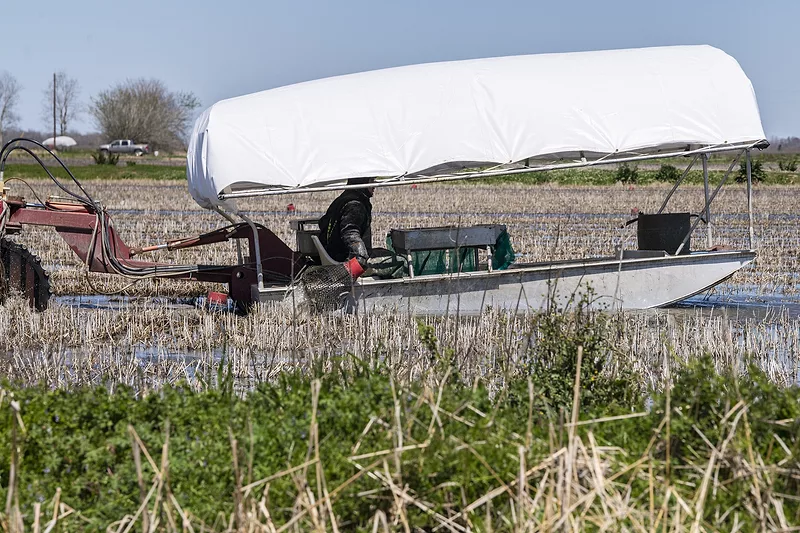
Rising costs, cheap imports and an unprecedented labor squeeze are converging with extreme weather to push Louisiana’s crawfish sector toward a breaking point, according to a new American Farm Bureau Federation analysis.
“The loss of processing capacity, continued import pressure and lack of risk management tools threaten to reduce production, shift market share overseas and weaken the rice-crawfish systems that underpin much of Louisiana’s rural economy,” writes economist Daniel Munch.
Prices have barely moved in a decade while production costs are up roughly 40% since 2014. Import competition has also intensified: After antidumping duties lapsed in 2019, landed import prices fell from $5.53 to $2.56 per pound — well below domestic production costs — and frozen whole‑boiled imports now compete directly with U.S. processors.
The industry’s most immediate crisis is the collapse of H‑2B visa access for 2026. A January rule from the departments of Homeland Security and Labor limited supplemental visas to start dates after Jan. 1, which excluded most crawfish processors, because they typically require labor beginning in the fourth quarter of the prior year.
More than 75% of returning‑worker applications were denied, eliminating processing labor that typically absorbs 40% of the crop, resulting in an estimated $299.5 million in total economic losses.
It’s easy to be “in the know” about what’s happening in Washington, D.C. Sign up for a FREE month of Agri-Pulse news! Simply click here
“Without that labor, processors cannot operate peeling lines, drastically reducing the processing market for the 2026 season and restricting purchases to live crawfish. This is a critical disruption,” Munch says.
Meanwhile, drought and heat cut yields by more than 37% in 2024, while bird depredation, invasive species and flooding continue to erode production and raise costs.
“Despite its economic importance, the crawfish industry operates with far less federal support than most major agricultural sectors, a gap that is increasingly consequential under current conditions,” Munch adds.
Crawfish producers are excluded from the $11 billion Farmer Bridge Assistance Program and the $1 billion for specialty crops and sugar. The primary federal program available — the Emergency Assistance for Livestock, Honeybees and Farm‑Raised Fish — primarily covers event‑based disasters and not broader market or cost pressures, Farm Bureau noted.
Louisiana leads the nation in crawfish production, with more than 1,000 fishermen and 1,300 farmers, according to the Louisiana Department of Wildlife and Fisheries, and the industry contributes more than $300 million to the state’s economy each year.
