
|
While — as many savvy consumers are aware — the U.S. is a net exporter of oil, due to both geography and policy, California is often referred to as a “fuel island” set apart from the rest of the nation.
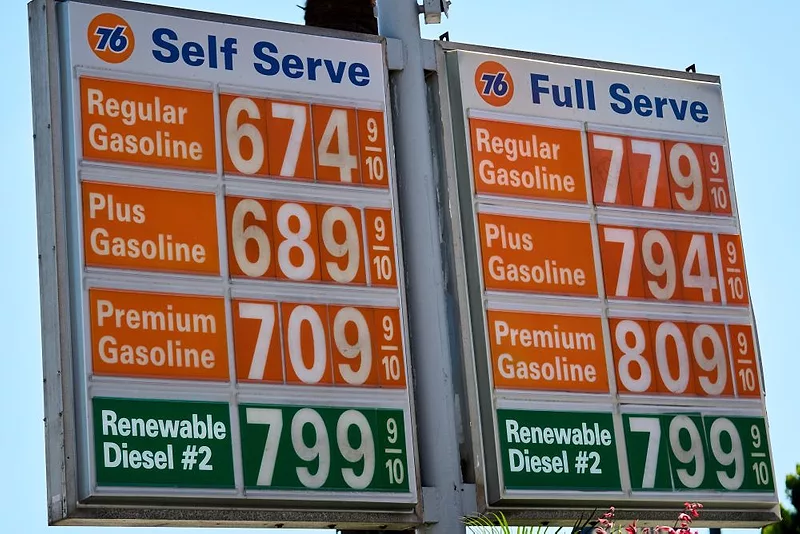
Between state-level requirements for unique fuel blends, a lack of connectivity to the rest of the U.S. fuel infrastructure and high taxes, Californians typically face the highest prices in the nation. In the wake of the closure of the Strait of Hormuz, state officials and consumers are concerned that fuel prices will continue to rise to unsustainable levels.
Between the week ending on Feb. 23 — a week before the Iran conflict began — and May 4, the average price of gas in California increased to $6.08 per gallon (+33%), and the cost of on-road diesel climbed to $7.36 per gallon (+49%). How did the state come to this point?
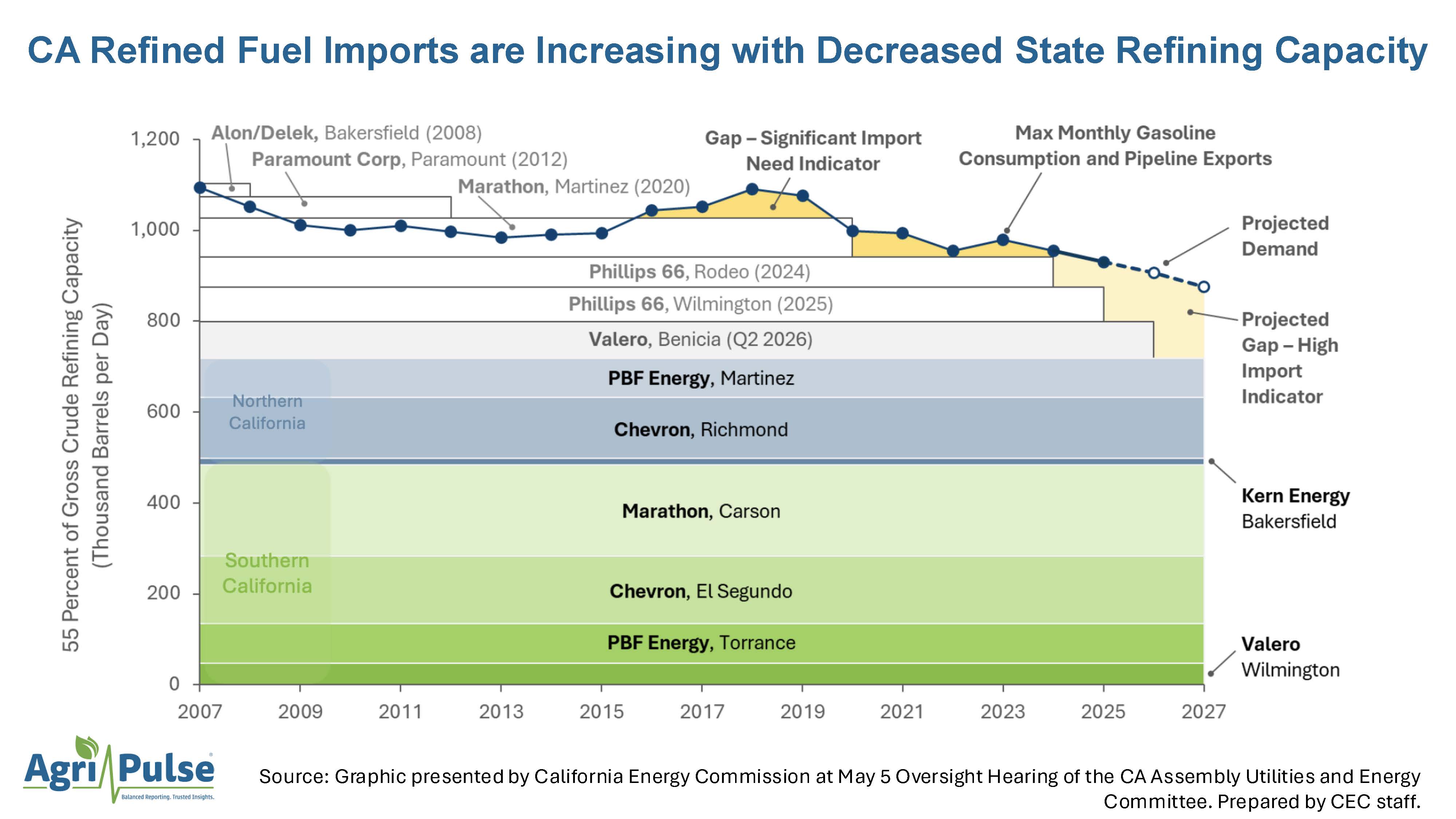
For decades, California has relied on a combination of internal production and imported crude oil to meet demand. But since 2012 a majority of the crude oil used in California has come from foreign imports. And since 2016, refinery closures in California have pushed the state to rely on imports to meet monthly gasoline consumption and pipeline exports to neighboring states. As California mandates a gasoline blend only used in the state (California Reformulated Gasoline Blendstock for Oxygen Blending, or CARBOB), it has few places to turn to for supply as the state’s refining capacity falls below demand.
The closure of the Strait of Hormuz began on Feb. 28 and has subsequently spiked global crude oil prices by over 50%. This worldwide crisis has been particularly ill-timed for California, which has lost approximately 20% of the state’s refining capacity in the last five months due to the closure of a 139,000-barrel-per-day Phillips 66 refinery in Los Angeles at the end of 2025 and the 145,000 barrel-per-day Valero plant in Benicia, California, in April 2026.
On May 5 the California State Assembly Utilities and Energy Committee held an oversight hearing related to the state’s petroleum supply resilience and strategic planning in the short- and medium-term.
California’s fuel imports are at risk from Strait of Hormuz crisis
California falls within the Petroleum Administration for Defense District (PADD) 5 region, which also encompasses Washington, Oregon, Arizona, Nevada, Alaska and Hawaii. In 2025 the region imported 46.9 million barrels of motor fuel (including blending components) accounting for 9% of total motor gasoline supplies. The top foreign suppliers were India (28%), South Korea (25%) and the Bahamas (18%). South Korea additionally provided 87% of imported jet fuel to PADD 5 (equal to 16% of total jet fuel supplies in the region). Of note, the Bahamas serves primarily as a transshipment point for fuel refined in the Gulf of Mexico region to meet Jones Act requirements. The Jones Act mandates that all goods transported between U.S. ports be carried on ships that are U.S. built, owned, flagged and crewed; by using the Bahamas as a transshipment point, the West Coast can ship U.S.-refined fuel utilizing foreign vessels.
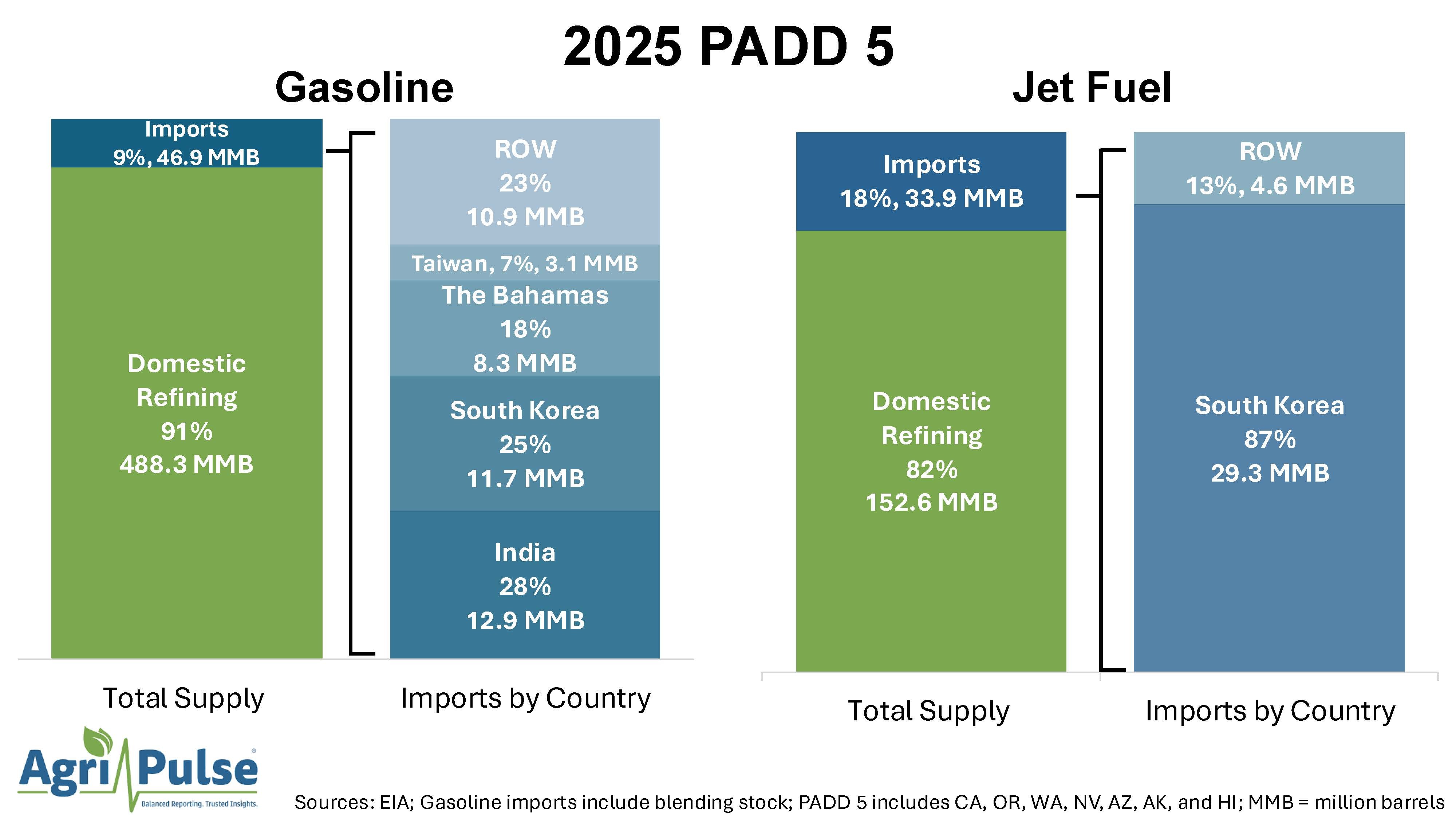
The reliance on Asian countries for refined products may prove especially problematic, as it is the region most reliant on crude oil imports from the Strait of Hormuz with approximately 30% of the world’s total seaborne oil and oil product trade involving shipment through the strait to Asia. In 2025 South Korea and India received 57% and 45% of their oil and natural gas supplies from the Middle East, respectively.
It’s easy to be “in the know” about what’s happening in Washington, D.C. Sign up for a FREE month of Agri-Pulse news! Simply click here
Both countries have moved quickly to shore up domestic energy availability. In South Korea, the government has capped exports to 100% of monthly 2025 levels, required refineries to maintain domestic supply at no less than 90% of 2025 levels, and placed caps on domestic fuel prices. In addition to securing supply, the South Korean government has taken steps to quell demand, including mandating certain days off of driving for public sector workers and encouraging all citizens to forgo driving at least one day per week.
India is known to quickly ban or introduce export restrictions in times of crisis, something that the U.S. rice market experienced firsthand in 2023. Since the closure of the Strait of Hormuz, in addition to domestic actions, India has introduced export taxes on diesel and aviation fuel. The new taxes reached highs of approximately $2.22/gallon for diesel and $1.68/gallon for aviation fuel in April, but have subsequently been reduced.
Despite online concern that California only has six weeks of fuel supplies remaining, officials at the May 5 oversight hearing reiterated that while fuel supply contracts can only be forecasted six weeks in the future, they are confident that they will be able to continue to receive imports moving forward. Additionally, current stockpiles of diesel, gasoline and jet fuel in the state all fall within 10-year norms, meaning that officials aren’t worried about pumps drying up.
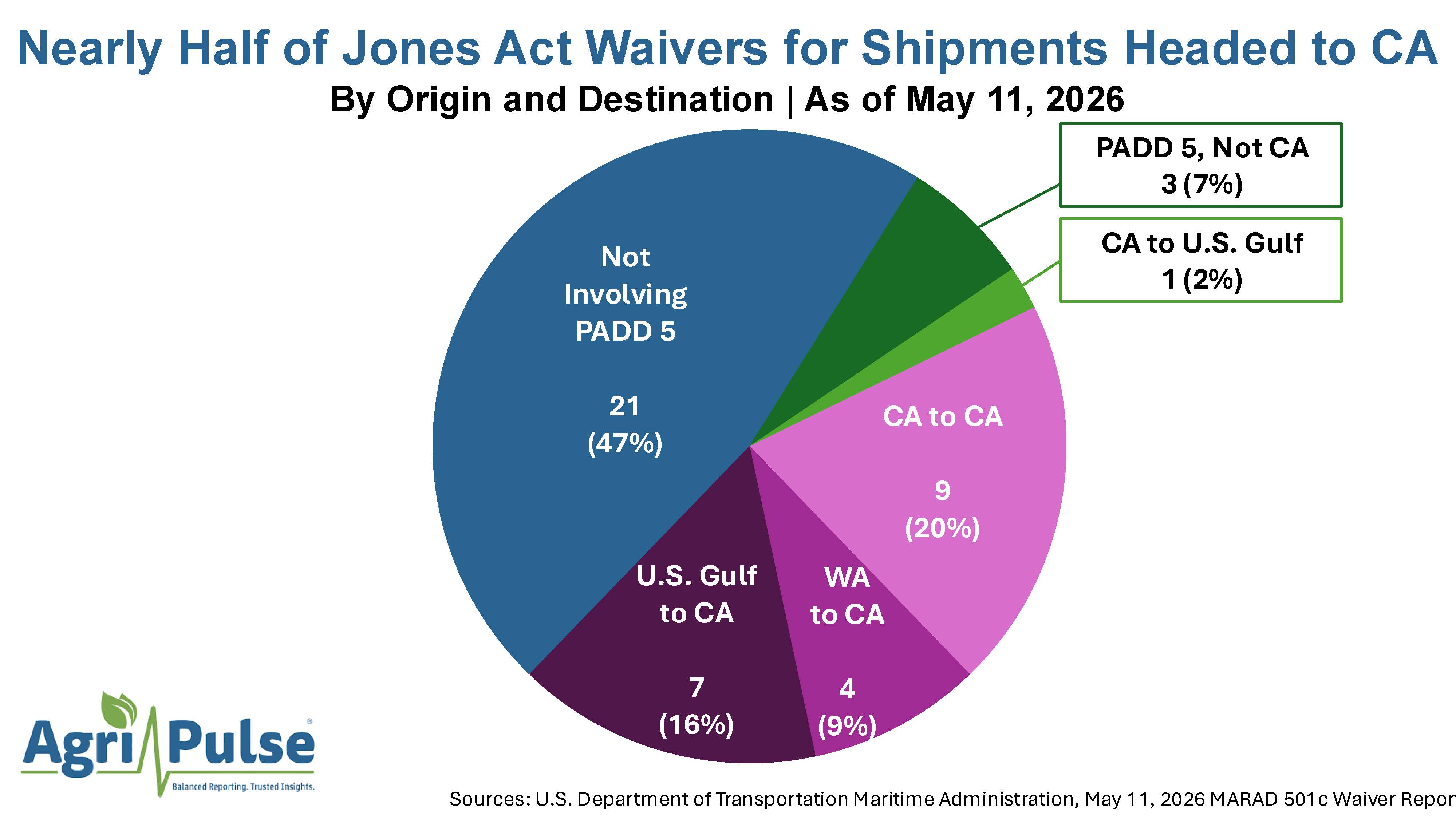
One piece of good news for West Coast consumers has been the temporary waiver of the Jones Act, which the White House instituted from March 18 through Aug. 16, 2026. As of May 11, there have been 45 shipments made under the waiver, of which 20 (44%) have been delivered to California. These shipments have delivered over 1.6 million barrels of refined fuel to the state from the Gulf of Mexico on an expedited timeline and at a lower transportation cost, and have also helped facilitate shipments between Northern and Southern California (which are not connected by a pipeline) and other West Coast states.
Potential changes ahead for California’s fuel system
Looking ahead, a new pipeline to connect California to refineries in the Gulf of Mexico and Plains states is in the works. The Western Gate Pipeline is tentatively planned to open in mid-2029 and will connect the Texas Panhandle to California via Phoenix, Arizona. In all, the Western Gate Pipeline project will potentially increase fuel supplies into California by up to 200,000 barrels per day.
The recent California State Assembly Utilities and Energy Committee’s oversight hearing included discussion on the adoption of E15 and a potential transition to a post-CARBOB future.
In October 2025 AB 30 was passed unanimously as an “urgency measure” that “immediately” permitted the sale of E15, making California the last state to approve it. Despite the approval, seven months later, E15 is still not available to consumers and, according to testimony from Matt Botill, chief of the Industrial Strategies Division at the California Air Resources Board, “it may be some time” before it is available at retail. Botill identified additional barriers — such as approving current dispensing equipment infrastructure by several state agencies — as causes of the delayed implementation. Additionally, during the hearing multiple witnesses and assemblymembers called into question the necessity and benefit of CARBOB for air quality compared to modern federal standards, which have become more stringent in recent decades.
The way forward
Like fuel consumers across the U.S. and around the world, Californians are waiting to see how long the Strait of Hormuz will remain closed. Until then, state officials have stressed that California is unlikely to face fuel shortages because it can compete for supplies in global markets on price. Even if the strait were to reopen tomorrow, prices would likely remain elevated for weeks to months as global fuel markets stabilize.
In the meantime, California’s farmers and rural communities will continue to feel the brunt of higher prices due to their heavy transportation fuel needs, and consumers nationwide may see higher costs in the produce aisle as input and shipping expenses rise.
Betty Resnick is an agricultural economist based in Monterey, California.
