
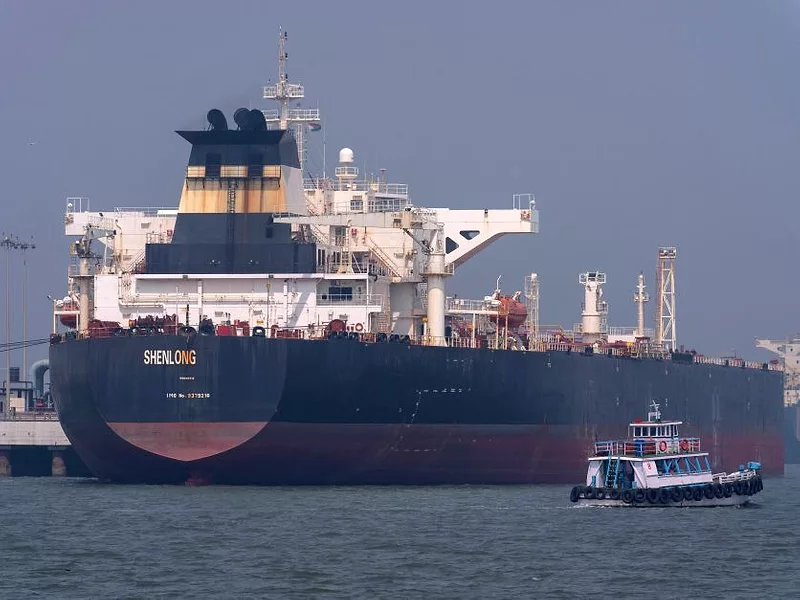
President Donald Trump says the U.S. will resume a blockade on Iranian vessels in the Strait of Hormuz and charge other ships a 20% toll to move cargo through the crucial maritime chokepoint, further casting doubt on an interim peace deal between Washington and Tehran.
“The U.S.A. will be, from this point forward, known as “THE GUARDIAN OF THE HORMUZ STRAIT,” but as such, and as a matter of FAIRNESS, will be reimbursed, at the rate of 20% on all cargo shipped, for any and all costs necessary to do the job of providing safety and security to this very volatile section of the World,” Trump wrote on social media Monday.
Trump’s plan, which is opposed by Iran, follows an exchange of strikes between the two nations in the Middle East, after Iran hit a commercial ship over the weekend and said it had closed off access to the strait.
The council of the United Nations’ International Maritime Organization said passage through the strait should remain free of any tolls and charges, in accordance with international law. The council also condemned the attacks on civilian commercial ships and called for the de-escalation of tensions in the Middle East region.
U.S. Central Command followed Trump’s statement on Monday by saying forces will resume blockading ship traffic entering and existing Iranian ports on July 14 at 4 p.m. Washington time. “The U.S. military continues to support traffic flow through regional waters for all vessels not violating the blockade,” CENTCOM said.
Crude oil and gasoline prices soared, with crude reaching its highest level in nearly four weeks and gasoline its highest in five weeks, according to Barchart.
A resumption of full war between the U.S. and Iran in the Middle East threatens to send retail fuel prices surging again, just a few months before critical congressional elections that determine the balance of power in Washington starting next year. The strait also is a major global waterway for fertilizer, with roughly a third of crop nutrients passing through the strait from the Persian Gulf to export markets globally, as well as about 20% of liquefied natural gas, a crucial fertilizer feedstock.
The specter of North American fertilizer prices surging again due to the Iran war comes as farmers will soon start planning for next year. An increase in already high production costs, like fuel and fertilizer, would put food supplies at risk and potentially trigger more U.S. farm bankruptcies.
Tensions between the U.S. and Iran are flaring just as Congress returns to work after a break. Trump is seeking congressional passage of a roughly $87 billion supplemental funding package to help pay for Iran war costs. It's not clear there will be enough votes to clear the legislation, especially given a narrowing Republican margin over the Democrats in the Senate with the death of Sen. Lindsey Graham, R-S.C., and hospitalization of Mitch McConnell, R-Ky.
Trump, in a July 10 letter to the Senate obtained by Agri-Pulse, said the U.S. had commenced defensive military action against targets within Iran on July 7. The strikes were in response to Iran attacking "several neutral-flagged commercial vessels transiting the Strait of Hormuz between July 6-7," despite its commitment to use best efforts for safe passage of commercial ships, Trump said.
Trump said ground forces aren't involved and that the strikes are limited and designed to minimize civilian casualties.
For more news, go to Agri-Pulse.com.
.webp?t=1762183428)
