
|
Agri Stats would face restrictions on the reports it can provide to chicken, pork and turkey processors under a new settlement, which an antitrust expert says is likely to secure a judge's approval.
Under the proposed settlement filed in Minnesota federal court last week, the data benchmarking firm would largely be required to stop reporting sales data, even if that data is anonymized. The exception is in the company’s Operations Profit Analysis book, which is made up of metrics on the overall profitability of a meat-processing operation. Agri Stats is also still allowed to give individual contributors their own data, but cannot share it with competitors.
Under the agreement's terms, Agri Stats would also be barred from reporting participant lists or revealing the identities of contributors. The company would not be able to share contributors' rankings, but could still report aggregated data from multiple contributors, statistical averages from multiple contributors, and average data values for contributors. In reports covering at least 50% of or more of U.S. sales for a particular protein segment, the company must make sure aggregated data and statistical data values include data from at least three meat processors.
Agri Stats also would need to make all of its reports and manuals available for anyone to purchase, not just poultry processors. Nonmeat processors would be able to limit their subscriptions to particular “books,” and the company can’t make them buy more than what it requires meat processors to purchase.
The proposed settlement “restricts, as I understand it, their ability to come up with new ways to exchange the kinds of information that has turned out to be anticompetitive,” said Peter Carstensen, a law professor at the University of Wisconsin. “If it’s workable — and that I don’t know — that may well be significant in terms of controlling what Agri Stats can do.”
 Peter Carstensen (U-Wis. Law School photo)
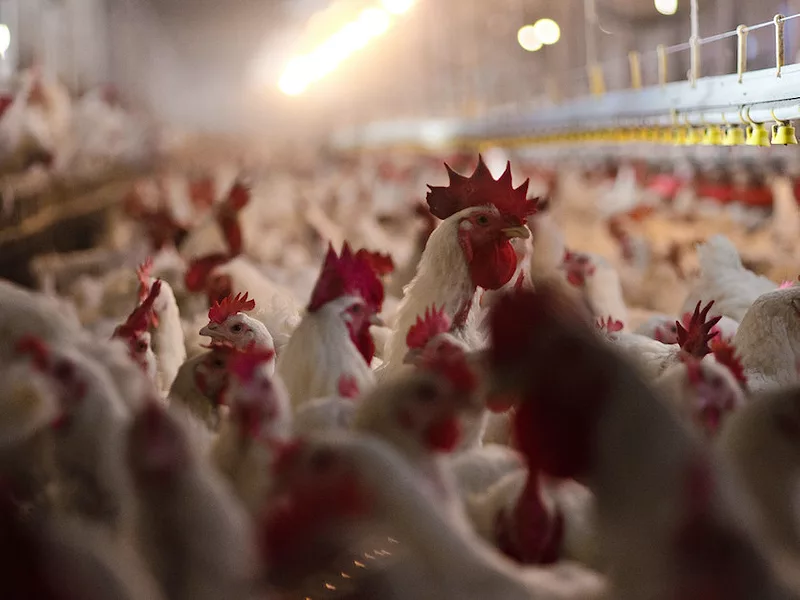
Agri Stats, an Indiana-based company, gathers data from chicken, turkey and pork processors, which it compiles into reports it then sells.
It’s easy to be “in the know” about what’s happening in Washington, D.C. Sign up for a FREE month of Agri-Pulse news! Simply click here
DOJ first filed its lawsuit against Agri Stats in 2023, alleging the company’s information-sharing violates the Sherman Act. Agency lawyers argued Agri Stats "operates its information exchanges to promote total industry profits at the expense of competition,” doing so "by providing processors with unique insights about their competitors’ production, costs, and pricing — and refusing to sell the same information to processors’ customers, farmers, workers, or consumers.”
"Agri Stats enables and encourages processors to use its asymmetrical information exchanges to weaken competition, curb production, and increase prices for purchasers,” agency lawyers argued in the original complaint. And processors follow this advice — ultimately harming consumers.” Agri Stats denied the claims.
Agri Stats has separately agreed to three other settlements that ended class-action antitrust lawsuits challenging its data-sharing practices in the broiler, pork and turkey sectors.
While Agri Stats would still be allowed to share some anonymized individual information under the proposed settlement, it wouldn’t be able to share pullet weights, feed owner variance, percent egg production, percent watchability, males per 100 females, percent males, percent mortality, average age, bird weight, bird weight range and a few other reporting metrics. However, it could continue providing feed formulation information, as well as some performance metrics and weekly feed, yield and performance reports.
The agreement would last for 10 years, though DOJ could seek to terminate it after seven years if it chooses.
To ensure Agri Stats is complying with the settlement, the court would approve a DOJ-elected monitor to scrutinize the company’s reports. The monitor would be paid by Agri Stats and could hire additional consultants to help with oversight work.
The company would also create a written antitrust compliance policy and implement trainings on data security, mandatory disclosure of violations and other antitrust information.
In a statement, Agri Stats President Eric Scholer said chicken processors have “made only about four cents per pound profit over the past 15 years,” which means that for a typical $5 or $6 quarter-pound chicken sandwich a consumer buys, the company that produced the chicken makes a penny.
“The only way those companies can continue to keep prices low for consumers and remain in business is to make their operations as efficient as possible, and Agri Stats helps them to do exactly that,” he said.
Scholer said since the company’s founding, “chicken prices have declined significantly and the amount available to consumers has increased several-fold.” He argued that Agri Stats “has been instrumental in the efficiency improvements in the chicken industry” that have made those shifts possible.
Meanwhile, Acting Assistant Attorney General Omeed Assefi said in a press release the settlement would deliver “immediate relief in the meat section of grocery stores across the nation.”
However, Lee Hepner, senior counsel for the American Economic Liberties Project, does not believe the settlement goes far enough. While it restricts the sharing of certain categories of non-public data, it will still allow Agri Stats to receive competitively sensitive information and “does nothing to restrict the use of data that is being shared publicly,” he argued.
“What you have here is effectively an incentive for meat processors to work around the prohibition in the settlement by sharing more data publicly,” Hepner told Agri-Pulse.
He also said it represents a recent pattern in the Justice Department of “refusing over and over again to litigate” cases and instead settle. He believes that DOJ's case was winnable, and he criticized the agency's decision to settle a week and a half before trial.
“I do think that the Justice Department is failing to confront the risk of collusion presented by these widespread data exchanges,” Hepner said.
The proposed settlement still needs the approval of John Tunheim, the Minnesota District Court judge overseeing the case. Carstensen said it’s likely Tunheim will approve the agreement, pointing out that all the state attorneys general involved in the case have signed on.
“For me, it was very significant that Minnesota and California … had signed on to the proposed decree, because Minnesota and California have been very significant on antitrust and pretty tough,” Carstensen said. “Their concurrence in the proposal suggests that their lawyers think this is a reasonably workable solution.”

