
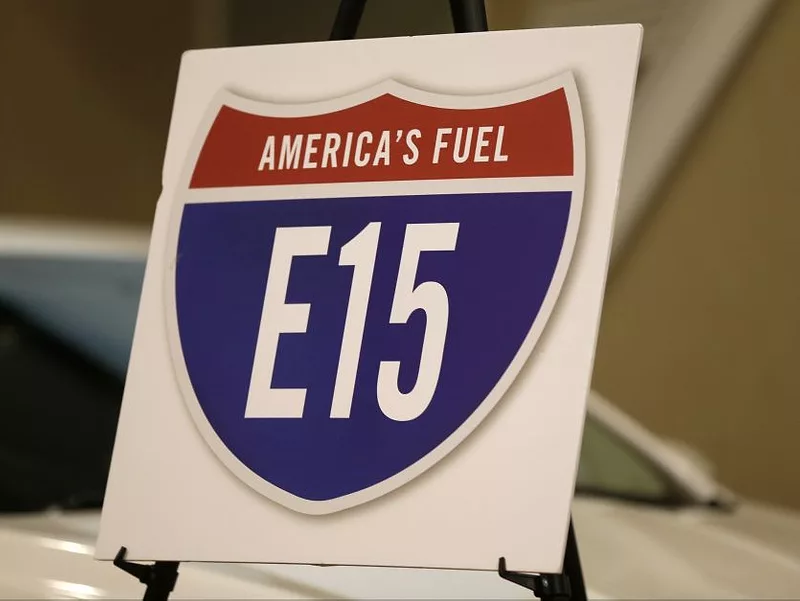
The corn industry's quest to get more biofuel into U.S. gasoline tanks took a stumble as estimates on the cost of proposed ethanol legislation to soybean farmers opened up a major rift in the agriculture world.
The discord erupted just hours before the House is expected to vote on legislation to allow voluntary, year-round sales of 15% ethanol blends with motor gasoline, known as E15.
The main hurdle to passing such legislation this year had been disagreement between large and small oil refiners over a provision to revamp the process of granting small refinery exemptions (SREs) from biofuel-blending rules under the Renewable Fuel Standard (RFS). But on Wednesday, major U.S. corn and soybean trade groups were in conflict over two separate estimates of how the bill, H.R. 1346, would impact biomass-based diesel and the soybeans frequently used to make the biofuel. The projections are based on the RFS part of the bill and not a reflection on stand-alone E15 on its own.
A study released Tuesday from the University of Missouri’s Food & Agricultural Policy Research Institute says the bill would lead to using more corn-based ethanol to meet national biofuel-blending quotas, as opposed to green diesel. Another sticking point is a Congressional Budget Office estimate that passage of the bill, H.R. 1346, would lead to direct federal spending on crop loss programs of $2.7 billion over 10 years, noted the Sustainable Advanced Biofuel Refiners (SABR) Coalition, which represents biodiesel producers.
“SABR is a biofuel advocate, so we support E15, but this current package is not the answer,” Tom Brooks of Western Dubuque Biodiesel and SABR chair, said in a statement. “The numbers in both the FAPRI study and the CBO estimate lay out a stark picture for soybean farmers and biodiesel producers. Rather than an E15 compromise with a side of SREs, it is more of a SRE compromise with a side of E15."
Soybean pushback
The CBO estimates that under the ethanol bill, if federal marketing loan program payments are included along with price crop coverage, the increase in direct federal spending goes up to $8 billion from 2026-36.
"Taken by itself, allowing year-round sales of E15 would tend to reduce the deficit," according to CBO.
The E15 measure from Rep. Adrian Smith, R-Neb., also would mean "higher demand for corn and lower demand for soybean oil and soybeans" due to how the RFS is structured, according to the research co-authored by Seth Meyer, who oversees FAPRI and until last year served as the USDA's chief economist.
The findings prompted the American Soybean Association to privately advise its membership that it can’t support the current E15 bill. “After reviewing the FAPRI study, ASA issued a member-only communication summarizing the data," an ASA spokesperson told Agri-Pulse. "Based on the study’s findings, we advised ASA members that we could not support the legislation in its current form. However, ASA has not yet taken a public position on the legislation”
When the E15 plan was unveiled last month, ASA said it was still assessing its potential impacts on soy-based biofuels and farmers. The group has since remained publicly neutral on the matter.
The National Corn Growers Association said the FAPRI study is flawed because it didn't factor in the historically high 2026-27 biofuel-blending rules set by the Trump administration in March, and because it assumes slower E15 adoption than industry projections.
“NCGA has also conducted its own analysis of year-round E15 and all outcomes point in the same direction: E15 strengthens corn demand and farm income for corn farmers, most of whom also raise soybeans," NCGA chief economist Krista Swanson said in a statement. "Year-round E15 saves drivers money at the pump, supports America’s corn farmers and improves energy security for our country. H.R. 1346 deserves a yes vote.”
It’s easy to be “in the know” about what’s happening in Washington, D.C. Sign up for a FREE month of Agri-Pulse news! Simply click here
Representatives from agriculture groups were on Capitol Hill this week pitching pro-ethanol messages to undecided lawmakers.
Two major points they worked to get across is that the bill wouldn’t be a mandate and that E15 has been shown to reduce fuel pump prices as much as 60 cents a gallon, despite being “negligibly” less energy dense than gasoline, Brian Werner, executive director of the Minnesota Bio-Fuels Association, told Agri-Pulse.
The bill would overturn rules barring higher ethanol blend sales in the summer months due to smog concerns that are now widely viewed as outdated. During his first term, President Donald Trump allowed year-round E15 by executive order, though it was later overturned in a court ruling that said Congress must decide the matter. For the past several years, EPA has issued summertime E15 sale waivers.
The legislation “would provide that regulatory certainty,” Werner said. “There are a lot of gas stations out there that would like to offer E15. … We don’t want to have to rely on going to EPA every single year asking for an emergency waiver.”
The mood ahead of the vote is “cautiously optimistic,” Werner said, adding that soaring gas prices are helping ethanol groups make their argument for the bill.
“It’s very clear to us that people are thinking and talking about high energy prices right now,” he said. “As these high gas prices continue to persist, this is a pretty easy lever to pull that really would provide that option. We’re hopeful that message is resonating.”
Republican lawmakers are divided on E15, with major opposition from some House members from heavy oil-refining states. The GOP will not do a whip count on the ethanol bill, even though House Majority Whip Tom Emmer, R-Minn., is making it clear he will support the legislation.
“I’ve always supported year-round E15 and I’m proud to vote ‘yes’ on the House floor later today to support Minnesota’s farmers and producers,” Emmer said in a statement.
Smith, co-chair of the congressional Biofuels Caucus, urged fellow House members to back E15 in comments on the chamber floor.
"Nationwide, year-round E15 would provide immediate relief to consumers, lowering costs at the pump in my district up to 52 cents per gallon, at a time when families need it most," he said. "It would increase demand for corn by over 2 billion bushels a year, delivering the certainty, opportunity, and market development America’s farmers have unequivocally called for. E15 is compatible with 97% of vehicles on the road today and can be delivered through existing infrastructure, as the past five years of summertime waivers have already demonstrated. The question is no longer whether E15 makes sense; it does. The question is whether Congress will allow consumers to have this access."
Oliver Ward and Noah Wicks contributed to this story.
For more news, go to Agri-Pulse.com.
.webp?t=1762183428)
