
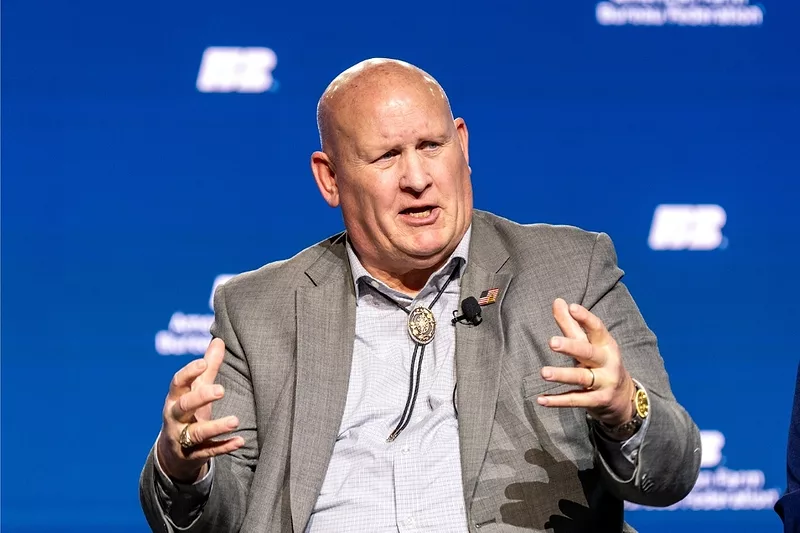
Leaders of the House and Senate Ag committees and GOP leadership have called for $15-$20 billion in farm aid, but details remain unclear.
House Ag Committee member Austin Scott, R-Ga., is confident there will be another bridge payment but told Agri-Pulse Newsmakers “there is some debate about paying some of that sooner rather than later and whether or not we should wait until the end of the crop year to figure out actually which commodities had bigger or shorter losses before you would pay all of the money out.”
Scott noted that others have “differing opinions.”
“Just know this: There will be honest debate, and we will get to what I believe will be an equitable solution among the honorable people in the discussions, including the associations of the different specialty crop producers as well as your traditional row crop producers.”
When asked about the aid issue Thursday, House Ag Committee Chair Glenn “GT” Thompson told Agri-Pulse he’s “communicating with the industry to see how it will be most helpful.”
Assuming a supplemental spending bill for the Iran war happens before the elections, Scott says it remains the most obvious vehicle to move additional farm aid. He also says a “fair amount” of the potential aid package will be set aside for specialty crop growers.
Big picture: Whether lawmakers will move an Iran war supplemental, or attach farm aid to any other vehicle, remains unclear. Republican senators have warned that any request from President Trump for tens of billions of dollars to pay for the war will have a tough time passing the Senate as patience wanes over seeing a clear plan to end the conflict.
In the House, Budget Committee Chair Jodey Arrington, R-Texas, told Agri-Pulse Thursday he hasn’t heard any “substantive conversation on assistance right now because we have to have the farm bill done.” There also are other priorities like appropriations and a second – and potentially third – budget reconciliation bill.
Such a bill could be an “appropriate vehicle” to move additional farm aid, Arrington noted. “It could end up in a lot of things.”
Commerce recommends tariffs on Canadian mushrooms
The Commerce Department has found evidence that Canada’s mushroom industry is benefiting from subsidies and is recommending tariffs on U.S. imports.
Commerce’s International Trade Administration has issued its preliminary findings in a countervailing duty case against fresh mushroom imports from Canada.
In a memo explaining the decision, the department said Canadian producers benefit from a preferential lending program, federal and local tax breaks, fuel charge exemptions and grants.
The department is recommending tariffs of almost 3% on all imports, with two companies facing tailored rates of 1.6% and 5%.
The final determination in the case is due in September.
More beef price pressures incoming, analyst warns
High beef prices have been a thorn in the Trump administration’s side, with the president grasping at policy levers to ease price pressures. But a former USDA economist warns that there are signs prices could go even higher.
Cal Poly Agricultural Economist Richard Volpe noted that alfalfa crops in the western states, a key input for cattle feed, are set for a challenging year.
The crop, he added, benefits from melting snow from the Sierras and the Rockies.
It’s easy to be “in the know” about what’s happening in Washington, D.C. Sign up for a FREE month of Agri-Pulse news! Simply click here
“Because it's been so warm, there's effectively no snowpack in the Sierras,” Volpe told reporters Thursday. “We're going to have limited crops. It's going to be expensive; it's going to require substitutions.”
Adding higher feed costs to existing challenges posed by higher transportation, labor, water and input costs will only add to the price pressures.
“I'm not predicting to see any substantial price relief … any time soon,” Volpe said.
The limited snowpack could also lead to price increases in other California-grown commodities, including fruits, vegetables, tree nuts and herbs and spices.
Senate Dems warn of potential research staff losses in USDA reorg
Twenty-four Senate Democrats are worried the Agriculture Department’s planned reorganization will “erode the capacity of USDA’s research agencies and threaten their ability to deliver innovation and timely economic data for farmers, ranchers, and rural communities,” according to a letter sent Thursday.
In a letter to Deputy Secretary Stephen Vaden, the lawmakers, led by Senate Ag Committee Ranking Member Amy Klobuchar, pointed to a Government Accountability Office report that found a similar relocation in 2018 and 2019 led to the Economic Research Service and National Institute of Food and Agriculture losing over half of their staff.
They also noted that the National Agricultural Statistics Service lost over 30% of its staff last year amid Trump administration downsizing efforts.
Poll finds 39% of farmers politically unsure ahead of U.S. midterms
With midterm elections less than six months away, roughly four in 10 farmers are not sure how to vote, a poll released today finds.
Nearly 40% of agriculture producers say they may vote for a different party, consider an independent or third-party candidate, or not cast a ballot at all, says the survey commissioned by Amato Advisors and conducted by Farm Journal in April.
Six-in-10 of surveyed farmers said they either “always” (30%) or “usually” (29%) vote for Republican candidates, according to the poll of 974 farmers and ranchers across 44 U.S. states.
Other findings include:
- 78% say input costs are a top challenge.
- 94% say war with Iran is raising fuel and fertilizer costs.
- 73% say elected officials understand realities farmers face "not very well" or "not at all."
Amato Advisors is headed by Michael Amato, who served in the Biden and Obama administrations, including as USDA communications director under former Agriculture Secretary Tom Vilsack.
New E15 drama begins as bill moves to Senate
The fight over E15 continued without pause the day after House passage of the pro-ethanol bill.
Senate Ag Chairman John Boozman, R-Ark., tells Agri-Pulse the measure that’s divided both the agriculture and fossil fuel industries will need changes to advance further. Read more on his comments at Agri-Pulse.com.
One major source of debate is a provision in the bill to change how national biofuel law exemptions are handled for small oil refiners.
“Small refineries already face higher costs under federal renewable fuel rules,” Senate Majority Whip John Barrasso, R-Wyo., said Thursday. “Without additional relief, the new mandate will likely raise gas prices all across the country by up to 35 cents a gallon. Small refineries have been ignored so far in the current E15 debate. It’s time for their voices to be heard.”
Meanwhile, the National Corn Growers Association released analysis stating that the bill to allow year-round higher ethanol fuel blends, known as E15, would benefit both corn and soybean farmers.
Reports released earlier this week showed a negative impact to biomass-diesel producers and soybean farmers.
Final word
“It’s complicated.” – Senate Agriculture Chairman John Boozman, R-Ark., on division among lawmakers and within the ag industry over House-passed E15 legislation that would also change how small oil refiners are treated under the Renewable Fuel Standard.
For more news, go to Agri-Pulse.com.
*Corrects Amato Advisors poll to say six-in-10 of surveyed farmers said they either “always” (30%) or “usually” (29%) vote for Republican candidates.
.webp?t=1762183428)


