
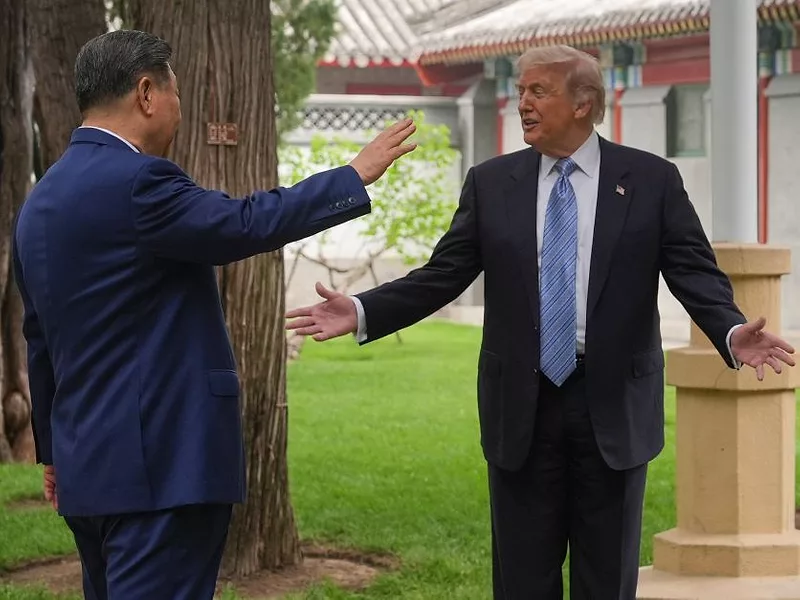
President Donald Trump left Beijing on Friday with two new vehicles for cooperation with Chinese officials on trade and investments, hundreds of reinstated beef export facility registrations as well as some new ones, and the next bilateral leaders' meeting lined up. U.S. agriculture is still hoping there is more in store.
A senior Chinese official confirmed on Friday that President Donald Trump and Chinese President Xi Jinping agreed to establish boards of trade and investment to manage the bilateral economic relationship and made progress on agricultural talks. Neither side has provided firm details on what ag measures were agreed to during Trump's China visit.
“The two countries' economic and trade teams reached generally balanced and positive results,” China’s Foreign Minister Wang Yi told reporters Friday, according to an unofficial translation. He said the two sides agreed to continue “to implement” previous deals and establish a board of trade and a board of investment.
Further, he noted there were discussions on “addressing each other's concerns about market access for agricultural products and promoting the expansion of bilateral trade under the framework of reciprocal tariff reductions.”
Xi has also accepted Trump’s offer of a Sept. 24 reciprocal visit to the U.S.
The Trump administration has provided few details about what agricultural commitments Beijing made during the two-day summit. But Beijing said as the meetings got underway on Thursday that it had reinstated several hundred lapsed registrations for U.S. beef export facilities.
The U.S. Meat Export Federation said Friday that those registrations, and some new ones, have now materialized.
Chinese customs gave five-year registrations to 425 facilities, which were initially approved in 2020 following the U.S.-China Phase One deal. An additional 77 facilities have been added to the system, USMEF said.
China still manages beef import volumes through a quota system, with the U.S. receiving just 164,000 metric tons. U.S. beef supply is also very tight amid low cattle numbers and high demand. Through the first quarter of 2026, U.S. beef imports were up 15% over the previous year, while exports fell 18%.
"Renewal of U.S. beef establishment registrations is a critical step forward for U.S. beef exports to China," USMEF President and CEO Dan Halstrom said in a statement Friday. "We await more details and a further readout from USTR’s engagements with China," he continued, referring to the Office of the U.S. Trade Representative.
Multiple agricultural industries on Friday were still hoping that there would be further agricultural trade announcements from the summit. In an interview with Bloomberg Asia Thursday night ahead of Trump and Xi’s second planned meeting, U.S. Trade Representative Jamieson Greer teased more purchase commitments, saying that he expected China to commit to purchasing “double-digit” billion-dollar ag purchases – not including soybeans – over the next three years.
During his flight back to the U.S on Friday, Trump also told reporters that he had made “a lot of great trade deals,” and that U.S. farmers would approve of the outcomes. But did not provide details on any new commitments.
“They’re going to be buying billions of dollars of soybeans,” Trump told reporters on Air Force One.
In October, China pledged to buy at least 25 million metric tons of soybeans annually, as well as 12 million tons in the last two months of 2025. So far, it has bought, at most, around 13 million tons since the October meeting.
Trump’s former USDA Undersecretary for Trade and Foreign Agricultural Affairs Ted McKinney told Agri-Pulse Friday that he is still optimistic that details of increased ag purchases will materialize.
It’s easy to be “in the know” about what’s happening in Washington, D.C. Sign up for a FREE month of Agri-Pulse news! Simply click here
“Jamieson's pretty careful with his words, to his great credit,” he said of USTR Greer. McKinney, who is now CEO of the National Association of State Departments of Agriculture, said he hopes “it all comes to pass” but added that “ultimately, the sale and the delivery is the proof.”
Further, McKinney said that the establishment of a board of trade could foster increased collaboration between the two countries and help ensure China lives up to its trade commitments.
But McKinney stressed that the success of the board would depend on which officials sit on it and the type of work it carries out.
“It just depends on what they would be seeking to do,” he said. “I tend to be the optimistic type – that dialogue usually nets good results, at least it breaks down barriers and helps to build trust and understanding.”
“I'm very anxious to see what it would look and feel like, who would be members of that board, and then I think we can make a more thorough and accurate judgment.”
During the Bloomberg Asia interview Greer confirmed that the board of trade would likely manage trade terms for around $30 billion of products. Total bilateral goods trade between the two countries is north of $400 billion annually, according to USTR.
Former Senior Trade Representative for China at USTR Sara Schuman told Agri-Pulse Friday that, if assembled, the board would be the first time that the two sides have had a venue for narrow discussions focused around lowering tariffs and nontariff trade barriers in non-strategic sectors.
"Many of the previous dialogues did touch on areas that had strategic implications, and so this is more limited," she said. "In a way, they're sort of defining a new trading relationship with China, which we really haven't done before."
Schuman now leads the international trade practice at Beacon Global Strategies.
Vice President and Chair of International Economics at the Atlantic Council Josh Lipsky pointed out Friday that with the outcomes of two U.S. probes into Chinese unfair trade practices still up in the air -- and higher U.S. tariffs still a possibility -- Beijing may not have felt inclined to offer too many concessions at the summit.
"That’s likely why China did not feel any urgency to make major new announcements on the follow-through of purchase agreements, whether it’s soybeans, beef, or energy," Lipsky said in a statement.
The two leaders could meet another three times this year, in September in Washington, at a November summit in Shenzhen and at a G20 meeting in Miami in December.
"That timeline aligns with the end of the trade truce brokered in South Korea in October 2025," Lipsky said, "and it may mean the tougher conversations are going to happen later in the year."
This story will be updated.
For more news, go to Agri-Pulse.com.

