
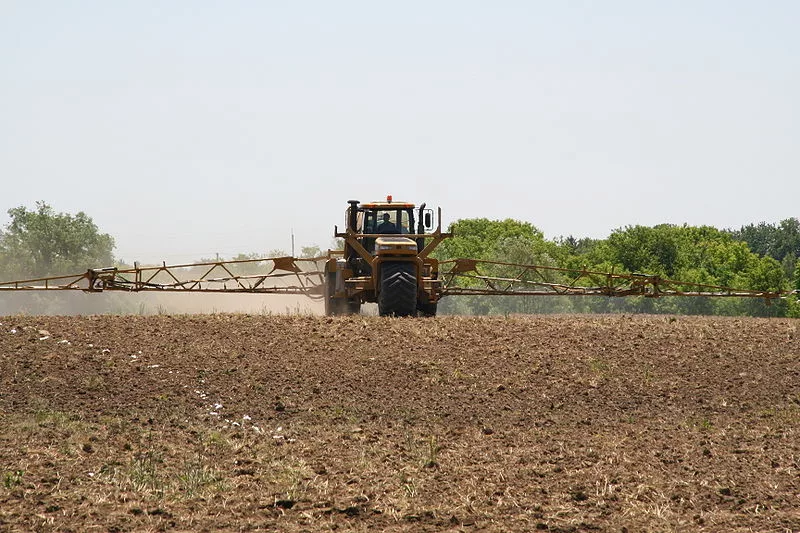
DOT to exempt fertilizer shippers from hours-of-service regs
Fertilizer haulers will be exempt from certain hours-of-service rules for the rest of 2026 under a waiver approved by the Transportation Department on Tuesday.
In response to a request from The Fertilizer Institute, the Federal Motor Carrier Safety Administration issued a waiver loosening driving time restrictions for haulers carrying straight or blended fertilizer products in 35 states.
Under the waiver, fertilizer haulers could drive 16 hours within a 24-hour period and must take at least one six-hour break in a sleeper berth every 24 hours, or one eight-hour break if they don’t have a sleeper berth.
Current hours-of-service rules don’t allow truckers to begin a driving shift until they have spent 10 consecutive hours off duty, and they must rest again after 14 consecutive hours of driving.
In a release Tuesday, TFI President and CEO Corey Rosenbusch applauded the exemption, which he said could “alleviate strain within the system and help avoid any potential bottlenecks in the fertilizer supply chain, especially as we transition to summer and fall fill.”
OPM proposal floats idea of NDAs as condition of employment
The nation’s largest union representing federal workers is criticizing a proposal that could force employees to sign non-disclosure agreements as a condition of employment.
The Office of Personnel Management published the notice requesting comment today, citing “several recent instances in which internal agency communications related to rulemaking and policy development were disclosed without authorization.”
Those types of disclosures “risk chilling candid interagency feedback, disrupting orderly decision-making, and weakening trust within and among federal agencies,” the notice says.
But American Federation of Government Employees President Everett Kelley said OPM is continuing to try “to silence federal employees. This proposed NDA is another attempt by the administration to purge the civil service of nonpartisan career employees and replace them with loyalists who won’t speak out against waste, fraud, and abuse.”
Federal employees, Kelley said, “do not surrender their First Amendment rights when they accept federal employment, and the public has a right to know about this administration’s abuses.”
OPM says in the proposal that the NDA Form will be “optional,” but AFGE contends OPM “will pressure agencies to make the NDA mandatory and then fire employees who refuse to sign it.”
It’s easy to be “in the know” about what’s happening in Washington, D.C. Sign up for a FREE month of Agri-Pulse news! Simply click here
Base meat facility definitions on production volumes, commenters say
The Food Safety and Inspection Service should change the way it defines the size of meat processing facilities, comments submitted to the agency say.
“There is a huge difference between a plant with 11 employees and a plant with 499 employees, though both are defined as a ‘small plant’ under the current definition,” said Christopher Young, executive director of the American Association of Meat Processors. The current definition dates from 1996.
The gap has become more noticeable in recent years “when setting parameters for applying for federal grants or reducing FSIS overtime charges,” Young said.
AAMP recommended basing the size on production volume instead of the number of employees, which could vary greatly in plants “based on types of products produced as well as automation used in the production of those products,” Young said.
Farm Action, which advocates against monopolies in agriculture, also recommended using production volumes, but said in its comments that “USDA should also evaluate establishment size at the level of the parent enterprise rather than solely at the individual facility level.”
“Subsidiaries of dominant meatpacking companies should not qualify for benefits intended for genuinely small independent processors merely because an individual facility falls below a numerical threshold,” the group said.
Land access grantees join lawsuit
Two dozen groups and local governments who had grant agreements under a program meant to increase access to land for farming are joining a lawsuit and seeking an injunction restoring the grants.
The lawsuit, which was originally filed by the Urban Sustainability Directors Network, resulted in an injunction restoring a handful of grants, including one for $28 million under the Urban and Community Forestry Assistance program.
USDA terminated the $300 million Increasing Land, Capital, and Market Access Program in April, claiming waste by the recipients.
Among the new plaintiffs are 2020 Farmers Collaborative, African Alliance of Rhode Island, Black Oregon Land Trust, H.O.P.E For Small Farm Sustainability and the Kansas Black Farmers Association.
The grants the new plaintiffs are suing to restore total $127 million.
Termination letters to the grantees “make vague references to ‘DEI preferences,’ and include incorrect claims that the programs don’t align with congressional intent or that the grants represent ‘waste, fraud, and abuse,’” according to a press release. “Over the course of this litigation, the government has repeatedly failed to substantiate ‘waste, fraud and abuse’ in terminated grants.”
New consortium established to address food safety testing
The National Institute of Standards and Technology, or NIST, is setting up a Food Nutrition and Safety Measurements and Methods Consortium.
The consortium “will bring together stakeholders to identify and address measurement and standards needs related to analytical testing of food ingredients and food products,” according to a notice in Wednesday’s Federal Register. Its efforts “are intended to advance food measurement capabilities, support the development of food reference materials, and collect data to support the development of best practices and standard methods.”
Greater mental health awareness for farmers sought
Reducing the stigma of mental illness within the agriculture industry is the focus of a bipartisan and bicameral resolution unveiled on Tuesday.
Sens. Deb Fischer, R-Neb., and Michael Bennet, D-Colo., introduced a resolution to designate May 29 “Mental Health Awareness in Agriculture Day,” the lawmakers said.
“A struggling farm economy is making life even harder, and it weighs heavily on the minds of those who feed and fuel our nation,” Fischer said in a statement.
The suicide rate among farmers is 3.5 times higher than the general population, according to the National Rural Health Association.
“Providing visibility and awareness to address these challenges is essential for progress,” Bennet said.
The measure is backed by lawmakers including Senate Ag Committee Chairman John Boozman, R-Ark., and Sen. Amy Klobuchar, the panel’s top-ranking Democrat.
Reps. Mike Bost R-Ill., and Kim Schrier, D-Wash., introduced a companion resolution in the House. Ag groups including the American Soybean Association and Farm Credit Services of America support the measure.
Final Word
“I think we're going to see exciting things on the horizon with the India deal as it relates to U.S. agriculture, but no news to break at the moment for you.” – USDA Undersecretary of Agriculture for Trade and Foreign Agricultural Affairs Luke Lindberg, responding to a question about which ag products India might commit to buy. Secretary of State Marco Rubio has said India will buy $500 billion worth of American goods, including agricultural imports, over the next five years.
.webp?t=1762183428)

