
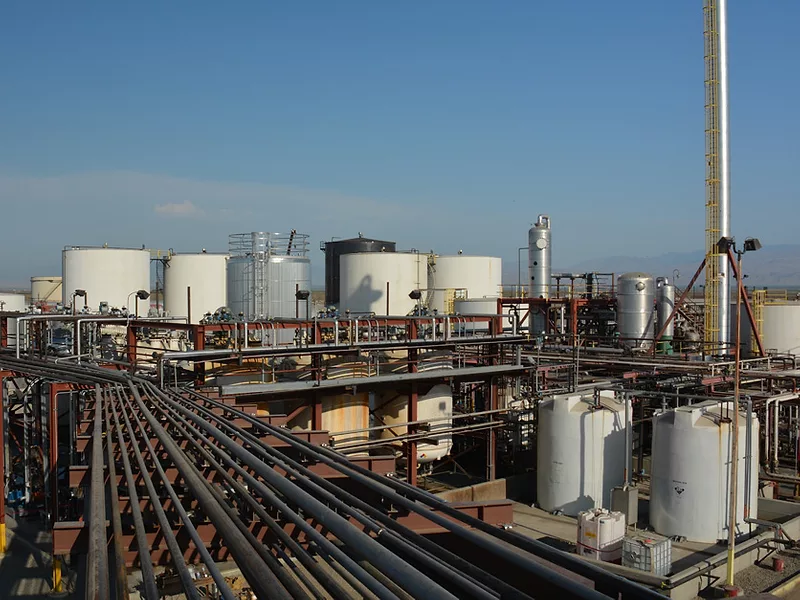
Import restrictions for 45Z debated at hearing
Companies and trade groups are debating whether imported feedstocks should count toward the 45Z Clean Fuel Production Credit as a three‑day IRS hearing on the proposed rule continues today.
Dan Lieberman, global lead for sustainability strategy and low-carbon solutions at Nufarm, called for “a broad feedstock approach, including responsibly sourced imported feedstocks that meet rigorous sustainability and carbon intensity standards,” during his remarks on Wednesday. The global chemical company is based in Australia.
He said imports are “absolutely necessary to prevent supply shortages, to stabilize fuel markets, to maintain affordability for consumers, and to ensure the continued growth and competitiveness of the U.S. biofuels market.”
But Eric Sievers, investment director for ClonBio Group Limited, which makes ethanol, noted that the One Big Beautiful Bill Act requires feedstocks for 45Z to come from the U.S., Mexico or Canada. The company is based in Ireland and owns Aztalan Bio in Wisconsin.
“The policy isn't up for debate,” he said. “The law is that 45Z feedstocks need to come from North America.” He said the requirement will benefit U.S. farmers and attract increased investment to the United States. He disputed the notion that Europe is welcoming foreign feedstocks.
“Europe does have a problem with imported feedstocks, and that problem is fraud,” he said.
The hearing continues through Friday, with representatives from the American Coalition for Ethanol, Roeslein Renewables, Clean Fuels Alliance America and the American Soybean Association scheduled to speak today.
Former House Ag staffer, lobbyist Tom Sell wins primary runoff
Tom Sell, co-founder and manager of ag lobbying firm Combest, Sell & Associates, defeated Abraham Enriquez to secure the Republican nomination in Texas’ 19th congressional district.
“First and foremost, I hope to be a constructive part of the House Agriculture Committee, a place that I love and support,” Sell told Agri-Pulse when asked about his priorities as a lawmaker if elected in the November general election.
“I know the role of a freshman congressman, will try and do as much as I can to support the party on good strong agricultural policy, which fits right in line with the America First Agenda,” Sell said.
The nonpartisan Cook Political Report rates the district, which is home to Lubbock and the Texas South Plains, as +25 solid Republican.
U.S. delegation readies for USMCA negotiations in Mexico
A U.S. delegation will make its way to Mexico City today and tomorrow for the first in a series of bilateral negotiating rounds over a review of the U.S.-Mexico-Canada Agreement, according to the Office of the U.S. Trade Representative.
The delegation, led by Deputy USTR Ambassador Jeff Goettman, will negotiate “economic security and rules of origin for key industrial goods” with Mexico, according to a press release. The negotiations "will focus on ensuring that the USMCA benefits U.S. manufacturers, farmers, ranchers, workers, and service suppliers, and businesses of all size, including our small and medium-sized enterprises,” it says.
A second negotiating round will occur in Washington, D.C. on June 16 and 17, which will include “discussions on agriculture and a level playing field,” the release says. A third round will be held the week of July 20.
It’s easy to be “in the know” about what’s happening in Washington, D.C. Sign up for a FREE month of Agri-Pulse news! Simply click here
Vermont governor approves paraquat ban
Vermont has officially become the first state to ban paraquat.
The state’s Republican governor, Phil Scott, has officially signed a bill to phase in restrictions on use of the herbicide by 2030, according to a press release from his office.
The new law bars the sale, use and application of paraquat without authorization from the state’s agriculture secretary, though producers have until the end of 2030 to seek state permits to use it in orchards or on small fruit crops.
Rio Grande water-sharing settlement gets Supreme Court approval
The Supreme Court has approved a settlement to end three states’ longstanding feud over the Rio Grande.
The court has issued an order allowing a proposed settlement between Texas, New Mexico and Colorado to move forward, wrapping up a 13-year legal dispute over the sharing of Rio Grande water. The settlement creates an annual index that measures water delivered to Texas against a formula-based target, with hard caps on how far New Mexico can fall behind before facing penalties.
The dispute began when Texas filed suit in 2013 claiming that New Mexico water users were “unfairly siphoning” water, leaving little for Texas. The three states proposed a different Rio Grande agreement in 2022, but the Supreme Court rejected it, finding it failed to meet the federal government’s interests.
USDA opens new research laboratory in Kerrville, Texas
The Agriculture Department is celebrating the opening of a lab dedicated to eliminating livestock pests like New World screwworm.
Screwworm will be a major focus of research at the 52,000-square-foot laboratory in Kerrville, Texas, according to a USDA press release. However, scientists also will be studying other livestock pests, such as ticks and biting flies. The new facility houses the Livestock Arthropod Pest Research Unit and the Veterinary Pest Genetics Research Unit.
The new lab has advanced genomics and cattle facilities, which will help researchers work on “improved surveillance and trapping tools, novel insecticides and acaricides [and] enhanced pesticide delivery techniques for cattle and wildlife,” the press release said.
The Knipling-Bushland U.S. Livestock Insects Research Laboratory was created in 1946 as a consolidation of three other laboratories to combat the threat of screwworm. It has been in Kerrville since 1963.
The lab is named after Edward F. Knipling and Raymond C. Bushland, both of whom were instrumental in developing the sterile insect technique, which helped eradicate the New World screwworm from the U.S. in 1966.
Final word
“We are holding accountable the states and individuals that have abused the system, while partnering closely with the states that actually want to help us restore integrity and transparency. It is no coincidence that many of the states leading the way are strong conservative states committed to fiscal responsibility and program integrity.” – Ag Secretary Brooke Rollins on X, thanking Vice President JD Vance for his remarks about SNAP at a cabinet meeting Wednesday. Vance said the administration is “working on a number of mechanisms to actually force the states to verify that the people who receive [SNAP] benefits are actually entitled to them.”


