

|
Senate Agriculture Chair John Boozman wants to move a farm bill out of his committee by the end of June. He has 17 legislative days left to do so.
The Arkansas Republican has made it clear there’s no room for items that would trigger major partisan headaches, such as streamlining pesticide-labeling laws or nullifying livestock welfare regulations, like California’s Proposition 12. Year-round sales of higher ethanol-fuel blends, known as E15, and other contentious issues remain wild cards.
Amid all the opposing views, one point of general agreement stands out: The biggest threat to getting a farm bill through the Senate is disagreement around the Supplemental Nutrition Assistance Program.
The hurdle is around a new law requiring states to begin paying a share of the program’s cost, based on their SNAP error rates. States with an error rate below 6% annually would continue to have food benefits fully funded by the federal government. “Fewer than 10 states, most of them with low populations, would have met this threshold to avoid a cost shift in 2024,” according to the Center on Budget and Policy Priorities, a nonpartisan research group.
When asked what the biggest obstacle is to getting a Senate farm bill passed this year, Sen. Chuck Grassley, R-Iowa, didn’t hesitate in his reply.
“Democrats wanting us to delay anti-fraud provisions that we put in last year's tax bill,” Grassley told reporters on Tuesday. “A delay of two years would cost $18 billion.”
 Sen. Chuck Grassley (official photo)
“You just can't tolerate big error rates in states,” Grassley said. “We got some states that are 20%, and getting it down to 6% would be quite an accomplishment. Even going lower would be better, but let's get our first victory before we move on.”
Last year's One Big Beautiful Bill Act (OBBBA), President Donald Trump’s signature tax law fast-tracked through Congress last year by Republican leaders, slashed $187 billion in SNAP funding. It also called for states to cover 75% of the program's administrative costs starting in fiscal 2027, up from 50% now, and to begin by the following year paying for SNAP benefits based on their payment error rates, "a volatile and often misleading performance metric," according to the Food Research & Action Center, a nutrition advocacy group.
Sen. Amy Klobuchar, the Agriculture Committee’s ranking member, is among Democratic lawmakers as well as state and local officials fighting to postpone the changes.
“My colleagues and I remain committed to a bipartisan farm bill to support farmers and ranchers in a difficult farm economy caused in part by trade chaos and rising input costs. We are committed to fixing the unfairness of the SNAP cost shift to states, which penalizes states working to reduce program errors while rewarding those states with the highest error rates," Klobuchar said in a statement to Agri-Pulse.
"The SNAP cost shift, for the first time ever, will force state and local governments to choose between providing food assistance to American families, reducing other critical services like law enforcement or health care, or raising property taxes," she said. "Democratic and Republican governors, state legislators, and county commissioners are asking Congress for a delay of certain shifts that are approximately 10 percent of total nutrition cuts over the ten years — to ensure all states are treated fairly."
SNAP compromise ahead?
States with payment error rates above 6% will be responsible for between 5% to 15% of SNAP benefit costs, representing an average $218 million a state a year, ranging from about $5.5 million in North Dakota and $37 million in Hawaii to $991 million in Florida and $1.8 billion in California, a coalition that includes the National Governors Association said in January, citing fiscal 2024 data.
The cost shift should be put on hold until fiscal 2030 to allow states and counties “adequate time to reduce payment error rates, and preserve investments in staffing, training and systems essential to program integrity,” the coalition told congressional leaders earlier this year.
Boozman so far has been firm in his stance that the change needs to go forward as intended, citing a flawed system that needs to be fixed.
Still, there’s been recent chatter that a bipartisan deal on SNAP could materialize.
Cut through the clutter! We deliver the news you need to stay informed about farm, food and rural issues. Sign up for a FREE month of Agri-Pulse here.
Further, some GOP lawmakers whose states are on the hook may quietly want the postponement as well, according to policy watchers.
Sen. Deb Fischer, R‑Neb., told Agri‑Pulse Newsmakers last month that Republicans are taking colleagues’ concerns seriously. “We’ll see if we can work that out,” she said.
Klobuchar on Tuesday said "discussions are ongoing and productive. Sen. Boozman and I have an excellent working relationship.”
Farm bill and voters
Cuts to federal government anti-hunger initiatives are also up for debate outside of Capitol Hill.
“Food bank usage has surged since the Trump administration’s cuts to food assistance programs, including SNAP, took effect,” according to Brookings Institution's Keon Gilbert, director of the Race, Prosperity, and Inclusion Initiative at the nonprofit Washington think tank.
Democrats trying to win back control of Congress next year are hammering a message of unaffordability under GOP leadership ahead of the November midterm elections.
“Latino and Black voters who shifted toward Trump in 2024 over economic concerns are now among the most likely to reconsider their support ahead of the midterms,” Gilbert said in an online post on Monday.
Fertilizer, E15, specialty crops
The Senate’s farm bill 2.0 deliberations follow heavy lifting from Boozman a year ago to update federal agriculture programs representing about 80% of the funding in a traditional, five-year farm bill, something Congress hasn’t passed since 2018 amid bitter partisan divisions.
The ag provisions included last year in OBBBA are expected to increase ag-focused federal spending by about $65 billion over the next decade, according to American Farm Bureau Federation economists. New provisions update the Agriculture Risk Coverage, Price Loss Coverage, Dairy Margin Coverage and crop insurance programs.
Farm-state lawmakers now are trying to tackle the 20% of funding still not addressed, which makes up roughly 80% of the ag programs. That involves issues important to the agriculture industry and broader rural economy that often are overshadowed by the attention given to big-ticket dollar items, or sticking points that lead to boisterous debates.
Those matters include items like rural credit availability, animal health and research, and rural energy.
Meanwhile, the biggest ag-related topics of the day have been pulled into the debate, like a controversial new hemp law, getting more economic aid into the hands of struggling farmers, E15 and surging fertilizer prices.
Sen. Tammy Baldwin, D-Wis., a member of the Senate Appropriations agriculture subcommittee, said she hopes E15 and fertilizer measures are ultimately part of the next farm bill.
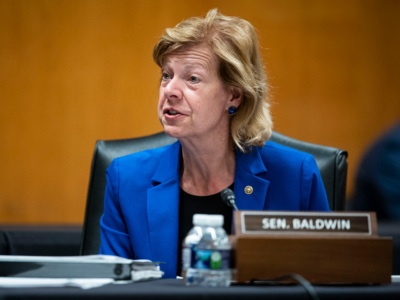 Sen. Tammy Baldwin (AP photo)Baldwin is cosponsoring various fertilizer measures, including one with Grassley that would require USDA to provide regular updates on the market.
“It would be a great help to our farmers to have that insight to be able to plan ahead,” Baldwin told Agri-Pulse on Monday.
Specialty crops, like tree nuts, fruits and vegetables, also are in focus. Senate Agriculture Committee member Adam Schiff, D-Calif., has said his farm bill priorities include reversing SNAP cuts and ensuring USDA programs are as accessible for specialty crop growers as they are for producers of the major cash commodity crops like corn and soybeans.
“This must cross a plethora of programs –- insurance, disaster, conservation, marketing, procurement, research and more,” Schiff said. “We must also ensure that the unique challenges of specialty crop production are addressed through robust and tailored science, research, and pest and disease mitigation.”
Schiff on Monday unveiled a suite of six bills he hopes to include in the farm bill, including a measure to provide $5 billion in economic aid for producers.
Other bills would expand insurance access for specialty crops and boost funding for automation.
Sen. John Hoeven, R-N.D., chair of the Appropriations’ ag subcommittee and Agriculture Committee member, also has been focused on specialty crops and getting more aid to those farmers amid a prolonged slump in the farm economy.
.webp?t=1762183428)
