
A new study identifies five areas where women in agriculture need support, including time and caregiving, skills development, financial future, overall well-being and leadership development.
The results of the study, based on a survey of nearly 4,400 women involved in agriculture, were revealed at the American Farm Bureau Federation’s ACE summit celebrating the International Year of the Woman Farmer.
“Women in ag ... face challenges and barriers to their positions in that, but also in leadership, but they’re doing it anyway,” said Stephanie Basey, one of the researchers for the study. "So this is not a, ‘this is tough and I’m going to stop. This is tough but I’m going to keep going, because it’s important to me and I care about it.’”
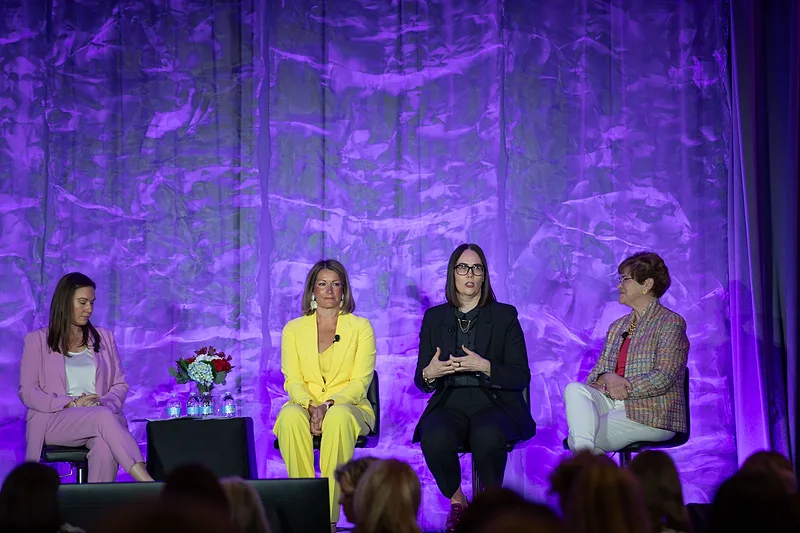
About 500 people attended the three-day summit, which highlighted leadership development for women in agriculture. “A celebration like this just really truly pays homage to those that have gone before us and have worked so hard to ensure that everybody has a seat at the table,” said Valerie Wagner, the first woman president of the North Dakota Farm Bureau.
The National Women in Agriculture study sought to determine how women in agriculture participate in leadership opportunities, based on a survey of 4,396 women from all 50 states and Puerto Rico and on focus groups It was conducted by the Hive Research Collective with sponsorship from AFBF's Women’s Leadership committee, CoBank, and JBS. Basey said they are working on a three-year plan with the data.
The study found that leadership roles among respondents began when they were in their 30s, but the women advised other women to start pursuing leadership positions before they are 25. However, younger women often do not know how to enter leadership spaces because of an “insiders’ club,” although 86% of women in agriculture are interested in leadership either now or later.
Time constraints and family responsibilities are both barriers to women participating in leadership, especially because the hours of agricultural work conflict with the hours for childcare.
Cut through the clutter! We deliver the news you need to stay informed about farm, food and rural issues. Sign up for a FREE month of Agri-Pulse here.
“I wish the farm made enough money to only work one job,” said Sarah Williams, who runs a goat operation in New Mexico. “If there’s funding for that where the interest rates aren’t so high or more grant opportunities, I feel like I’m always searching for grants, and I can never find them.” There was broad support for targeted economic incentives and need-specific financial programs from 85% of respondents.
Williams explained the importance of the International Year of the Woman Farmer to her. “Everything is about the veteran husband,” she said. “I’m the one who runs the farm. He’s like the quiet partner behind. I’m the one who’s milking the goats and delivering babies while I’m also working a full-time job.” In addition to family responsibilities, 60% of the women hold roles outside of agriculture, with 21% working full-time non-agricultural jobs – often for insurance.
Although 62% of women in agriculture own or share ownership of their operation, business and financial management is a key training area 56% of women in agriculture wish they could participate in more.
Amanda Durow, the lead relationship manager at CoBank, co-led a session on risk management at the summit. “What motivates me about inspiring women to take control of their finances is just to empower them with knowledge, with tools, with resources,” she said. “Women take, I think, a holistic approach; they go off almost a full 360 view of managing the risk assessment.”
Fifty-six percent of women report they need to put in extra effort to have their knowledge and expertise recognized, according to the study’s results. Wagner is no stranger to being the only woman in the room. “Sometimes I get a little frustrated when we have events, and then you see you’re the only female there, and you feel like, ‘Well, was I invited because of what I have accomplished and what I’m here for, or is there a box that needed to be checked?”
Ninety percent of women in agriculture are confident in speaking about agriculture, but only 61% are confident in their knowledge to effectively advocate for agriculture, indicating a gap in education. Forty-five percent hoped for training on policy or civic engagement.
Krysta Harden, former deputy secretary of agriculture, said, “I think continuing to make sure they have a place at the table, that we hear their voices, sometimes they’re softer voices. So it’s almost deliberate to say, I want to ask you the question, I want your input, I want your ideas. Listening to them, I think it’s also important about what they need.”
This study is the latest effort for women in agriculture to be counted. Another way women have been more included in datasets are the changes in the 2022 USDA Census of Agriculture to remove “principal” or “primary” producers from the dataset and instead measure the contributions of all people making decisions for the farm.
In the past, the contributions of women were often overlooked unless they were the primary producer. “Women’s contributions absolutely matter, and now we can quantify it,” said Alexis Taylor, former undersecretary for trade and agricultural affairs at USDA.
Harden pushed to allow multiple people to be primary producers in the 2017 census because, she said, “if you’re not counted, if people do not see what you do, only you know it.”
For more news, go to www.Agri-Pulse.com.
