
|
Federal and state officials are scrambling to respond to a growing list of New World screwworm cases in Texas, but face a key constraint in their goal of re-eradicating the pest: the U.S. isn’t producing enough sterile flies.
It took dropping around 500 million sterile screwworm flies per week to push screwworm out of the U.S. in past outbreaks, according to Michael Schmoyer, associate administrator for the Agriculture Department’s Animal and Plant Health Inspection Service and director of the New World Screwworm Directorate. Currently, USDA is bringing in 100 million sterile flies each week from a production facility in Panama to deploy to parts of Texas where cases have been detected, he said during a press conference on Monday.
According to Schmoyer, an additional 100 million sterile flies will likely become available by the end of the year as a new production facility comes online in Metapa, Mexico. Another $750 million facility being built in Edinburg, Texas, will be capable of producing 300 million sterile flies per week when fully complete, but won’t start operating until next fall, Agriculture Secretary Brooke Rollins said last week.
 John Bellinger (Texas A&M photo)
Amid the constraint, USDA officials are analyzing ways to bolster the agency's production of male sterile flies, using modeling to target where sterile flies should be placed, and implementing movement restrictions in affected areas with the hopes of keeping the pest from spreading.
“We are going to turn over every stone to find more sterile flies,” John Bellinger, a Texas A&M Board of Regents member and USDA’s newly appointed senior adviser for New World screwworm preparedness, said during the press conference in Texas on Monday.
Sterile flies remain key as screwworm returns to U.S. livestock.
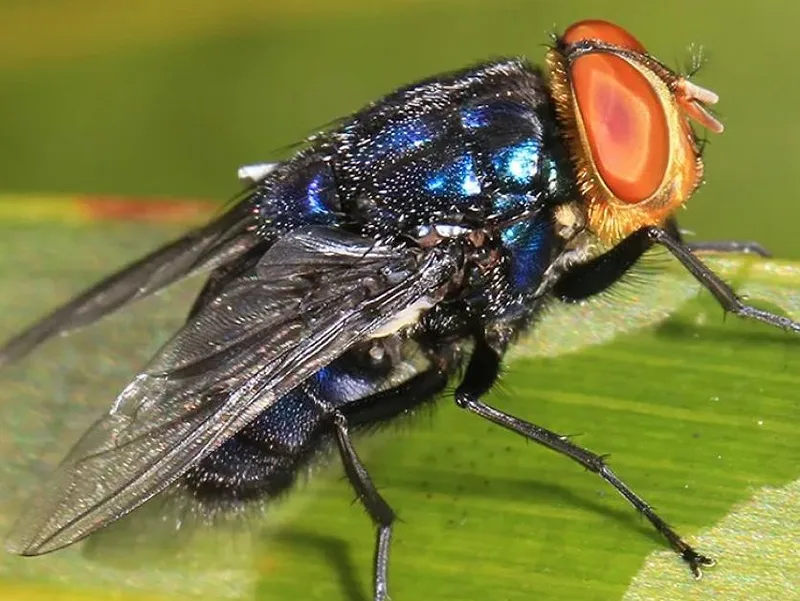
Female New World screwworms find wounds on living, warm-blooded animals to lay their eggs. When the eggs hatch, the larvae begin eating at the animal’s living flesh, said Edward Burgess, an assistant professor of veterinary entomology at the University of Florida. Rows of something akin to “stiff hair” wrap around their body, helping them move through the living tissue like a screw as they’re feeding, he said.
Female screwworms can lay between 200 and 300 eggs in a single sitting, and eggs can hatch within a few hours of being laid, Burgess said. It can take a few days to a week for the larvae to finish feeding, climb out of the wound, and burrow into the soil where they surround themselves with a dark-brown, cocoon-like shell, and metamorphose into a fly. As infected animals' wounds worsen, additional female flies are drawn in by the scent.
“The problem is that when the wound starts to expand, it starts to smell really bad and as that smell kind of amplifies, it attracts other females to the wound, where they then lay their eggs,” Burgess said. “So you get this overlapping generation of multiple females’ larvae that turn into this really big problem.”
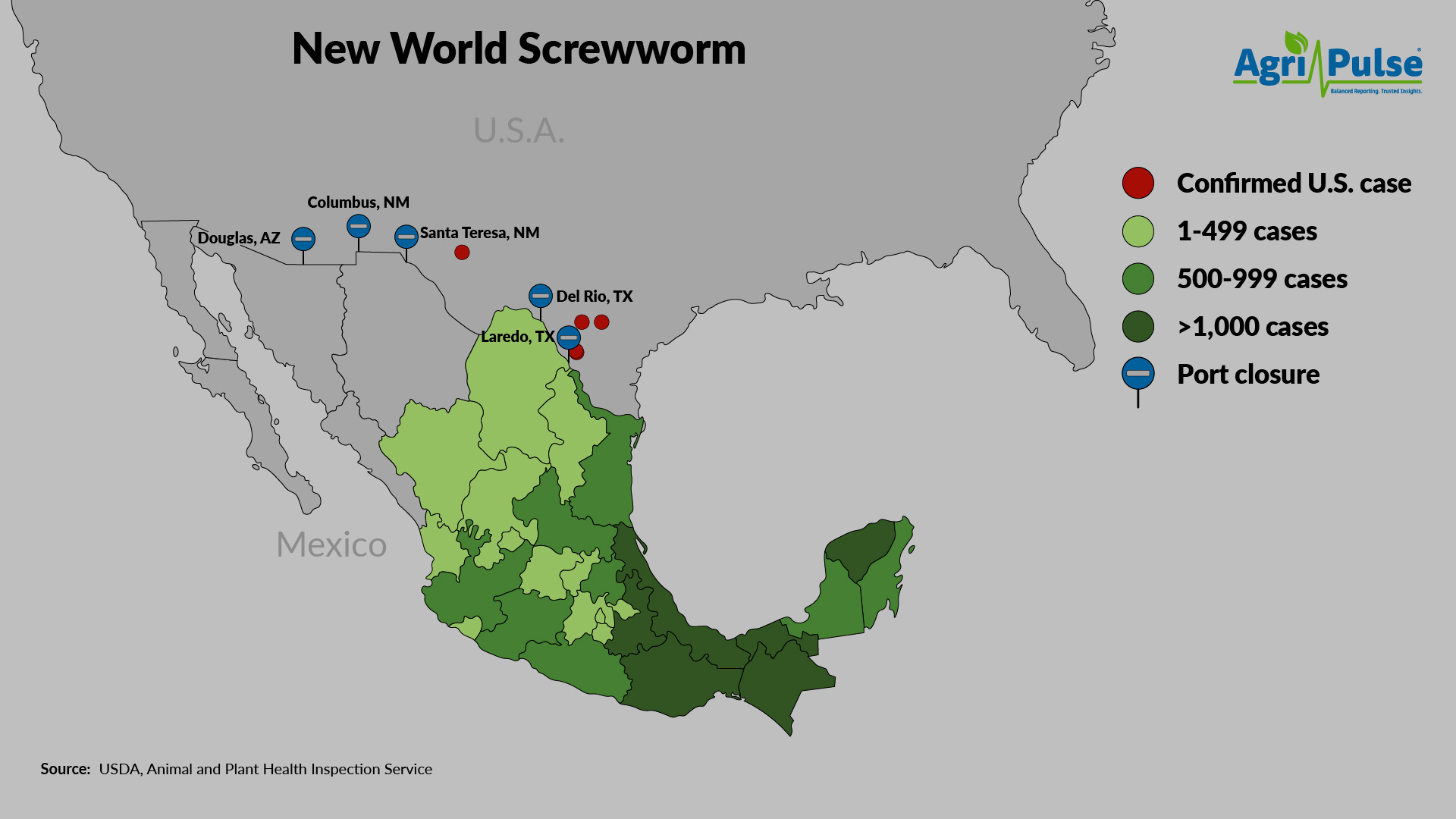
The pest was widely considered to be eradicated from the U.S. by 1966, though it re-emerged in the Southwestern U.S. for a few years in the late 1970s, according to a report from the United Nations Food and Agriculture Organization. After that, it was driven off U.S. soil until 2016, when an outbreak in the Florida Keys infested local deer before officials stamped it out.
However, it never disappeared from Latin America, and in recent years, has been pushing steadily northward through Central America and Mexico. It arrived in the U.S. earlier this week, as USDA officials last Wednesday confirmed a case in a 3-week-old calf near La Pryor, and has since been detected in three other calves and a goat from Texas, and a dog from New Mexico.
 Scott Hutchins (USDA photo)
USDA Undersecretary for Research, Education and Economics Scott Hutchins, said at the Monday press conference that USDA is working to develop a fly production process called NovoFly that would allow it to produce only male sterile flies, potentially doubling the number of flies that can be used for treatments. Female flies mate only once in their lifespan, making the development of male sterile flies important for ensuring wild females do not produce larvae.
“It’s going to give us a tremendous edge,” he said of the approach.
He also said with the help of artificial intelligence, the agency is developing “very precise modeling techniques for the fly and its movement” to help identify where to drop flies.
Fred Gingrich, the executive director of the American Association of Bovine Practitioners, told Agri-Pulse that the screwworm’s arrival in the U.S. was not a surprise, noting its steady movement upward through Mexico in recent years. The fly’s spread is generally tied to the movement of animals and while it typically doesn’t fly “great distances” on its own, it can travel a few miles once in a region, he said.
“As we’ve known that screwworm was south of our border for almost two years, we’ve had a lot of time to prepare,” said U.S. Cattlemen’s Association President Justin Tupper. “I think most people that were in the industry believed it wasn’t ‘if’ it was going to get here, but ‘when,’ and so I think there’s been a lot of preparation in that sense.”
The Food and Drug Administration has so far granted conditional approvals for three products intended to prevent and treat NWS infestations, and emergency use authorizations for another nine, according to the agency’s website. Some of these products are injectable, while others are topical or oral. Each product has its own rules for use and can only be used on specific species.
Cut through the clutter! We deliver the news you need to stay informed about farm, food and rural issues. Sign up for a FREE month of Agri-Pulse here.
Ellen Hart, vice president of regulatory and international affairs at the Animal Health Institute, said the availability of these products is the result of work that both drug manufacturers and FDA began a year ago in preparation for the pest’s arrival. That effort is “paying dividends now that we have detections in the United States,” she added.
Hart stressed that producers and veterinarians should always follow the directions on the label, and ensure “appropriate,” “targeted,” and “judicious” use of the products, noting that improper use or overuse heighten the risk of screwworms developing resistance to the drugs. She called them “a tool in our toolbox to help control the spread” of screwworm, but emphasized that sterile fly treatments, biosecurity and inspections are also key to halting the pest's spread.
“I think we should be really clear that sterile flies are the way we will eradicate this — hard stop,” Hart said.
APHIS’s Schmoyer said USDA, FDA and the Texas Parks and Wildlife Department are exploring the possibility of using ivermectin in feed to help prevent cases in wildlife.
Texas Agriculture Commissioner Sid Miller has been advocating for the use of insecticide-laced fly baits to control the pests, a method that has been used in past outbreaks. However, Hutchins said during a press call last week that these bait products are not able to be registered with the Environmental Protection Agency and include ingredients that are “no longer really viable to utilize anymore.” He said the agency is working to develop its own version focused specifically on screwworm “without any collateral impact to the environment.”
Economists expect limited market fallout from screwworm, but added costs for ranchers
Oklahoma State University Economist Derrell Peel said most of the economic impacts of the disease are going to appear in the form of labor and treatments, noting that ranchers in impacted areas are going to need to check their herds daily for signs of infection or risk their livestock dying a “slow, horrible, agonizing death.”
He said the labor supply on ranches is now generally tighter than when U.S. producers last faced the fly, making the labor costs particularly significant for producers.
However, since infections are highly treatable and don’t impact food safety, Peel doesn’t expect it to have much impact on beef markets more broadly, so long as consumers keep buying beef.
“I don’t think it has a lot of economic impacts, as far as markets, broadly speaking,” Peel said. "But it will have economic impacts in the sense that it’s going to be an extremely costly, difficult management issue for everybody that’s involved to deal with.”
Similarly, Mississippi State University Economist Josh Maples said screwworm is “not something we should expect to meaningfully reduce the supply of cattle,” noting that it can be managed, though “it's costly and time-consuming to do so.”
While screwworms are capable of killing individual animals, the pest's targets are often "just a single, isolated animal" rather than an entire herd, Gingrich noted.
A USDA analysis estimated that if a New World screwworm outbreak at 1976 levels would have occurred in Texas in 2024, it could have led to $732 million in losses for Texas producers and a $1.8 billion loss for the state’s economy. Nearly half of expected costs were associated with animal deaths, while 17% were associated with marketing losses, 13% with extra labor, and 10% with animal weight loss. The study assumed a U.S. beef herd the size of the one in 1976.
However, Rollins said in a press call last week that that study assumed “that we were going to be battling a full infestation, and that we were going to have to completely stop all movement [and] processing of any of our Texas cattle for a long period of time.”
“There is nothing right now that tells us that any of that will actually be the case in this instance," Rollins said in the call Thursday, adding that she was “very confident" the agency would be able to pick off the infections one by one. “The cattle industry in Texas is strong and vibrant — this should not affect it much moving forward, at least from what we’re seeing right now.”
Farm Journal Foundation Policy Adviser Stephanie Mercier, who formerly served as team leader for the trade policy and programs area of USDA’s Economic Research Service and chief economist for the Democratic staff of the Senate Agriculture Committee, noted in an interview that even if the USDA’s estimates are out of date, the beef cattle sector is a $15 billion industry in Texas, and “a $1.8 billion hit on that is not a small blow, and it could be even greater depending on whether they can contain it within Texas.”
Nationally, the U.S. cattle industry produces around $96 billion worth of beef every year, she added in a follow-up email.
When combined with drought pressures already impacting producers in some parts of the country, added costs from monitoring for and treating screwworm may dissuade some from moving forward with herd expansion plans, Maples said. Agriculture Department estimates earlier this year put the U.S. beef herd at a low not seen since 1951, a driver of heightened beef prices amid strong consumer demand for the meat.
 Josh Maples (Mississippi State University photo)
USDA estimated the number of cows and heifers that have calved at 37.2 million head in January, a slight decrease from 37.3 million a year earlier. The agency estimated beef cows at 27.6 million head, a 1% drop from the year prior.
“We’re at a point in the cattle cycle right now where everybody’s looking for signals that we’re keeping back more heifers and trying to produce more calves, and screwworm makes it more costly,” Maples said. “It increases production cost and is just flat out another headwind to expansion efforts in Texas, in particular.”
In the wake of last week’s detections, Canada implemented temporary restrictions on livestock from areas of the U.S. impacted by the fly. Peel said Canada imports a limited amount of cattle from the U.S. and that the impacts of these restrictions may be more noticeable in the U.S. horse industry.
Canada imported 492,214 total U.S. cattle in 2025, roughly 97% of total U.S. cattle exports that year, according to Economic Research Service statistics. And it imported 99,170 U.S. hogs, only around 7% of U.S. hog exports.
Meanwhile, U.S. Census Bureau trade data indicates that Canada imported $13.8 million worth of live horses, asses and mules from the U.S. in 2025, roughly 58% of the overall value of U.S. exports in that category.
Mercier said she “wouldn’t be surprised” if other countries attempted to impose such bans. While these may have a limited impact on the beef industry since low U.S. cattle inventories have likely already limited sales to other countries, she said that “those are still lucrative markets for us, and I’m sure our cattle producers would rather not lose them.”
Even the threat of losing access to Canadian markets has producers in some states concerned. Montana Farmers Union President Walter Schweitzer said Canada is a significant market for Montana feeder calves. He worries the horses of Montana rodeo cowboys who travel to Texas for events may accidentally carry the pest northward, or that it might hitchhike through pets or other livestock.
“I’m really concerned here in Montana,” Schweitzer said, adding that if someone shows up in the state with an infected horse, dog, cow or other animal, "We would not be able to sell feeder calves into Canada. They'd shut the border in a moment and then we'd really be stuck."

