

|
The Central Valley Regional Water Quality Control Board’s first nitrate management zone order is setting up a long-term test for farm communities around Modesto. At issue is whether the agency can protect rural residents from contaminated drinking water while giving agriculture, dairies, cities and food processors enough time to reduce the nitrate loading that has built up in groundwater over generations.
The board this month approved the Modesto Management Zone Implementation Plan, launching enforceable timelines for drinking water assistance, well testing, nitrate reductions and groundwater restoration. The order applies to a broad set of nitrate dischargers in the Modesto groundwater basin, spanning irrigated agriculture, dairies, cities, and poultry and cattle operations. It also sets a precedent for other priority management zones across the Central Valley.
The decision carries two immediate consequences for agricultural communities. Rural households with nitrate-tainted domestic wells are supposed to continue receiving free drinking water support, while farmers and dairies enter a 35-year compliance pathway that will require major changes in nutrient management, manure handling, monitoring and reporting.
Bob Ditto, who manages the board’s nitrate control program, described the Modesto order as first of its kind and said it starts a timeline that grants the dischargers some relief from strict nitrate water quality objectives while they carry out required milestones.
 Ryan Flaherty, Sustainable Conservation (LinkedIn photo)
The order is part of the broader CV-SALTS nitrate control program, which was designed to address one of the Central Valley’s most persistent water quality problems. Nitrate contamination is especially acute in rural, groundwater-dependent areas, where many households rely on private wells and lack access to public water systems.
The Modesto Management Zone is administered by the Valley Water Collaborative, which also oversees the Turlock zone. Under the management zone model, dischargers share responsibility for well testing, bottled water, treatment systems, public fill stations, outreach, nitrate reduction planning and long-term drinking water solutions. The alternative would be for permittees to comply individually under stricter regulatory requirements.
Board staff said the Modesto program has already tested more than 1,500 wells, provided drinking water to more than 1,000 households and held 876 meetings and outreach events over the past four years. The new order requires the management zone to complete an inventory of domestic wells within one year, offer testing to all domestic wells within five years, and install at least one public water fill station during the first year.
The plan also requires long-term drinking water work to begin moving beyond bottled water. The management zone must submit a long-term drinking water evaluation work plan within two years and a full implementation plan within five years. It must offer long-term solutions to 20% of impacted domestic wells by Year 6 and 100% by Year 18. Those solutions could include in-home treatment, consolidation with public water systems or centralized treatment projects.
Agriculture argues certainty is needed to make changes
Agricultural groups and local agencies reason that the management zone approach gives rural areas the best chance to address nitrate contamination without overwhelming individual farms, dairies or small public agencies.
Cut through the clutter! We deliver the news you need to stay informed about farm, food and rural issues. Sign up for a FREE month of Agri-Pulse here.
Ben Koehler, chief plant operator for Modesto’s regional recycled water facility and a Valley Water Collaborative board member, said the framework gives local agencies and dischargers a coordinated way to respond.
“The management zone brings together municipalities, irrigated agriculture, dairies and other dischargers under shared implementation structure,” explained Koehler.
Sustainable Conservation also backed the approach, saying the order is needed to give both communities and farmers certainty. Ryan Flaherty, who leads the group’s efforts to reduce nitrate leaching, said growers and industries need clear requirements before they can make investments in nutrient management and new practices.
“We need approval to start timelines,” said Flaherty. “We need approval to give farmers and industry certainty about where to make investments and to give communities certainty about the path towards clean drinking water.”
For dairies, the order sets up one of the most difficult compliance challenges. Full-coverage dairies receive 35-year nitrate exceptions, but dairy advocates stressed to the board the long timeline does not mean waiting decades to act. They said dairies are already collecting water, manure, forage and soil data, filing nutrient management reports, and contributing to drinking water programs.
Denise Mullinax, executive director of the California Dairy Research Foundation and assistant director of the California Dairy Quality Assurance Program, said the state’s dairy industry has changed dramatically since the board adopted its original order in 2007. Dairies that once had little experience with water quality regulation now routinely sample, plan and report, she said.
But Mullinax said the next stage will require new research, field testing and financing. Her organization is funding work on manure water automation, alternative forages that remove nitrogen from soils, and manure treatment technologies like vermifiltration.
“Based on my experience in research and education, I would say we are going to need the full 35 years to be successful,” said Mullinax.
Paul Sousa, who directs environmental services at Western United Dairies, said management zones should be viewed as accelerating progress, not delaying it. He said dairy families are already contributing to drinking water programs and adopting new practices despite difficult economics.
“Thirty-five years does not mean a lack of progress,” said Sousa. “We are already working hard, but we have a long way to go.”
The order lands at a difficult moment for farm communities. Lynne McBride, executive director of the California Dairy Campaign, noted that many dairy farmers are receiving net prices well below their cost of production. Noelle Cremers, who directs regulatory and environmental affairs at the Wine Institute, pointed out that the wine sector is struggling with declining demand, the smallest grape crush since the mid-1990s and the loss of access to Canadian shelves for U.S. alcohol.
California produces 85% of U.S. wine and 95% of the nation’s wine exports, with the Central Valley producing more than 70% of the grapes used in California wine. Despite the industry’s economic pressure, Cremers said the order was the most reasonable approach.
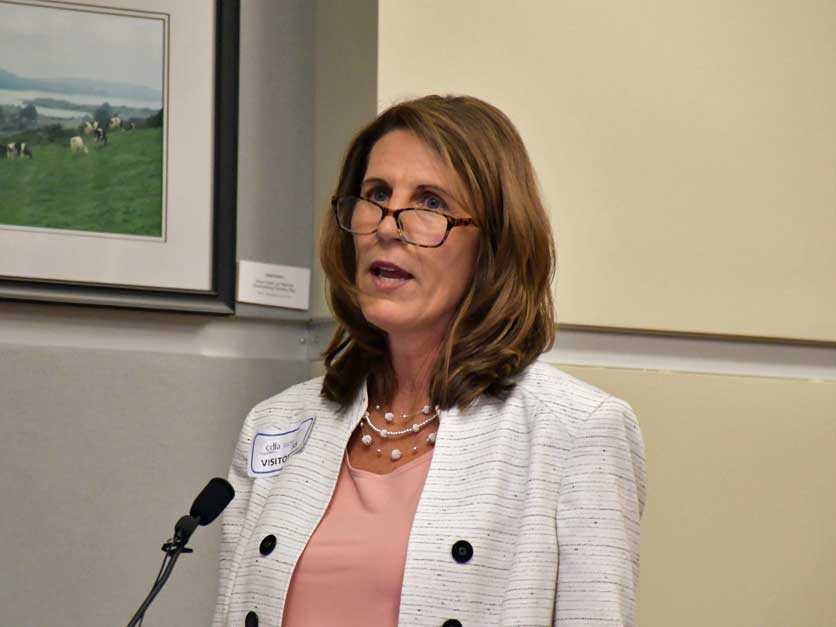 Denise Mullinax, California Dairy Research Foundation (Brad Hooker/Agri-Pulse)
Communities press for faster drinking water solutions
Environmental justice advocates and rural residents argued the order asks for too much patience from people who cannot drink their well water.
Kjia Rivers, a senior policy advocate at the Community Water Center, described nitrate contamination as “a very serious problem that is disproportionately impacting communities of color.” An environmental justice coalition encompassing the water center along with Clean Water Action and the Leadership Counsel for Justice & Accountability, along with local residents, pressed the board for shorter deadlines, stricter language on restoring aquifers and clearer funding obligations.
Advocates argued the board should require the management zone to fund long-term drinking water solutions regardless of whether public funding is available. They also called for more frequent community meetings, stronger compliance milestones, and clearer requirements to ensure restoration work moves beyond planning and modeling.
Jennifer Clary, who directs the California branch of Clean Water Action, argued the order should require at least one field-based pilot project and recurring restoration updates. Corinne Gibson, an attorney at Leadership Counsel, warned that township-scale averages could hide local hotspots and said dischargers need individualized compliance milestones.
Several community advocates came from outside the Modesto zone but said the same issues exist across the valley.
Esteban Curiel, who hails from Woodville and advocates alongside the water center, compared delayed drinking water solutions to a patient waiting for cancer treatment, who is continually told the treatment will be delayed. His partner, Martha Curiel, pressed the board to shorten the timeline, arguing she did not think their “grandchildren will be around to see when our water is finally clean.”
Board member Sean Yang, a medical specialist in Sacramento, described the environmental justice testimony as “raw” and “real” and urged the management zones to move quickly with bottled water and other services for seniors, disabled residents and families without resources. Board member Denise Kadara, a water leader from Allensworth, pressed for stronger engagement with the community and a possible hotline or better use of the CalEPA complaint system so residents do not have to wait for formal reviews to raise concerns.
Executive Officer Patrick Pulupa emphasized that staff can bring issues back to the board before the five-year review if needed. He cautioned that the board is trying to manage a program in which timelines may feel far too fast to some dischargers and “abysmally too slow” to communities still waiting for safe water.
Chair Nicholas Avdis said the board had reached the point where implementation needs to begin. Even if current discharges stopped immediately, he warned, nitrate already in the aquifer would remain a problem for years.
“At the end of the day, we’ve got to do something,” said Avdis.

