
|
As debate ramps up nationwide over the impacts of data centers — particularly in rural areas — California legislators may impose strict controls on how new ones would operate in the state and who would pay to power them.
Senate Bills 886 and 887, authored by Sen. Steve Padilla, D-San Diego, aim to mitigate the massive energy, water and financial burdens that large data centers place on communities and utility ratepayers.
SB 886 would require the Public Utilities Commission to charge builders an electrical corporation tariff to cover transmission hookups to new projects so other ratepayers won’t end up with the bill, while SB 887 would ease California Environmental Quality Act approval for projects that use recycled water and clean on-site energy storage and pay their full infrastructure costs.
The legislation is cosponsored by The Utility Reform Network (TURN), a ratepayer advocacy group, and Net-Zero California, an environmental group.
“It would be an incredibly high bar for them to meet,” Adria Tinnin, TURN’s director of race equity and legislative policy, said during a panel discussion on data centers June 2 at the Agri-Pulse Food and Ag Issues Summit West in Sacramento. “Hopefully what we’re trying to do is incentivize the data centers that do choose to come to California to not harm the rest of us and to be good actors.”
The two bills passed the Senate on May 26 and moved to the Assembly, where SB 887 will be heard in the Natural Resources Committee on June 22 and SB 886 will go before the Utilities and Energy Committee on June 24.
A coalition of technology, manufacturing and business associations oppose the legislation – particularly SB 886, arguing it is unnecessary and may negatively impact economic development and decarbonization goals. Among SB 886’s critics is Pacific Gas & Electric Co., which has about 5.3 gigawatts of data center projects in its pipeline – enough electricity to power nearly 4 million homes, utility spokesman Fred Han said. Of that, 4.6 GW are in the final design stage before construction, he told Agri-Pulse.
Cut through the clutter! We deliver the news you need to stay informed about farm, food and rural issues. Sign up for a FREE month of Agri-Pulse here.
As written, SB 886 “would introduce rigid, duplicative requirements that conflict with existing regulatory processes, risk higher costs for customers, and delay critical infrastructure needed to serve California’s growing energy demand,” Han said in an email.
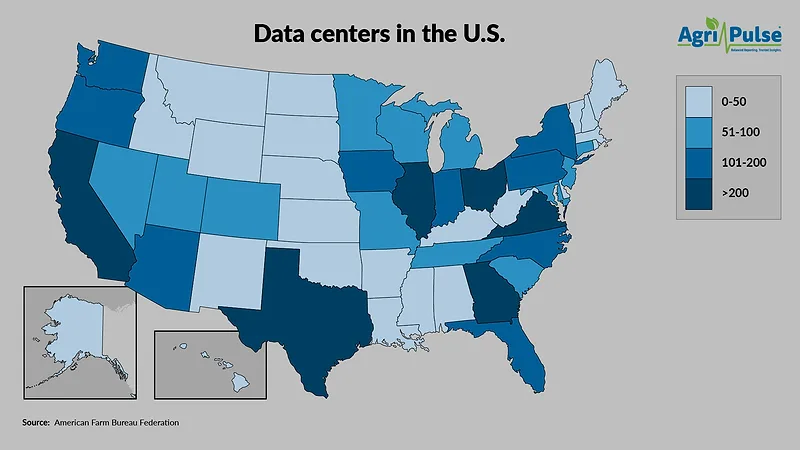
The legislation comes as the rapid growth of artificial intelligence and high-capacity cloud computing is accelerating data center development nationwide, with capacity expected to grow by about 33% annually through 2030, according to a primer from the National Association of Counties.
This trend presents both opportunity and risk for agriculture, the American Farm Bureau Federation noted in an April report. Data centers can compete with ag for land, water and energy, but farms also increasingly depend on the digital infrastructure the centers provide, the report stated.
“From NACo’s perspective, data centers might really work for you in your community or they might not,” said Ashleigh Holand, the organization’s chief program officer. Eryn Hurley, NACo’s chief government affairs officer, added the organization seeks to protect local authority to regulate or ban the centers.
“Land use and zoning are local functions, and counties have exercised this authority for decades,” Hurley told Agri-Pulse.
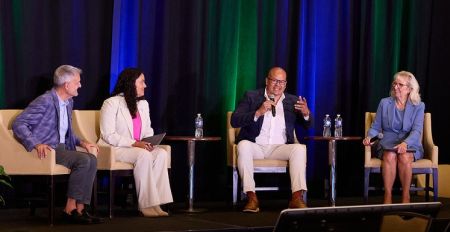 Data center panel discussion at the 2026 Food & Ag Issues Summit. From left: Michael Boccadoro, Agricultural Energy Consumers Association; Adria Tinnin, The Utility Reform Network; José Atilio Hernández, Little Hoover Commission; and Sara Wyant, Agri-Pulse. (Agri-Pulse photo)
In March, California’s Little Hoover Commission, an independent government watchdog, made 15 recommendations for accommodating data center growth without increasing costs for ratepayers or undermining clean-energy goals. The first was to develop a “stable regulatory framework” that makes sure costs associated with new large-load development are fairly allocated.
“In a perfect world, if more people are connected, it will bring down the infrastructure costs,” Commissioner Jose Atilio Hernandez said at the Agri-Pulse summit, noting that the grid would need to be expanded even without data centers. “Why not take advantage of a large customer that will pay the cost of our infrastructure?”
For PG&E, most of the data center-driven demand growth is in the Bay Area and Silicon Valley, where existing technology and one of the nation’s cleanest power grids make it a natural fit, Han said. But the utility is also seeing growing interest in the Central Valley and Sacramento region, he said.
Unless the Legislature sets guidelines, “this is going to be particularly impactful for our farmers and ranchers,” TURN’s Tinnin said.
