
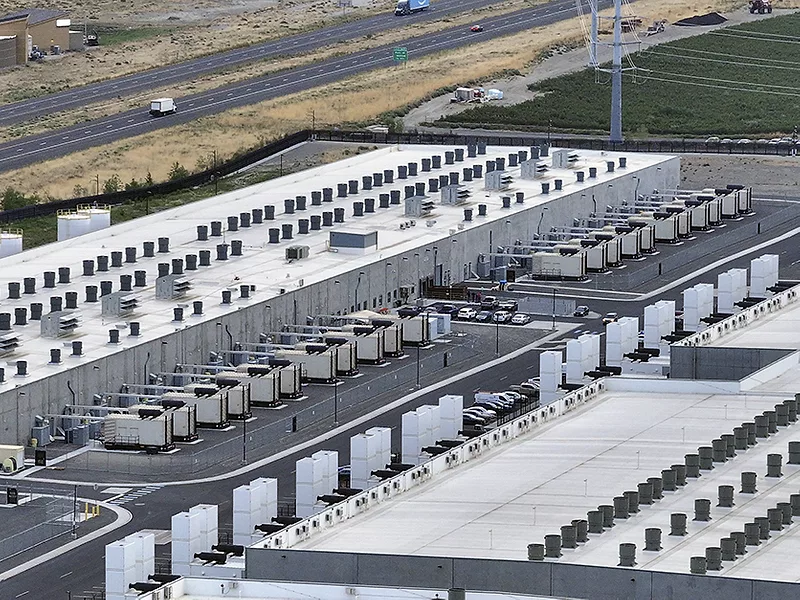
- Data centers are rapidly increasing demand for electricity and water, putting agricultural ratepayers on alert.
- Farmers are criticizing large investor-owned utilities for profiting from large data center investments.
- Lawmakers are considering safeguards to prevent cost shifts.
The rapid push to accommodate data centers powering artificial intelligence and cloud computing is forcing lawmakers, regulators and utilities to confront a central question for agriculture: Who pays when electricity and water systems are pushed to their limits?
Regulators and industry experts are acknowledging that while data centers promise economic growth and technological leadership, their unprecedented energy and water demands could shift costs onto existing ratepayers — including farmers, food processors and other energy-intensive agricultural businesses — if not carefully managed.
New policy discussions on the issue paint a picture of extraordinary uncertainty around how fast data centers will grow, how much electricity and water they will ultimately consume, and whether current regulatory frameworks are adequate to protect ratepayers.
Unprecedented load growth meets an already expensive grid
For decades, utilities planned around flat or modest electricity demand growth. That era is ending. Data centers alone are projected to drive thousands of megawatts of new demand, much of it operating around the clock.
The California Energy Commission has already received requests totaling nearly 18 gigawatts of new data center load — nearly 40% of the state’s current peak demand. While many of those projects remain speculative, even a fraction coming online would require major investments in generation, transmission and distribution infrastructure.
 Michael Boccadoro, Agricultural Energy Consumers Association (Fred Greaves/Agri-Pulse)
Those investments raise immediate concerns for the state’s agricultural energy users, who already face some of the highest electricity rates in the nation. Irrigation pumping, cold storage, food processing and on-farm electrification leave growers particularly exposed to changes in rate design and cost allocation.
Michael Boccadoro, executive director of the Agricultural Energy Consumers Association, warned state lawmakers during an informational hearing last week that data center expansion risks repeating past mistakes where infrastructure costs were socialized across all ratepayers.
“I have a lot of confidence in what I heard from Silicon Valley Power,” said Boccadoro, praising the municipal utility’s local accountability. “I have zero confidence in PG&E being able to deliver on ratepayer savings.”
Boccadoro drew a sharp contrast between locally owned utilities and investor-owned utilities, arguing that shareholder incentives can skew decision-making.
“There’s a big difference between that investor-owned utility and that locally owned utility, and that is a profit motive,” he said. “PG&E is gung ho for data centers in their service territory … for massive capital investment and massive additional profits for shareholders.”
Even modest increases can be consequential for agriculture. Unlike some industrial users, farms cannot easily shift irrigation or processing loads away from peak periods without affecting crops, labor schedules or food safety.
Boccadoro explained that the agriculture community is particularly sensitive since its footprint is shrinking in California. Studies have shown the implementation of the Sustainable Groundwater Management Act could take up to a million acres out of production, meaning each farmer will take on a greater share of the infrastructure and energy costs for building out the data centers.
According to Nate Gleason, who leads research into cyber and infrastructure resilience at Lawrence Livermore National Laboratory, U.S. data centers accounted for 4.4% of the total electricity use in 2024 and could reach between 6.7% and 12% by 2028, with California facing some of the steepest growth.
The professional association Infrastructure Masons found that in 2024 alone around 50 gigawatts of new data center capacity was added globally — “roughly the entire electricity demand of California during its hottest, most stressed hours.” That year data centers in the U.S. used about 200 terawatt-hours, which is enough to power Thailand for a year.
The growth of large data center facilities in rural regions has posed a threat to agriculture as well. Last month the American Farm Bureau Federation approved a new internal policy calling for the “responsible development of data centers, server facilities and other similar facilities in rural communities, recognizing their potential economic benefits while prioritizing responsible stewardship of local resources and respect for private property rights.”
The policy also calls for the implementation of large load tariff rates to ensure data centers “are paying their fair share for energy” and that residential and agricultural electrical usage demands are prioritized.
Data centers pose another unique challenge, in that their loads can ramp up or down rapidly and are not tied to predictable factors like weather, according to Gleason. They can also be built and pull power in a fraction of the time needed for traditional large power-consuming facilities.
“Data centers can be built in 18 months and consume hundreds of megawatts, the equivalent of over half a million households,” he said, while transmission lines and power plants can take a decade to permit and construct.
That uncertainty presents a planning dilemma. Overbuilding transmission and generation risks leaving ratepayers on the hook for stranded assets if projected data centers never materialize. Underbuilding risks price spikes and reliability threats during extreme heat events, explained Karin Hieta, a program manager at the Public Advocates Office, an independent consumer watchdog housed at the California Public Utilities Commission.
Data center advocates argue that large new loads could lower rates over time by spreading fixed grid costs across more electricity sales. Mike Medeiros, vice president of strategic commercial solutions at PG&E, pointed to analyses suggesting that each additional gigawatt of load could reduce average residential bills by about 1% over a decade.
The California Business Roundtable also defended data centers, arguing in a letter to lawmakers that the state’s electricity prices are high regardless of data center growth and that data centers represent a relatively small share of the total demand and are increasingly energy-efficient.
State regulators said they are exploring new planning tools, including flexible service connections and demand response programs that would allow data centers to curtail load during peak periods. They also warned that such flexibility often relies on backup generators, raising air quality concerns that threaten the state’s climate goals while doing little to reduce overall system costs.
Water: the hidden cost driver
While electricity dominates the conversation, water impacts are emerging as a parallel concern —with direct implications for agriculture.
Current estimates put direct water use by data centers in California at roughly 2,000 acre-feet per year, a modest figure compared to agriculture, explained Kelly Sanders, an associate professor in civil and environmental engineering at the University of Southern California. Speaking at the annual conference for the California Irrigation Institute last week in Sacramento, Sanders cautioned that individual facilities could consume far more. Three proposed data centers in San Jose alone are projected to use about 3,500 acre-feet annually, exceeding statewide estimates and highlighting the uncertainty surrounding existing data.
The largest water footprint associated with data centers may be indirect. Data centers require enormous amounts of electricity, and power plants — particularly natural gas and nuclear facilities — consume substantial water for cooling. In some cases, the water needed to cool power plants serving data centers could be 10 to 18 times greater than the water used on-site, said Sanders.
Scientists at the University of California, Riverside, have found that each 100-word AI prompt is estimated to use roughly one bottle of water. Other studies have shown that larger data centers use up to 5 million gallons per day, or about 1.8 billion annually, equivalent to a town of around 50,000 people.
California’s growing reliance on solar and wind power helps limit that indirect water use, since renewable generation requires little to no cooling water.
“The tricky news for California is wind and solar also happen to be where electricity tends to be very cheap from a wholesale perspective,” said Sanders, pointing to heavily agricultural districts like Fresno County.
The geographic overlap between renewable energy development and water scarcity complicates siting decisions. The state’s major solar development regions are in the Central Valley and the region encompassing the Imperial Valley, where water supplies are already stretched and agricultural users are facing tightening groundwater restrictions.
“If you look at this from a national or a statewide perspective, this water use looks quite small,” said Sanders. “But these individual facilities can really exacerbate existing water stress.”
A fundamental shift is underway in data center design that could add further stress. Traditional air-cooled facilities are giving way to liquid cooling systems as computing chips grow hotter and more densely packed, according to Jason Hick, a program director at Los Alamos National Laboratory. That transition makes water access increasingly central to future data center operations, particularly for artificial intelligence training and high-performance computing.
“By the mid 2030s it's not going to be just the niche [facilities] asking you for water,” Hick told the water managers. “It's going to be a discussion with Comcast, AT&T — whoever it is who's trying to deploy the average data center. They will all need water, and they don't today.”
 Kelly Sanders (USC photo)
Sanders noted that the absence of mandatory reporting requirements for data center water use makes it difficult for the state to track cumulative impacts or plan proactively. Sean Maguire, a civil engineer who serves on the State Water Resources Control Board, separately explained that data center water use is generally treated as industrial process water, which is excluded from California’s urban water use efficiency targets, a policy framework that, he said, limits the state’s visibility into how much water these facilities consume and complicates statewide conservation planning.
Transparency gaps persist
The lack of mandatory reporting on energy and water use has been a recurring theme. Without consistent data, regulators are forced to rely on estimates and utility interconnection requests that may not reflect actual operations. Last year state lawmakers faced mounting pressure to address the rapid expansion of data centers and filed bills aimed at shedding light on their impacts on energy costs and scarce water resources.
Assembly Bill 93, passed by the Legislature but vetoed by Gov. Gavin Newsom, would have required data centers to report water use to local suppliers. The climate and conservation groups backing the bill argued it would have improved planning and transparency, particularly in water-stressed regions. While Newsom recognized the unprecedented electricity demand, he argued the bill would “impose rigid reporting requirements … without understanding the full impact on businesses and the consumers of their technology.”
Similarly, Senate Bill 57 directs the California Public Utilities Commission to study whether data center energy costs could be shifted onto other ratepayers, including agricultural users. But the bill stops short of imposing new requirements, leaving policy decisions for future sessions.
The strain on energy, water and land has prompted Congress members to take action as well. Last year Reps. Jim Costa, D-Calif., and Blake Moore, R-Utah, pressed for a comprehensive federal study on how the explosive growth is affecting rural communities.
Some local governments have also stepped up to experiment with safeguards. As state lawmakers learned in the hearing, Santa Clara is requiring new data centers to use recycled water, while San Jose mandates energy and water reporting for large buildings. Municipal utilities like Silicon Valley Power have also structured data center growth to support system upgrades without raising rates for residents.
But most agricultural areas in California fall within investor-owned utility territories, where statewide policy decisions will determine how costs are allocated.
As California positions itself as a global hub for artificial intelligence, lawmakers acknowledged the stakes extend beyond technology. For agriculture, the concern is not whether data centers should be built, but whether their growth will come at the expense of affordable, reliable water and energy.
“We’re all in it together,” said Maguire, suggesting that data centers are not immune to drought or grid stress any more than farmers or cities are.

