
|
U.S. mushroom growers are making progress in persuading federal regulators that Canada's farms are undercutting them with what they say are subsidized, underpriced mushrooms.
In January, the U.S. International Trade Commission preliminarily found a reasonable indication that Canadian imports of fresh mushrooms are materially injuring American producers. The Commerce Department in May ruled preliminarily that the Canadian government subsidizes its mushroom industry and ordered that a 2.84% tariff be placed on Canadian fresh mushrooms generally, though it set different rates for a few individual companies.
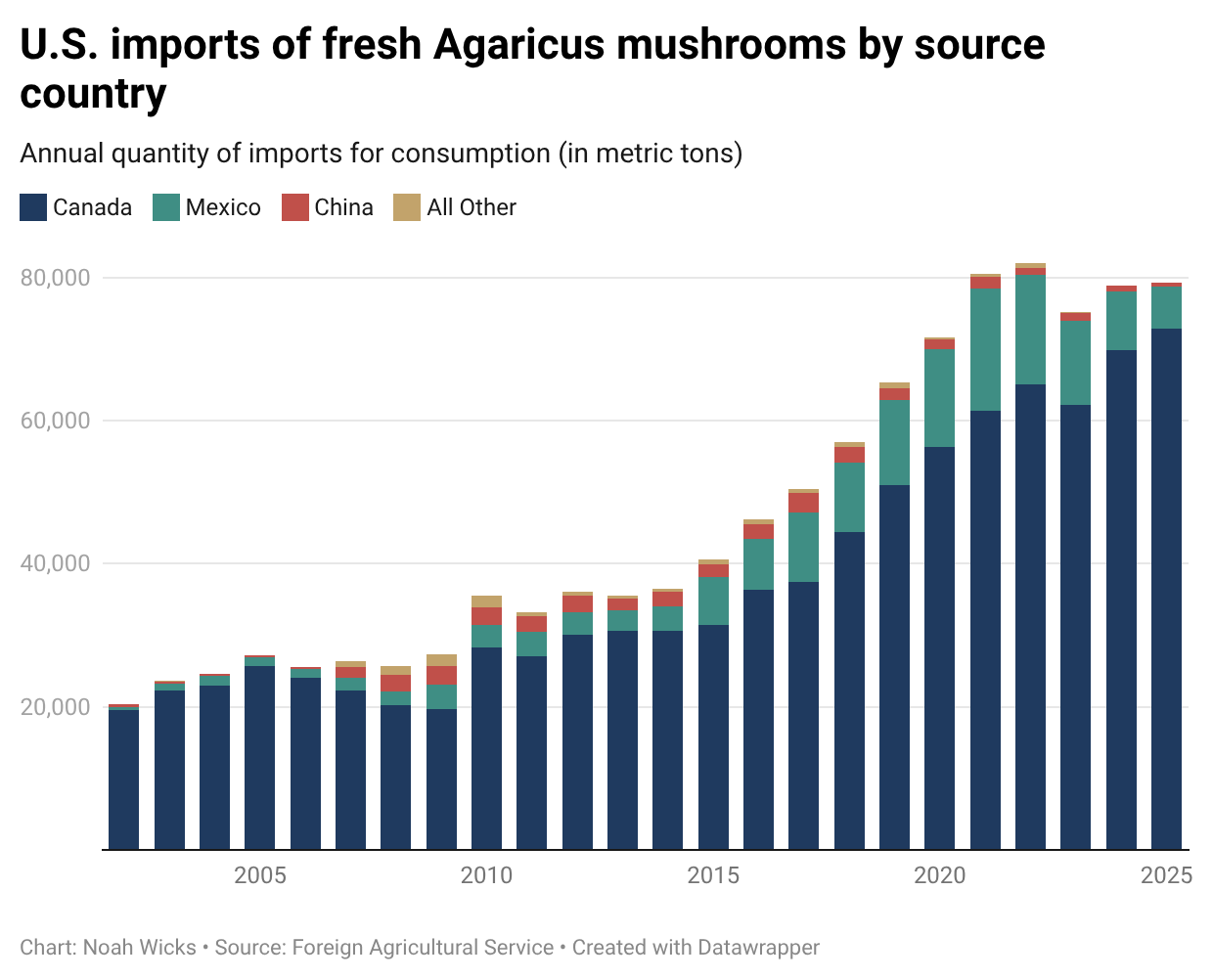
Canada accounted for roughly 90.8% of U.S. fresh mushroom imports between August 2024 and July 2025, and a coalition of U.S. growers alleged in a petition to federal trade regulators last September that those imports were taking sales from domestic producers and pushing down prices. These imports cover mushrooms of the genus Agaricus, which include button mushrooms, criminis, baby bellas, and portabellas.
The growers, all members of the Fresh Mushrooms Fair Trade Coalition, argued last fall that U.S. growers were being forced out of business, pointing to the closure of three facilities owned by the company Monterey Mushrooms. They leveled two accusations under U.S. trade law: that Canadian producers were selling mushrooms below their fair value, a practice known as dumping, and that they were propped up by subsidies from the Canadian government.
Cut through the clutter! We deliver the news you need to stay informed about farm, food and rural issues. Sign up for a FREE month of Agri-Pulse here.
Mushrooms Canada and the Government of Canada opposed the claims, saying the U.S. industry's troubles stem from other factors. One grower, South Mill Champs, suggested a roughly 10% decline in U.S. per-capita mushroom consumption since before the pandemic, according to a USITC report.
The U.S. growers' complaint set parallel investigations in motion — one at the U.S. International Trade Commission, which decides whether American producers are actually being harmed, and one at the Commerce Department, which calculates and imposes any duties. So far, Commerce has issued a preliminary determination setting 2.84% tariffs on Canadian fresh mushroom imports generally, though two individual suppliers were given their own rates: 1.62% for Champ’s Fresh Farms Inc., and 4.97% for Farmers Fresh Mushrooms.
Ryan Koeslag, the executive vice president and chief operating officer of Mushrooms Canada, believes the tariffs will be felt by consumers.
“Ultimately I think the consumers are going to be paying more for mushrooms, which is going to result in likely less mushrooms being sold, and the trickle down will impact Canada and the United States markets,” he told Agri-Pulse. “We'll just have to kind of recover from there after that becomes established.”
Commerce has yet to rule on whether the mushrooms are also being sold in the U.S. below fair value. It is expected to issue a decision on that by July 13.
U.S. mushroom producer frustrated by rising Canadian imports
Pat Jurgensmeyer, a mushroom farmer and president of J-M Farms in Oklahoma, estimates that around 10 years ago, Canada produced around 4% of all fresh pounds sold in the United States. Today, Canadian producers grow more than 20%, he said. According to market share data appended to U.S. growers’ original complaint, fresh mushroom imports grew from 143.4 million pounds in 2022 to 154 million pounds in 2024.
“It’s picking up exponentially,” Jurgensmeyer said of Canadian imports.
“Our share, meaning the U.S. growers, continues to get eroded,” Jurgensmeyer said of U.S. growers’ competitiveness. “And the Canadian has growth in their markets because of the unfair advantage that they have.”
Based on a “moderately high degree of substitutability" between U.S. and Canadian fresh mushrooms, “the importance of price (among other factors) in purchasing decisions," and "the preponderant evidence of subject import underselling,” USITC Chair Amy Karpel and Commissioners David Johanson and Jason Kearns found Canadian imports “significantly undersold the domestic-like product” during the review period. They wrote that “underselling” allowed Canadian imports to gain market share “at the expense of the domestic industry."
According to USITC’s preliminary investigation report, five of seven responding U.S. producers and four of seven responding U.S. importers reported overall U.S. demand for fresh mushrooms has steadily decreased since January 2022.
In testimony filed with USITC last November, former Giorgi Mushroom Company President David Carroll noted steady increases of Canadian imports for nearly a decade, but said these “have intensified in volume” over the last four years while U.S. market demand was declining. He said Giorgi and Monterey Mushrooms were forced to shutter a 77-growing room facility called Donna Bella Farms, and said his company has also had to cut back production by up to 20% seasonally between January 2022 and June 2025.
Carroll said current U.S. market conditions are “unsustainable,” and that “the difficulty of this situation has been magnified by our customers demanding lower prices to compete with Canadian imports."
 David Carroll (Penn State University photo)
"As a result, our financial condition — which has been far from healthy over the past four years — is now anemic, and we are struggling just to maintain a semblance of profitability,” Carroll said. "Without relief, we will be obliged to make additional difficult decisions that affect our operations and our workers.”
Ron Moule, CEO of Kennett Square Mushroom Operation, said in 2025 testimony that his company had to destroy “significant volumes of lower quality mushrooms for three straight years” amid a lack of demand for higher quality mushrooms that is forcing the company to sell its higher quality product at lower “soup grade prices” and destroy its lower-quality stock.
"We are an excellent mushroom grower, capable of supplying very large volumes of fresh Agaricus mushrooms for all sales channels. But when low-priced Canadian imports are taking market share from our packers, the injury is felt just as acutely at the grower level in lost sales volumes, lower prices, and in an inability to invest and advance our business,” he wrote.
Bryan Shelton, vice president of sales and marketing at Giorgio Fresh Co., a subsidiary of Giorgi, testified at a USITC conference in November that when faced with low-priced Canadian imports, Giorgi lost a significant percentage of business with one food service customer, was underbid by Ontario-based Highline Mushrooms for a cooperative’s business even after making a low-margin offer, and was told at one point that its prices were 15% too high despite offering bids that were “barely above break-even margins.”
“Over the past two years, in the instances that we have been awarded business, we have had to lower our prices or offer pricing that is at just above break-even levels,” he said during the conference. “We cannot continue down this path.”
Lewis Macleod, chief executive of South Mill Champs, which has locations in both the U.S. and Canada, testified last year that demand for fresh mushrooms in both the U.S. and Canada has fallen about 10 percent since before the pandemic, a decline that another witness, Justin McLean of Canada-based Farmers Fresh Mushrooms, attributed to higher food prices and tightened household budgets.
During that conference, Jurgensmeyer acknowledged that there had been “a little bit of a decline in demand,” but argued it was far smaller than the surge in Canadian imports.
Mushrooms Canada's Koeslag told Agri-Pulse fresh mushroom consumption has “really either stagnated or declined in market growth” amid inflation, which he believes has pushed U.S. mushroom growers to blame Canadian imports. While he noted that roughly 22% of American mushroom consumption right now is of Canadian mushrooms and acknowledged that U.S. mushroom imports from Canadian have increased over the past decade, he attributed Canadian growers' success to recent investments in technology upgrades and the development of new facilities.
Daniel Porter, a lawyer representing Canadian growers, argued during the conference last November that roughly 90% of Canadian production comes from automated "new-generation" farms versus about 25% in the U.S.
In a statement filed with USITC, Jose Cambon, the CEO of Canada-based Highline Mushrooms, argued U.S. mushroom farm closures were less likely a result of low-priced imports and instead were likely caused by “less competitive operating model, aging infrastructure, adverse weather conditions, increased costs for raw materials and labor, and decreased demand."
 Jose Cambon (LinkedIn photo)
“In our industry, some mushroom growers are still using old infrastructure to produce Model T mushrooms,” Cambon wrote. “But today’s customers and consumers expect the F-150 version of mushrooms, not the Model T, because Highline has innovated and invested to deliver them."
Canadian group warns of implications duty decision may have for agricultural tax incentives
Koeslag noted that the Commerce Department’s countervailing duty decision revolved around general farm tax exemptions and not necessarily programs specific to the mushroom industry. He said that if such tax exemptions start to be used as a reason to impose countervailing duties, “the United States and all areas of agriculture open themselves to a similar countervail action.”
According to a Commerce Department decision memorandum, the agency determined a British Columbia provincial sales tax exemption on farm machinery “constitutes a financial contribution in the form of revenue forgone.” It found the program countervailable because it is "limited to qualifying farmers" and applies only to specified farm equipment, goods, parts, and related services.
Prior to a December 2024 change to Commerce’s countervailing-duty regulations, the department only considered farm tax exemptions in such decisions if they were tailored to a specific commodity, but would not consider general tax exemptions, Koeslag said. He also said that many U.S. farm groups have long stood behind such farm tax exemptions on their side of the border.
“The fact that they named this as part of their investigation is, again, against American and Canadian business practices, so it’s worrisome that the United States government would be examining these well-established, well-used, and advocated-for programs as reasons for wanting to apply a duty to fresh mushrooms coming from Canada,” Koeslag said.
However, Jurgensmeyer pushed back, arguing the debate over general farm tax exemptions doesn’t change the validity of U.S. mushroom growers’ overall concerns about Canadian practices.
“From our perspective, right is right and wrong is wrong,” he said.

