
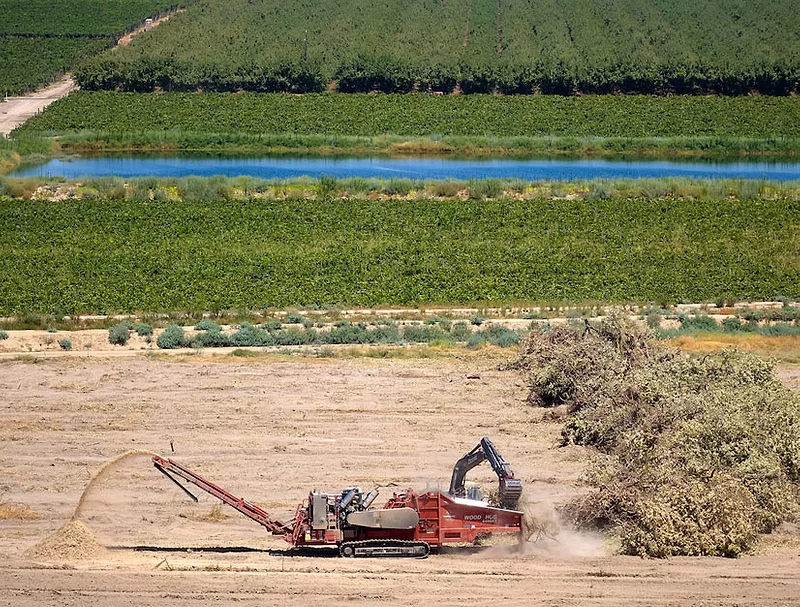
California could turn mounting pressure on agriculture — from groundwater restrictions, labor shortages and climate change — into new revenue streams by converting crop residues and other biological materials into energy, fertilizers and higher-value products, according to a collection of papers from University of California agricultural economists.
The special bioeconomy issue of the Giannini Foundation’s ARE Update argues that California, and particularly the San Joaquin Valley, is well positioned to develop a circular bioeconomy. Under that model, agricultural residues and other waste products become inputs for new industries rather than disposal burdens.
California generates about 54 million metric tons of biomass residue annually, including 10 million metric tons from agricultural waste, according to M. Anne Visser, a professor in community and regional development at UC Davis. The state is already turning nut hulls into livestock feed and converting food waste and dairy manure into renewable energy and fertilizer. But researchers see significant room for expansion there.
Visser argues the shift could help rural communities absorb some of the economic losses expected as the Sustainable Groundwater Management Act forces farms to reduce groundwater pumping, fallowing up to a million San Joaquin Valley acres.
Rather than viewing all of that acreage and agricultural residue as a loss, Visser writes that the valley could develop regional hubs producing renewable natural gas, biofertilizers, biochar, alternative proteins, pharmaceuticals and bioplastics. Precision agriculture, robotics and gene editing could also help producers use fewer inputs and make crop residues more suitable for industrial processing.
Robotic weeding systems, for example, can reduce herbicide use by as much as 95% and cut costs by more than half, according to the paper. Biotechnology could eventually alter the composition of almond shells, grape pomace and other residues to improve their value as feedstocks.
The transition faces substantial obstacles, however. Processing plants, aggregation sites and transportation systems remain limited outside pilot projects. Small producers often cannot afford conversion equipment, while overlapping requirements from CDFA, CalRecycle and the State Water Resources Control Board can discourage investment.
Cut through the clutter! We deliver the news you need to stay informed about farm, food and rural issues. Sign up for a FREE month of Agri-Pulse here.
Visser calls for consolidated permitting, shared processing facilities, community college training programs, and continued access to state and federal environmental credits.
A second paper offers almond shells as a practical example of how circularity could generate value. California produces about 875,500 tons of shells annually. Returning those shells to orchards at 4.5 tons per acre could treat nearly 195,000 acres, or about 14% of bearing almond acreage.
Researchers estimate the shells’ potassium and potential mulch benefits could generate $21 million to $31 million in annual surplus. That estimate does not subtract the purchase price of shells or the value of existing outlets such as animal bedding and biomass. Transportation is also critical, with the economics strongest for orchards near processors.
A third paper finds forestry has emerged as California’s leading source of job postings explicitly tied to the bioeconomy. Agriculture, forestry, fishing and hunting represented about one-quarter of identified postings in 2025, replacing manufacturing as the largest sector.
The authors conclude that realizing the bioeconomy’s potential will require coordinated investment in infrastructure, extension, workforce training and university-industry partnerships.

