
As USDA responds to the spread of New World screwworm in the U.S., federal food safety officials are also advancing a broader agenda that includes Salmonella reform, line-speed regulations, support for small meat processors and expanded use of Product of USA labeling.
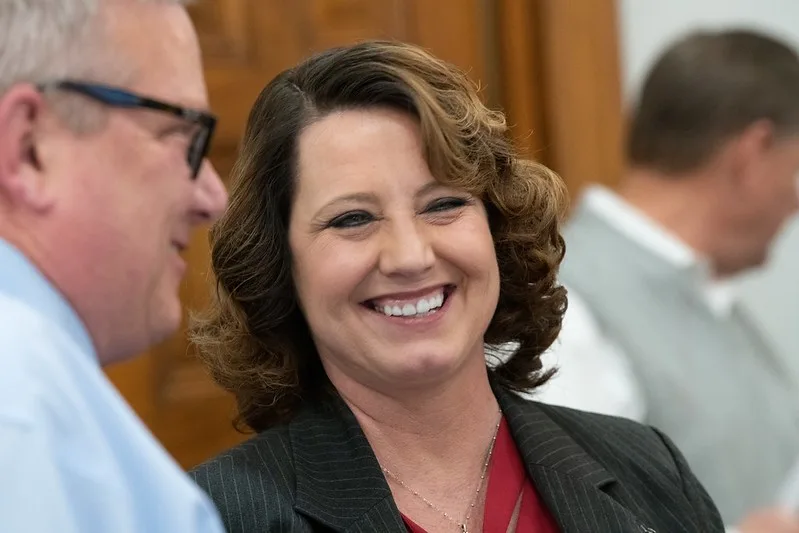
In an interview with Agri-Pulse Newsmakers, USDA Undersecretary for Food Safety Mindy Brashears said the department is mounting an “all‑of‑USDA effort” to address the screwworm outbreak with urgency while stressing that the parasitic fly does not pose a food safety risk. She also detailed plans to reshape the agency’s Salmonella strategy, bolster small and very small processing facilities, and finalize long‑debated line‑speed rules.
Brashears, who returned to USDA after serving in the first Trump administration and previously led the International Center for Food Industry Excellence at Texas Tech University, said her priority is building science-based policies that can withstand changes in administrations and deliver measurable public health improvements.
She opened the conversation by noting that New World screwworm can only survive on healthy, living tissue and does not threaten food safety. The following conversation has been edited for brevity.
Q: There's been a lot of concern and misinformation online about New World screwworm. What are you hearing that you’d like to set the record straight on?
A: One of the biggest things I saw on social media this morning was that there was a concern that there could be worms in your meat. That's absolutely not true. We are not going to see that in the meat.
We've been preparing for this at USDA since Day One in January of 2025. We have invested in research and putting people in place with expertise to be able to work on the containment identification. We invested in the Panama facility, bringing in sterile flies, rebuilding the facility in Mexico. We just opened a new facility in Texas where we'll have our own sterile fly facility. So there's been substantial investment.
We knew that it [New World screwworm] would eventually get to the U.S., but we slowed it down substantially. And now we're doing everything we can to mitigate it and push back.
Q: There are over 7,000 Food Safety Inspection Service inspectors across the country who focus on ensuring that meat and protein products are safe for the public to consume. Tell us about what that preparation looks like to make sure that the food supply chain stays safe.
A: Our FSIS inspectors are in the plants every day, and they will inspect every animal that comes into a facility. They've been trained to look for the signs of New World screwworm, if they see anything, it's not going to meet our antemortem inspection. They know what to do with that animal even if they find it after the animal was harvested. They know how to take care of any lesions to make sure that it doesn't spread. Then even after the fact, we have an inspection of the carcasses and all of the parts of the animals to make sure that our food supply when it reaches a consumer is safe.
Q: Do you and the USDA team have plans to make changes to that process as New World screwworm cases rise?
A: We are really on top of any new data and science that could come along. There has been some information out there about a fly attraction system that was used back in the 1970s. Well, the actual information about that is that that system was not very specific. It would attract all flies and kill them, including our sterile flies that are being released, and so we don't want that to happen.
We're working on developing a system that would only attract the females and flies that cause screwworms. So there's always going to be new information, new data, new science, and we will definitely align with the science and move that ahead and make changes as needed as new information comes out. ARS is also developing something called a NovoFly that is even more effective than our sterile flies. We're looking forward to the approval of that.
Q: USDA recently rolled out the small plant action plan. What impact will that have on the processing sector?
A: Of our inspected facilities, over 90% are small or very small, so we really want to focus on them to make sure that we're meeting their needs. We will be offering technical assistance to them through our inspectors. We will have better services through ‘Ask FSIS’ where if they have a question, there's a user-friendly website.
There has also been $20 million allocated to help supplement overtime hours. Most USDA inspections are free of charge, but if there's holiday time or overtime hours, then the small plant or any plant has to pay for that. We have a $20 million fund that can be used to offset those charges and reduce the rate for them. There's also an impact grant that was released through Rural Development that they can apply for, and this gives them opportunities to purchase equipment, make renovations, and other things that will make their business more profitable.
Q: How does this plan balance keeping the same high food safety standards while also supporting those smaller processors?
That's a great question because our larger plants have a lot of technical expertise. They have multiple Ph.D.s to address issues, but we want everything that we do to be scalable down to these small plants. We want to help connect them with university extension agents. Extension plays a major role in getting our technical information out to small plants and supporting that. We've been talking across the board with the Agricultural Research Service about the importance of having our food safety extension program strengthened so they have that information. Our individual inspectors will play a role in that, as well, to make sure that they can provide technical assistance.
Q: Salmonella oversight has been a big focus of FSIS. The proposed framework was withdrawn in 2024 but as you look to the future, how do you hope to reshape it?
A: Salmonella is really, in terms of food safety, my number one priority. We will be expanding beyond just chicken to all species – chicken, turkey, beef, pork – because they all play a role in Salmonella. We will be using data-driven decisions to identify the highly pathogenic Salmonella and looking at the highest risk for quantification, then finding out where the target areas are to have the biggest impact that will correspond back to our public health metrics and really reduce foodborne illness. I'm really excited.
Q: The line speed issue has also been a very big focus of FSIS. How do you hope to move the needle on that issue in your role?
A: I was in this role in the first Trump administration, and it's been around since that time. So I was very happy that we finally have proposed rules out on line speeds. And just to clarify, line speeds are informed by 20 years of data, so we have a lot of data to show that the efficiency of the process works in the industry and that our product is still safe.
Most of our facilities already operate at these line speeds under waivers, so the line speeds will codify that. Ultimately, at the end of the day this will correlate back to utilization of new technologies that are available, plus efficiency and affordability for the consumer. So we are very excited about this, and we'll be happy to get those final line speed rules out.
Q: The Trump administration has promoted "Product of USA" labeling and broadly encouraged products that are grown, raised, produced and processed here in the U.S. Does an increase to line speeds allow the U.S. to deliver more "Product of USA" food products to meet those goals?
A: Absolutely. Our counterparts around the world operate at much higher line speeds, especially in poultry, than we do, so we're just looking for a relatively small increase. You look at how they operate in Europe and other countries, and so we can actually prepare more product at a faster rate in the U.S., and produce it safely.
Q: Are there any other bottlenecks in the system that need to be corrected to produce more "Product of USA" items?
A: It's a challenge across the board. It's no secret that our cattle herds are at an all-time low. That's not just in the U.S.; that's around the world. We would like to have more beef that’s "Product of USA," which we have a lot. But we raise great cattle here. We have the best beef in the world and being able to get that herd size up and have incentives regarding our herd rebuild, that's going to be really important. It'll happen eventually, and once we get more cattle and more support of our small farms, small ranges, and small plants that service them, then we'll be able to have a bigger industry on that product.
Q: What do you hope to move the needle on the most, or what other priorities do you have during the rest of the Trump administration?
A: Well, there's all the foodborne pathogens. We have some big Listeria programs rolling out. E coli is always important as well as Campylobacter. We're always looking at the emerging pathogens. At the end of the day, it's a public health impact. We want to reduce the number of foodborne illnesses in the population, from beef, pork, and processed eggs. That's where we have our authority. As I roll through the next couple of years in this role, I'm going to be really focused on moving the needle there.
And also, just building the partnerships and relationships across government with the Centers for Disease Control, Food and Drug Administration and all the public health partners. I want a foundation, and if you leave a foundation here that is solid, science-based, and data-driven, then whoever comes behind us can build on that.

