
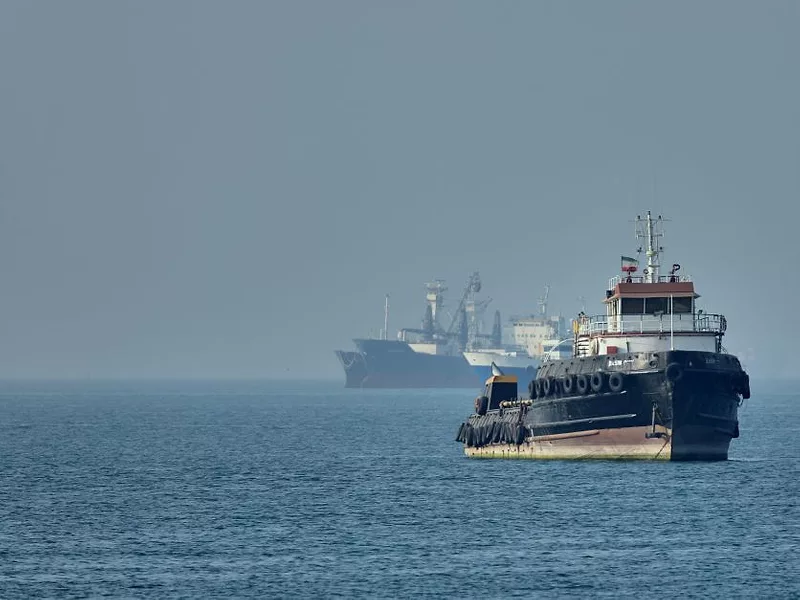
The breakdown of a ceasefire between the U.S. and Iran is threatening a fresh wave of disruption to global energy and agriculture supply chains.
President Donald Trump told the Hugh Hewitt Show that the U.S. would hit Iran “very hard” on Monday and again on Tuesday, after Iran violated a tentative peace agreement over the weekend by firing on commercial ships in the Strait of Hormuz.
Oil and gasoline prices soared Monday, with crude reaching its highest level in nearly four weeks and gasoline its highest in five weeks, according to Barchart.
Trump said he will address the nation on Thursday at 9 p.m. Eastern time.
At Trump’s direction, the U.S. began a third straight night of military action against Iran, late afternoon on Monday, according to the Pentagon. “The strikes will continue imposing a heavy cost on Iranian forces and degrade their ability to attack innocent civilians and commercial shipping in the Strait of Hormuz,” U.S. Central Command said.
The U.S. began defensive military action against targets within Iran on July 7, according to a July 10 letter obtained by Agri-Pulse from Trump to the Senate. The strikes were in response to Iran attacking "several neutral-flagged commercial vessels transiting the Strait of Hormuz between July 6-7," despite its commitment to use best efforts for safe passage, Trump said.
The breakdown of the ceasefire with Iran is intensifying a dispute between Washington and Tehran over control of Hormuz, the crucial maritime chokepoint for energy and agricultural goods.
Trump said the U.S. would resume a blockade on Iran in the strait and become “guardian” of the waterway. He also said the U.S. would start charging a 20% toll on cargo moving through the strait in exchange for safe passage. The plan contradicts Secretary of State Marco Rubio saying last month that "no country is allowed to charge tolls or fees on an international waterway."
Sen. John Kennedy, R-La., said it’s clear the ceasefire with Iran has collapsed and that he supports Trump’s blockade in the strait. He disagrees, though, with charging tolls. “That’s a mistake,” Kennedy told Agri-Pulse. “It’s an international waterway.”
As far as the potential for fuel costs to surge again, if traffic in the strait can get back to 40% to 50% of where it was before the war, it should hold energy prices down, Kennedy said. "If we can get the traffic in the strait back up to 40 or 50 percent, it'll hold energy prices down, and I don't know about fertilizer, but energy prices prices, yeah. But I think that's the best we can do."
Sen. Tim Kaine, D-Va., said Congress has been clear that the war with Iran is illegal.
“We're nearly five months in and the president is signaling today we're not getting out anytime soon,” Kaine told reporters on Monday.
“If we're suddenly going to be the guardian of the strait, that's not going to just be accepted lying down,” he said. “That's going to put more troops at risk and impose more damage on the American economy.”
A resumption of war between the U.S. and Iran threatens to send retail fuel prices surging again, just a few months before high-stakes congressional elections. The strait also is a major trade route for fertilizer, with roughly a third of crop nutrients passing through the strait to export markets, as well as about 20% of liquefied natural gas, a crucial fertilizer feedstock.
The specter of fertilizer prices surging again comes as farmers will soon start planning for next year. An increase in already high production costs, like fuel and fertilizer, would put food supplies at risk and potentially trigger more U.S. farm bankruptcies.
Tensions between the U.S. and Iran are flaring just as Congress returns to work after a break. Trump is seeking congressional passage of a roughly $87 billion supplemental funding package to help pay for Iran war costs. It's not clear there will be enough votes to pass the legislation, especially given a narrowing Republican margin over the Democrats in the Senate with the death of Sen. Lindsey Graham, R-S.C., and hospitalization of Mitch McConnell, R-Ky.
Trump has called for a supplemental bill to also include about $11 billion in additional federal aid for farmers hurt by high production costs, as well as a measure to allow year-round, voluntary sales of higher ethanol fuel blends, known as E15.
For more news, go to Agri-Pulse.com
.webp?t=1762183428)
