
The House Budget Committee on Wednesday released the GOP’s third reconciliation package. The concurrent resolution would boost government funding by $95 billion for FY 2027 through 2036.
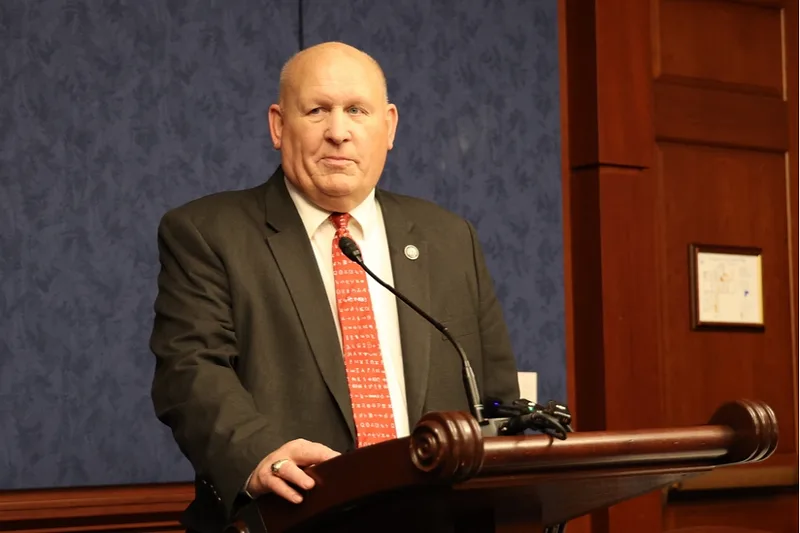
The package would allow the House Agriculture Committee to increase the federal deficit by no more than $12 billion. Chairman Glenn “GT” Thompson, R-Pa., said to Agri-Pulse that the funds will provide aid to farmers impacted by weather, economic losses and trade.
Other congressional committees also will be permitted to increase funding levels: House Armed Services Committee, $60 billion; House Permanent Select Committee on Intelligence, $13 billion; and House Administration Committee, $10 billion.
"We will use every tool and resource at our disposal to govern our great nation and deliver on behalf of the freedom-loving people who gave us unified Republican leadership,” House Budget Committee Chairman Jodey Arrington, R-Texas, said in a press release.
The panel will hold a markup on Thursday. Arrington said reconciliation 3.0 will “stop Democrat obstruction, support our troops, and safeguard the integrity of our elections.”
Corn Congress urges long-term certainty for USMCA
Members and officials of the National Corn Growers Association, gathered in Washington, D.C., for their bi-annual Corn Congress, said Wednesday one of their top priorities is renewing the U.S.-Mexico-Canada Agreement.
The Trump administration opted not to renew the agreement on July 1, but it will remain in place for the next decade and be reviewed annually in the meantime.
“What we are pushing for now is long-term certainty around this agreement,” Lesly Weber McNitt, NCGA’s vice president of public policy, said. She told members that Rep. Rudy Yakym, R-Ind., is circulating a letter to be sent to the Trump administration expressing congressional support for the USMCA.
Rep. Randy Feenstra, R-Iowa, expressed support for the USMCA at the event. He noted that Canada is a key trading partner for ethanol and Mexico is the top buyer of U.S. corn. “USMCA is so important. We've got to make sure that we hold onto USMCA,” Feenstra said. He was the recipient of the NCGA President's Award.
Status of Iran supplemental funding request unknown to lawmakers
There is “nothing settled” regarding President Trump’s June 24 supplemental request for over $11 billion in farm funding, according to Sen. Chuck Grassley, R-Iowa, on Wednesday. The president tacked the agriculture funding onto an $87.6 billion total request, the majority of which was defense funding for the Iran conflict. As noted above, the House Budget Committee on Wednesday released a resolution that includes allowing the Agriculture Committee to add $12 billion to the deficit, known as reconciliation 3.0.
Grassley, Sen. Tina Smith, D-Minn., and House Ag Committee Chair Thompson told Agri-Pulse they don’t know the status of the funding request. Smith added, “It's cynical to attach those agriculture relief dollars to a much, much larger military budget that is going to be very difficult for most Democrats to support, given this illegal war.”
“The supplemental funding, of course, they need it, but as my farmers say, they want trade, not aid,” House Agriculture Committee member April McClain Delaney, D-Md., said June 24. “And unless we change the policies, they're going to be at the same place again next year.”
USDA highlights modernization of NASS data gathering
Ag Secretary Brooke Rollins touted USDA’s efforts to modernize the agency’s data collection at an event held with corn growers Wednesday at USDA’s Whitten building.
Over nearly 35 years, Rollins said the National Agricultural Statistics Service has seen a drastic drop in participation rates for its surveys, along with increased frustration, especially from corn growers, about the data in its reports.
In 1992, she said response rates ranged from 80% to 85%. “By 2016, that survey number had dropped to 55% to 65%, and since 2016, those response rates have continued to decline.” They now average in the 30% range.
Deputy Secretary Stephen Vaden said for June reports, NASS sent out more surveys than it normally does. “So even if the participation rate remained the same, which it basically did, we have far more actual individual responses that have come in, with the expectation being … there's less chance that we will miss something,” Vaden said.
The department plans to release a report in the next few months on its plan to modernize NASS data-gathering. Vaden mentioned a partnership with Colorado State University, which has been working with NASS to use satellite data “to give us crop information about how well the crop is developing” without anyone having to actually visit the fields.
Kip Tom, ambassador to the United Nations Agencies for Food and Agriculture during the first Trump administration, will be a special government employee working on the project.
WRDA advances through Senate, House committees
Committees in both the House and Senate have advanced their versions of the Water Resources Development Act, a biennial bill that guides the development and repair of water infrastructure projects across the U.S.
The Senate Environment and Public Works Committee on Wednesday approved its version of the legislation, sending it to the chamber floor. Meanwhile, the House version advanced through the Transportation and Infrastructure Committee on Tuesday.
In a statement following committee approval of the House bill, National Grain and Feed Association President Mike Seyfert applauded the committee’s advancement of the measure, which he said “provides critical certainty for planning and investing in the infrastructure that supports farmers, agribusinesses and rural communities.”
After the Senate committee’s approval, Seyfert said “NGFA looks forward to working with lawmakers to advance this legislation and ensure a final bipartisan WRDA bill reaches the President’s desk this year.”
Commerce Department authorizes more tariffs on Canadian fresh mushrooms
The Commerce Department has authorized new 8.26% tariffs on Canadian fresh mushroom growers as part of a preliminary ruling on antidumping claims brought by U.S. growers, but set different rates for a few individual operations.
While the agency authorized an 8.26% tariff on Canadian mushroom growers broadly, Highline Produce will see an 11.8% rate. Meanwhile, Champ’s Fresh Farms and Loveday Mushroom Farms will see 8.71% tariffs and Farmers’ Fresh Mushrooms will see 2% tariffs.
A group of U.S. growers argued last fall that their Canadian counterparts were selling mushrooms below their fair value, a practice known as dumping, and that they were propped up by subsidies from the Canadian government. In May, Commerce issued a preliminary ruling on the subsidization question and authorized a general 2.84% tariff.
The tariffs remain provisional and could change when Commerce issues its final determination, currently expected in December 2026.
Companion FARM AI bill introduced in House
Reps. Zach Nunn, R-Iowa, and Don Davis, D-N.C., have introduced companion legislation for the Fostering Agricultural Research and Modernization through Artificial Intelligence (FARM AI) Act, which would designate AI as a priority research area and create an AI adviser role at the Agriculture Department.
The bill also would provide AI training in workforce development and technical training programs to producers.
The Senate version was referred to the Agriculture Committee, but there has been no further action.
Final Word
"Ongoing research and development drive innovation in the seed industry, and intellectual property rights provide the incentive and protection to sustaining that innovation. Whether new varieties and technologies are developed by private seed companies, universities, or consortiums, they choose the method of IP protection that best suits their business model — enabling the seed industry to bring new varieties and technologies to America's farmers, land managers, and consumers every year.” — Andy LaVigne, president and CEO of the American Seed Trade Association, in response to a bill from Reps. Jim McGovern, D-Mass. and Greg Casar, D-Texas, that limits seed patentability.
.webp?t=1762183428)


