
WASHINGTON, Sept. 15, 2016 - Top executives of the leading
biotech and chemical companies will face the Senate next week to defend their
pending mega-mergers, including Bayer’s $66 billion deal announced yesterday to
take over Monsanto.
The witness
list for Tuesday’s Senate Judiciary Committee hearing includes Robb
Fraley, chief technology officer of Monsanto, and Jim Blome, president and CEO
of Bayer Crop Science North America.
Executives from Dow and DuPont and Syngenta CEO Erik Fyrwald
also will be on the hot seat. Dow and DuPont are in the process of merging, and
Syngenta is being taken over by ChemChina.
Senate Judiciary Chairman Chuck Grassley, R-Iowa, says
the Bayer-Monsanto deal only increases the concerns that farmers already had
about the impact of industry consolidation on input costs. The
American Farm Bureau Federation’s chief economist, Bob Young, says the Justice
Department needs to review the overall business climate that is giving rise to
the mergers. Young also will be a witness at next week’s hearing.
Water projects bill set for vote with farm tank exemption. The
Senate has cleared the way for a final vote today on a two-year water resources
development bill that would authorize more than $12 billion for 29 Army Corps
of Engineers projects in 18 states.
The largest of the projects would replace aging locks and
dams on the upper Ohio River at a cost of $2.6 billion.
Nebraska Sen. Deb Fischer inserted a provision in the bill
to provide relief to farmers from EPA regulations on fuel storage tanks. Her
provision would exempt farms with storage tanks that have an individual
capacity of 1,000 gallons or less, or an aggregate capacity of 2,000 gallons or
less, from having to prepare a spill control plan. The exemption also would
apply to storage containers for animal feed ingredients.
The House could take up its version of the bill next week.
CFTC nominees face Senate Ag. Nominees to fill the two
vacancies on the Commodity Futures Trading Commission are likely to hear quite
a bit today about considering the impact of regulations on farmers, grain
companies and other end-users. The Senate Agriculture Committee is holding a
confirmation hearing for the two nominees, Georgetown University law professor Chris
Brummer and Brian
Quintenz, a former House Republican adviser.
Committee Chairman Pat Roberts tells Agri-Pulse he’s
been "favorably impressed" with the two nominees. Roberts says they
came to private meetings with senators prepared to reassure them that they
understood the importance of the futures market to farmers.
It doesn’t hurt that the CFTC under the chairmanship of
Timothy Massad has also gone a long way in addressing concerns that the
industry had about the bonafide hedging exemption and other issues. The
commission is “very much aware of the risk management tools the farmers have to
have and that the end user is not a swap dealer,” Roberts said.
Glickman: Clinton should pick Republican for USDA. Former
Agriculture Secretary Dan Glickman says he’d like to see Hillary Clinton
nominate a Republican to run USDA, if she’s elected. Glickman made the comment
during a debate with former GOP Ag Secretary John Block before members of the
United Fresh Produce Association yesterday. “Agriculture does tend to be
bipartisan,” Glickman said.
Block needled Glickman a bit, saying at one point that if
Glickman “hadn’t been so close to Hillary” he would probably have joined
Trump’s agricultural advisory team.
Glickman
said that voting for Clinton should be a no brainer for the produce industry because
of her support for immigration reform and her interest in boosting nutrition
standards. Block downplayed Trump’s campaign rhetoric on immigration and trade
and talked up his support for tax reform and rolling back regulations.
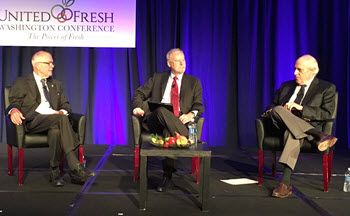
Block, United Fresh President and CEO Tom Stenzel and
Glickman.
FDA has asked companies to voluntarily stop selling the
drugs for growth promotion but has taken no steps to end the usage of
antibiotics for prevention. The petition says more must be done to prevent
overuse of antibiotics because growth-promotion uses account for only 10 to 15
percent of livestock antibiotic sales.
The drug industry’s trade group, the Animal Health
Institute, says it would be “inhumane and unethical” to bar the use of the
drugs for prevention when “clear disease threats exist.”
Majority of House back catfish repeal. Some 220 House
members, a majority of the chamber, have signed onto a letter calling
for a vote to shut down the catfish inspection program at USDA. The Senate has
already approved a resolution to kill the rule that USDA needs to operate the
program.
Importers have been trying for years to eliminate the
program, which was originally authorized by the 2008 farm bill. The letter to
House leaders say it makes no sense to have USDA inspecting catfish and FDA
regulating all other forms of seafood.
He said it. “Ninety percent of the time what they say
is what they think and what they mean.” - Agriculture Secretary Dan Glickman,
on politicians.
Steve Davies contributed to this report.
#30
For more news, go to: www.Agri-Pulse.com
