
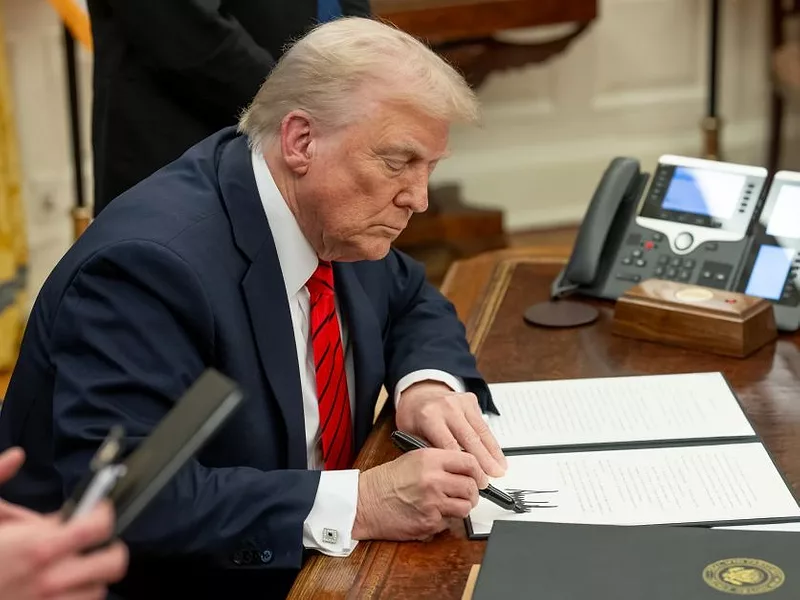
Legal experts are deeply skeptical, if not dismissive, of President Donald Trump’s attempt to summarily rescind regulations he deems illegal, saying he cannot short circuit the administrative rulemaking process.
Recent executive orders and statements from the White House and EPA Administrator Lee Zeldin take aim at a collection of regulations issued by the Biden administration. Among the targets is the long-controversial “waters of the U.S.” rule that is interpreted one way in about half the states and another way in the others, due to varying court rulings.
The WOTUS rule is singled out in Trump's EO, which mentions the Supreme Court’s 2023 Sackett decision that narrowed the federal government’s jurisdiction over wetlands under the Clean Water Act. EPA issued guidance to the field in March directing regulators to not extend jurisdiction over wetlands that do not directly abut already regulated waters.
“An interpretation of ‘continuous surface connection’ which allows for wetlands far removed from and not directly abutting covered waters to be jurisdictional as adjacent wetlands has the potential to violate the direct abutment requirement for ‘adjacent wetlands’ under the plurality’s standard and now Sackett’s endorsement of that standard,” the guidance memo said.
The latest EO on the subject of rules states that the administration can quickly repeal “unlawful regulations” using what’s known as the “good cause” exception to the Administrative Procedure Act, the law governing the way regulations are both issued and repealed.
In both cases, legal experts say, the government must give the public an opportunity to weigh in.
“He would have to go through notice and comment in each case,” says Richard Pierce, a professor at the George Washington University School of Law and the author of more than 20 books and 130 articles on administrative law and regulation.
“Almost all the rules that he wants to rescind have been the subject of cost-benefit analysis that have found that their benefits exceed their costs by an average of five or six to one, and have been upheld by courts," Pierce says. "So coming into court and saying, ‘Hi, we did something 10 years ago and now we discovered it was illegal,’ that's laughable. It's not going to work.”
The EO mentions the APA’s “good cause” exemption from notice and comment, but Pierce says “courts are very stingy about accepting the ‘good cause’ basis for avoiding notice and comment.”
“They only do it in one of two circumstances,” he says. In one, “advance announcement of the proposed rule would distort patterns of decision-making,” as in a tax case when an extended comment period would cause people “to accelerate abnormally their patterns of transactions.”
The other situation involves true emergencies, as when a volcano erupted in Hawaii in 1995 and the Federal Aviation Administration “was able to sell the courts on the good cause exception to issue an emergency rule governing the tourist air traffic over the volcano,” Pierce said.
However, “generally, they're highly unlikely to consider any of these [targeted regulations] emergency situations.” When rules have been in place – and criticized -- for years, “then how the hell is it all of a sudden an emergency? It's a silly argument. It's not going anywhere,” he said.
It’s easy to be “in the know” about agriculture news from coast to coast! Sign up for a FREE month of Agri-Pulse news. Simply click here.
An analysis by lawyers at the Wiley law firm says that “when courts have held the exception applicable, it has often been in response to discrete emergencies or statutory deadlines.”
 Jim Murphy (LinkedIn photo)
Despite what appear to be clear legal obstacles, the National Wildlife Federation’s Jim Murphy told Agri-Pulse, “It doesn't mean they're not going to try to do it.”
Murphy, director of legal advocacy for NWF, also pointed to a separate executive order that would “sunset” environmental regulations by October 2026, although it’s not clear whether those would include WOTUS or other rules issued by EPA. (EPA shares jurisdiction over the Clean Water Act with the Army Corps of Engineers, which also is mentioned in the sunset order.)
“Potentially every EPA rule on the books” could be subject to that order, Murphy said. The April 9 order directs EPA to submit a list of affected rules to the White House within 30 days.
“That also seems to be patently illegal,” Murphy said. “But I think the idea here is just to create so much chaos and confusion that people can't keep up.”
Murphy said the Biden administration already responded to the Sackett decision by issuing what it called the “conforming rule” to bring its WOTUS rule – published shortly before the Sackett decision – into line with that opinion.
“The Sackett decision had just come out, and they responded directly to it,” he said. “So any kind of emergency need to do that is over.” New changes to the rule “would, I think pretty squarely fall into what would have to go through the normal notice and then comment rulemaking process.”
Still, the libertarian Competitive Enterprise Institute found much to like in Trump’s regulatory executive orders.
Wayne Crews, CEI’s Fred L. Smith Fellow in Regulatory Studies, called the “sunsetting” order “long overdue."
He also complimented Sen. Joni Ernst’s, R-Iowa, SCRUB Act. “The administration seems to be making all efforts to create a target inventory for revocations before the government releases the new Unified Agenda of Regulation,” Crews said in a statement.
Crews said the EO on repealing unlawful regulations “goes beyond previous orders invoking typical platitudes about efficiency, cost-benefit and ‘outdated, unnecessary or ineffective’ by specifically invoking ‘deconstruction’ of an administrative state now largely regarded as unconstitutional and irredeemable,” Crews said.
For more news, go to www.Agri-Pulse.com

