
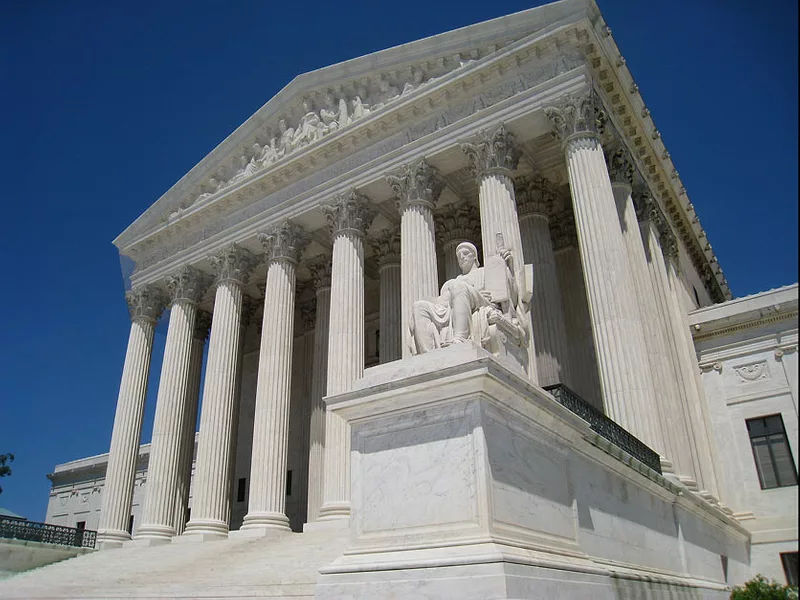
California opened a fourth legal challenge to President Donald Trump’s use of emergency presidential powers to impose tariffs last week. But while the case may have merits and could inspire additional cases, those hoping the courts will provide swift relief from the duties will likely be disappointed, legal experts say.
Gov. Gavin Newsom and State Attorney General Rob Bonta are suing the administration in a district court in California, arguing that Congress, not the president, has purview over U.S. tariff policy and that nowhere in the powers delegated to the president does it state he may use tariffs in an economic emergency.
“There's a very reasonable chance that they could win,” said Jason Kenner, who leads the litigation practice at Sandler, Travis and Rosenberg, an international trade law firm.
The International Emergency Economic Powers Act has never been used to impose tariffs before and does not specifically mention tariffs in the list of authorities it grants the president to respond to an economic emergency.
“This is completely new ground,” a former general counsel at the Office of the U.S. Trade Representative, Greta Peisch, told Agri-Pulse.
The administration will likely point to President Richard Nixon’s use of a precursor of IEEPA to impose a 10% on all U.S. imports as a legal precedent, Peisch said. But the court’s application of the major questions doctrine – which requires explicit and clear congressional authorization for agencies and the president to regulate issues of national importance – has changed since the 1970s, Peisch added. This would put the argument on shaky ground.
“There's a lot of uncertainty around it,” Peisch said of the case.
The California case is the fourth to challenge the president’s use of IEEPA authorities to impose tariffs. Members of the Blackfeet Nation in Montana are suing the administration in a district court, alleging that the administration violated the constitution and infringed on tribal treaty rights when it used IEEPA to impose duties on Canada. A case brought by a conservative legal organization at the Court of International Trade, like Newsom and Bonta’s, covers both the reciprocal tariffs imposed on April 2 and the separate tariffs on Mexico, Canada and China.
The New Civil Liberties Alliance, a nonprofit dedicated to challenging administrative overreach, filed a case in a Florida district court challenging the tariffs on China over its role in the fentanyl crisis.
In the Montana case, the plaintiffs are seeking an injunction to pause the tariffs while the case plays out, arguing they are causing irreparable harm to those affected. The Liberty Justice Center, which brought the case at the CIT, also filed for a preliminary injunction.
But even with multiple plaintiffs seeking injunctions, Kenner said the cases are unlikely to result in the swift suspension of the tariffs.
Irreparable harm is notoriously difficult to prove in trade cases, Kenner argued.
It’s easy to be “in the know” about agriculture news from coast to coast! Sign up for a FREE month of Agri-Pulse news. Simply click here.
“Financial harms not going to be enough to get you there,” Kenner said. “It's going to have to be something a little bit more.”
The administration is also arguing that the Montana case should be transferred to the Court of International Trade before the injunction is decided. If the court rules with the Department of Homeland Security, the defendant in the case, there could be a protracted fight over jurisdiction before an injunction is even considered.
This question over jurisdiction, Kenner said, could cause delays in several of the cases.
The CIT has “exclusive” subject matter jurisdiction, meaning it is the only court allowed to hear cases that relate to international trade. The administration has also filed to move the Florida case to the CIT.
“What you're seeing right now is the jurisdictional fight that's going to come before any determination on the merits,” Kenner said. “I would bet dollars to donuts that you're going to see the same motion to transfer filed in California,” he added, which “could delay things quite a lot.”
The lone case brought to the CIT by the Liberty Justice Center would likely have the quickest path to a resolution, Kenner said, because it is unlikely to get bogged down over matters of jurisdiction.
But even there, a decision on an injunction could be many weeks away. If an injunction isn’t granted, a final decision could take years. Kenner pointed out that a CIT case challenging Trump’s application of tariffs on China implemented during his first term that took two years to get an initial decision and is still playing out in the Court of Appeals for the Federal Circuit.
“But if there's no political solution here, the court option is your only hope,” Kenner said.
Peisch, who is now a partner at Wiley Rein, pointed out that other cases challenging the administration’s legal powers have moved quickly, particularly those challenging personnel firings and administrative cuts. But added that with these cases, because they are challenging the president’s novel use of IEEPA, there is no precedent to look at for a timeline of quickly the cases are likely to move.
“It's not a predictable process,” Peisch said. “It's early. It could be that in the next few weeks, we have some more clarity about how fast these cases will move and how courts are thinking about it.”
Peisch, however, cautioned that a favorable outcome in these cases may not be a panacea for those hoping for tariff relief.
The president used IEEPA to impose tariffs quickly, but there are a number of other legal tools the Trump administration could use to impose tariffs – they just take more time.
The president can launch more investigations into using tariffs to protect national security, address unfair trade practices, or safeguard domestic industries. There are also other little used statutes that allow for the imposition of tariffs to address balance of payment issues and discrimination from foreign countries.
“If the president is committed to this policy, companies and others shouldn't expect that tariffs will go away and not reappear in another form, even if these cases are successful,” Peisch said.
But in the meantime, Kenner argued that the handful of cases filed so far are likely to inspire more plaintiffs to assemble their own legal challenges.
“There’s a fear of retribution, so nobody wants to be first. But now that we do have four cases filed, I do think that people will start getting more comfortable with the idea of challenging these tariffs themselves,” Kenner said. “I do believe that we will see significantly more cases.”
For more news, go to Agri-Pulse.com.

