

The Natural Resources Conservation Service’s new chief says the agency is trying to “go mobile” with aims to have its staffers complete more work during in-person visits to farms while attempting to reduce the time it takes producers to fill out paperwork.
Aubrey Bettencourt told members of the National Association of Farm Broadcasting Tuesday she sees “underlying infrastructure and cumbersome programs” as challenges that make it difficult to retain staff and ensure farmers are able to access conservation assistance.
For example, she hopes to improve network infrastructure in county offices to prevent outages from hindering farmers’ abilities to get assistance in local offices. She said she would also like to create a “singular platform” for interacting with farmers and conservation partners.
She also said she’s looking at finding ways to have NRCS staff do more on visits to farms, like being able to snap photos of fields and more quickly upload the images into the agency’s network system. Doing more on site during one visit will cut back the need for staff to return multiple times while working on the same conservation plan, she said.
“If we were to recommit ourselves to taking care of our farmers and taking care of our natural resources, what would that look like?” Bettencourt asked rhetorically. “I don’t think we’d be using the same technology that we did in 1930, when Hugh Hammond Bennett set this all in motion, but I think we would keep the core principles of helping our farmers have the absolute best technical assistance that they need.” Bennett launched what has become the NRCS.
Bettencourt takes charge as many staff leaving
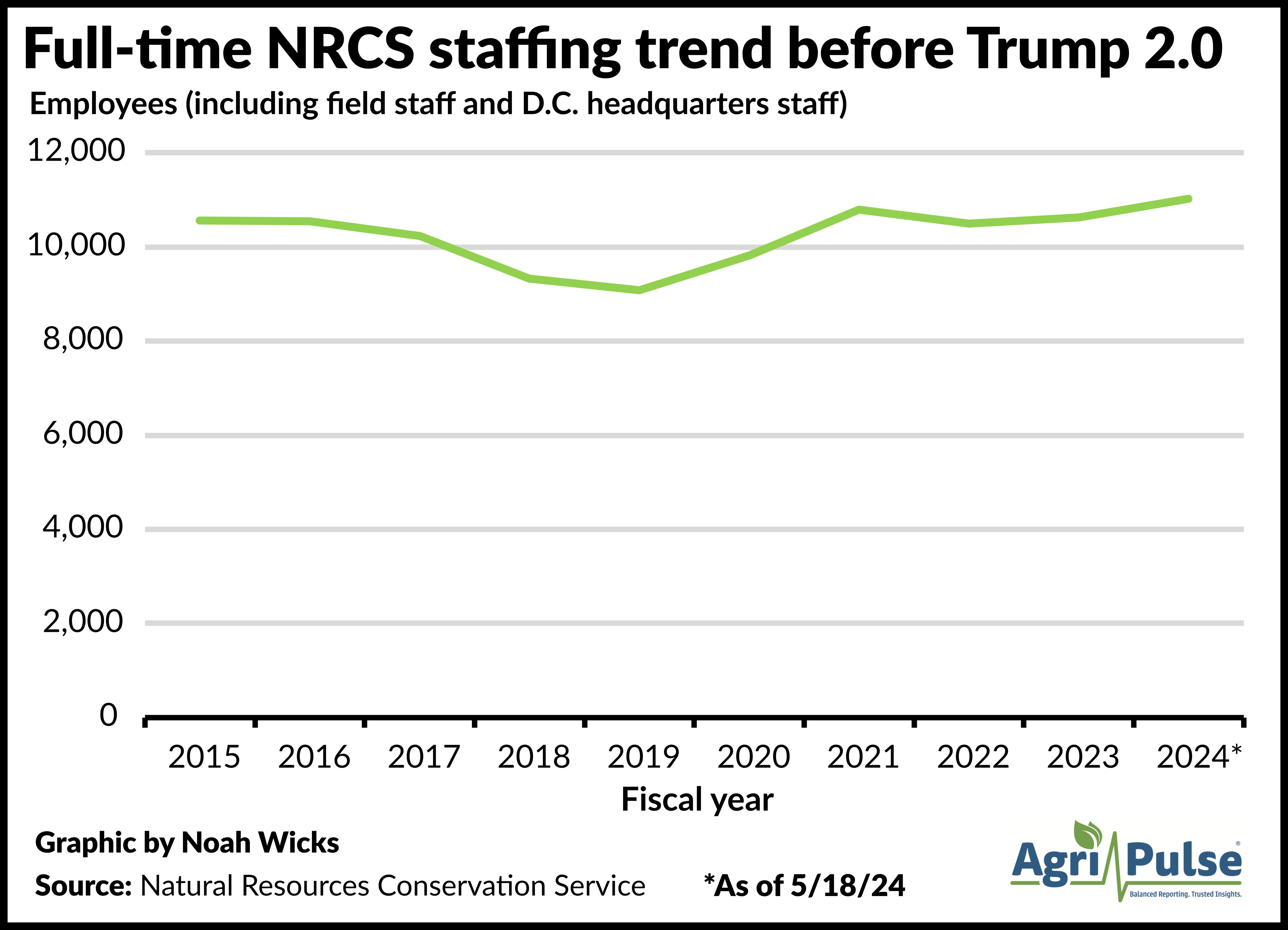
NRCS has for years struggled to maintain a workforce, and in recent months has lost additional staff due to the Trump administration's downsizing efforts. According to data reported by Agri-Pulse this week, NRCS stands to lose about 2,400 employees who have accepted buyout offers.
Bettencourt acknowledged that staff retention has long been a challenge at the agency and she said NRCS has a team focused on determining how to better keep recruits at the agency.
Cut through the clutter! We deliver the news you need to stay informed about farm, food and rural issues. Sign up for a FREE month of Agri-Pulse here.
“I actually am confident that the direction that we’re going, if we also prioritize the investment in the infrastructure to support that staff, the training to help them move up and continue to gain skill sets as well as programs that they deliver that are reliable … I think we’re going to have a great workforce that can deliver and increase our productivity and responsiveness, and that’s our goal,” she said.
Bettencourt served in the first Trump administration in roles at USDA and the Interior Department. She subsequently served as president and CEO of the Almond Alliance and then as an executive with Netafim, a precision irrigation company.
Bettencourt said she’s also looking at ways to collect data that can help farmers “get credit” in marketplaces for voluntary conservation activities they have completed. She said there are "a lot of commitments out there" asking farmers do certain practices, “but not ponying up cash to do it.” She said this gives farmers an opportunity to say, "I’ve got something that’s marketable, I’ve got something that’s above and beyond, and I can meet those criteria … but I need credit to do that.”
“We’ve got great partners in the nonprofit space,” Bettencourt said. “We’re starting to see more partnership in the corporate space around volumetric water benefit, water savings, as well as other things. I would love to start having more conversations and hope to have more conversations with those partners about how we can measure and quantify that."
Asked about NRCS office closures, Bettencourt said she would refer that question to the General Services Administration. On the number of staff that have left or been cut from the agency as part of downsizing, she said she was “not really in a position to comment on that at this time."
Trump proposing to slash conservation technical assistance
President Donald Trump's fiscal 2026 budget proposes a $754 million cut to discretionary conservation technical assistance in NRCS’s Conservation Operations account. Such cuts would limit the agency’s capacity to fund conservation planning and staff-sharing agreements with outside entities like conservation districts, state agencies or nonprofit organizations.
Conservation technical assistance funding supports agency staff who work on drafting conservation plans for farmers and pays for field office space, vehicles, computers, equipment and cooperative agreements with nonfederal agencies and organizations, according to a National Association of Conservation Districts summary.
For fiscal 2025, $895 million is set aside for the conservation operations account, which in large part includes funding for conservation technical assistance and includes soil and snow surveys. The account received $941 million in FY23 and again in FY24, USDA budget summaries show.
The Trump administration’s budget proposes elimination of discretionary funding for conservation technical assistance because “it has historically received over a billion dollars in mandatory funding, in addition to funding at the state and local levels.”
"While funding has helped producers deploy conservation practices on their lands, many have been forced to participate in the program in order to comply with state environmental regulations such as California’s Irrigated Lands Regulatory Program, which regulates agricultural runoff,” the budget says. "These cost drivers should be connected to the resource demands they impose.”
The budget also proposes a $16 million cut to NRCS’s Watershed Operations account, which helps fund renovation projects for nonfederal high hazard dams. The document says, “funding for this type of activity is the responsibility of the local dam owners.”
It said these programs “received an enormous influx of funding” through the Infrastructure Investment and Jobs Act and have over $100 million in unobligated balances between the two programs.
Bettencourt said she stands by the budget, and that adjustments are needed to refocus the agency on its “core competencies and core programs."
“We saw a lot of things get shoved through NRCS over the last number of years that took us very wide,” Bettencourt said.
Lydia Johnson contributed to this report.
For more news, go to Agri-Pulse.com.

