
While the Trump administration walked back Chinese tariffs Monday, the market impacts from yet another trade war are likely to linger for years to come, warn farm groups.
Almond farmers, wine makers and tomato growers are already seeing export markets shrink, and more pain could come in the form of shipping delays at California’s ports and higher costs for inputs and equipment.
“It's tough times for the wine industry,” said Julie Berge, who joined the Wine Institute in March as its new vice president of communications and member relations. “We're facing many headwinds, and so every single bottle sold matters.”
Berge explained to the State Board of Food and Agriculture last week that the industry is already in a vulnerable position as consumers drink less, production costs rise, and market growth in China and other countries stalled in the wake of the first Trump administration’s trade war. Wine makers and grape growers are taking a bigger hit in this round amid the dispute with Canada, their strongest export partner.
The Golden State exports about 70% of its almond production each year and, at $4 billion, the tree nut is the state’s top agricultural export as well as the nation’s leading specialty crop product abroad, reaching markets in more than 100 countries. Yet the Australian almond industry, at a fraction of California’s size, is tapping into free trade agreements to take over the market in China and make inroads to India, which had recently surpassed China as the largest export market, according to Keith Schneller, senior trade policy specialist at the Almond Board of California.
 Julie Berge, Wine Institute (photo: Wine Institute)
The situation is different for the growers who supply the bulk of the nation’s processed tomatoes for pizza sauce, ketchup and many other products. About 20% of those tomatoes are exported, meaning the greatest impact to the industry will come from retaliatory tariffs on steel, clarified Mike Montna, president and CEO of the California Tomato Growers Association. About 40% of the production cost goes into the can and just 20% for the raw product.
A shrinking international footprint for the top ag state
“Trade matters here in California,” stressed Josh Eddy, executive director of the California Department of Food and Agriculture, who pointed out that the state supplies 13% of the U.S. agricultural exports, at an annual value of $22.5 billion. “It means something on the international stage. Our products are known for their quality. They're known for the high standards by which we grow them.”
Cut through the clutter! We deliver the news you need to stay informed about farm, food and rural issues. Sign up for a FREE month of Agri-Pulse here.
California exports nearly a quarter of its agricultural production, with China, the European Union, Canada and Mexico its top destinations — which are also the top targets in the Trump administration’s trade strategy. Factoring in “the trucks, the ports, the marketing, the irrigation, the farmworkers” and the many other support industries, the state’s agriculture sector contributes an additional $46.8 billion to the U.S. economy and around 141,000 jobs, explained Eddy.
While trade wars create major export hurdles, farm groups must also routinely deal with nontariff barriers like sanitary and phytosanitary standards, import bans on food additives like Red Dye No. 5 and unfair trade practices, he said. Overall about 64,000 export companies operate in the state, with 6,000 in the food manufacturing and beverage sector — and nearly all are considered small businesses.
Within the beverage industry, California accounts for 95% of U.S. wine exports and is the fourth-largest wine growing region in the world, explained Berge. With more than a million wine jobs nationwide, the industry employs more workers than Google, Facebook and Apple combined.
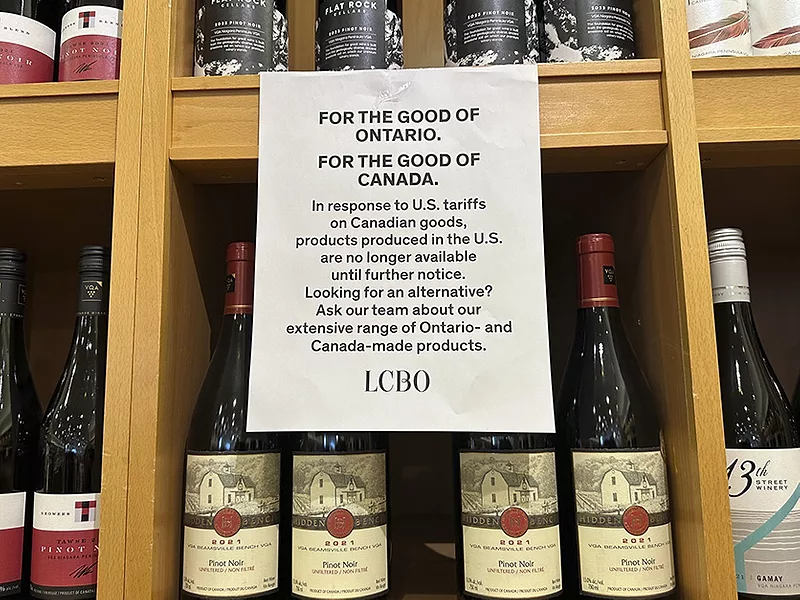
Canada is the largest international market for California wine, bigger than the next three export countries combined and valued at $1.1 billion. Yet since early March, Canadian stores have been pulling U.S. wine, beer and spirits from their shelves as consumers boycott American goods in protest to the steep tariffs imposed on the country. Small wine businesses in California had supplies ready to ship “and now they're left trying to figure out what to do,” said Berge.
Financial pain extends beyond market losses
“Tariffs have impacted every aspect of the cost that goes into growing and producing wine — higher costs as it relates to bottles, to corks, to labels, to the wooden and metal stakes that we use in the vineyards,” said Berge. “It's hurting businesses, but it's also destabilizing entire communities.”
Also relying on long-term trade stability are California’s bustling ports. In contrast to Canadian wine retailers, the Port of Los Angeles experienced a significant amount of frontloading starting last summer, as cargo owners attempted to get ahead of the anticipated tariffs under a Trump presidency, according to David Libatique, deputy executive director at the port. He is now anticipating a 31% drop in trade volumes compared to a year ago.
The trends mirror those of 2018 and 2019, during Trump’s first round of tariffs. Before that time, China represented 60% of the port’s trade. It is now down to 45%.
Echoing the post-pandemic shipping constraints the almond industry grappled with for years, Libatique expects international carriers to deploy fewer vessels to the U.S., leading to fewer outgoing ships and containers to handle agricultural exports.
“Big businesses have spent months bulking up inventory, doing what they can to spread out costs,” said Emily Desai, chief deputy director at the Governor’s Office of Business and Economic Development, describing the situation for California’s $675 billion overall trade economy. “They're trying to weather those storms. We know that the small businesses are going to struggle, and we know that some will fail.”
For more news, go to Agri-Pulse.com.

