
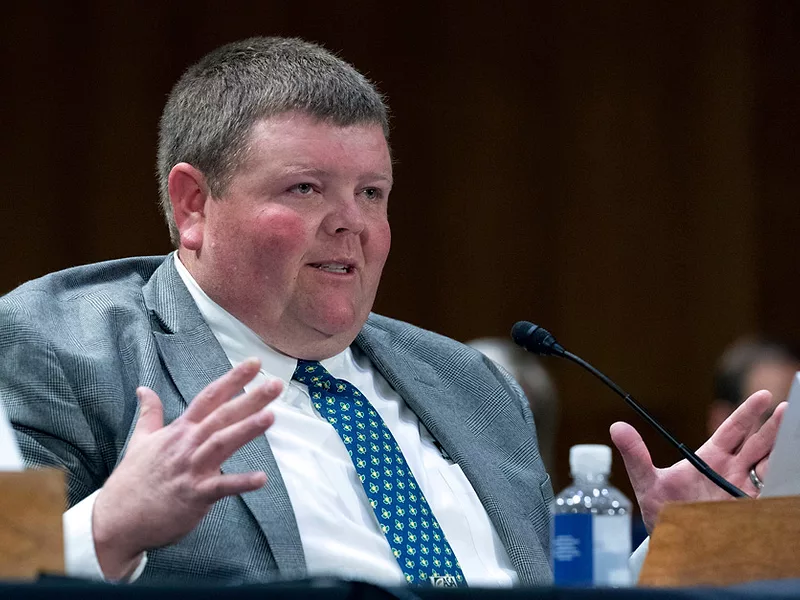
U.S. trade policies are compounding preexisting economic challenges, putting farmers on course for a crisis at a scale not seen since the 1980s, American Soybean Association President Caleb Ragland warned senators on Wednesday.
“Agriculture in general is in a difficult spot,” Kentucky-based Ragland told the Senate Finance Committee during a hearing on supply chains and trade challenges. He described several years of falling prices and rising input costs.
“It’s already tough. You add a trade war, and it takes it to a whole other level,” Ragland said. He argued the situation is reminiscent of the farm crisis of the 1980s that “devastated our farm economy.”
In the 1980s, high interest rates and a strong dollar collided with falling overseas demand, triggering widespread farm closures and economic hardship across the Midwest and rural America.
There are significant differences between then and now as well: The farm debt-to-asset ratio exceeded 20% at its peak in 1985, while USDA projects the ratio this year to be 12.8%.
In February, USDA forecast that net farm income would actually rise sharply this year although largely due to an influx of federal aid Congress authorized in December. Ag Secretary Brooke Rollins has pledged to compensate farmers for the impacts of a trade war just as the first Trump administration did.
Still, Ragland, who was born in 1986, shortly after the crisis’ peak, said commodity prices are hovering around 2018 levels, but the costs of production have soared in recent years.
“There are bankruptcies taking place,” Ragland said. “I know older farmers who are choosing to leave the industry because of the limited economic opportunity. They don’t want to lose what they’ve worked their whole lives for,” he told Sen. Maria Cantwell, D-Wash.
The fallout, Ragland warned senators, won’t stop at the farm gate. He argued that $1 earned in agriculture is returned more than six times over across rural communities.
“That's hardware stores, small businesses that impact the schools, churches, community organizations and a whole lot of people that do the living and dying and working and playing across this country,” Ragland said.
Tit-for-tat tariff escalations with China have dented U.S. soybean exports to its largest buyer. In the first week of May, the U.S. sent just 68,100 metric tons, compared to more than 91,000 during the same week last year, according to Agriculture Department data.
This week the U.S. and China agreed to reduce their tariffs for 90 days on each other’s products from 145% and 125% to 30% and 10%, respectively. But Ragland and others say that while the tariff relief is welcome, the 10% duty rate, on top of the existing duties, still leaves U.S. soybeans less competitive in the Chinese market.
“You're the supplier of last resort with your customers, and that's the reality of what we face,” Ragland told Agri-Pulse after the hearing.
The European Union has also included soybeans on a proposed list of retaliatory tariffs should trade talks with the Trump administration fail.
Ragland told senators that Brazil has the potential to increase its acreage by some 270 million acres, around three times the entire U.S. soybean acreage, leaving little doubt that it can keep up with renewed global demand for its product.
“There is nearly unlimited opportunity,” Ragland warned. “If we give excuses for our customers to look elsewhere, they will.”
Sen. Thom Tillis, R-N.C., pointed out that based on conversations he has had with farmers, the window to avert significant trade losses could be narrow. Ragland agreed. In comments to Agri-Pulse after the hearing he warned that tariff pain for soybean producers could significantly escalate as soon as September.
U.S. export losses have been tempered so far by rising prices for Brazilian soybeans. As Chinese buyers pivoted away from U.S. soybeans and rushed to buy more from Brazilian producers, prices for the Brazilian product have increased, leading some non-Chinese buyers to turn to U.S. soybeans because of their smaller price premium and superior quality, U.S. Soybean Export Council CEO Jim Sutter told Agri-Pulse earlier this week.
But Ragland is expecting this temporary buffer will soon end once the U.S. harvest ramps up and more U.S. soybeans enter the global market.
“That's when we'll really start seeing some potentially strong price movement,” Ragland said. “The pain is going to come in the coming months.”
Tillis is also skeptical that farmers will see the trade policy certainty they are craving by the time harvest rolls around. In comments to Agri-Pulse after the hearing, the North Carolina senator said that the high volume of concurrent trade negotiations the administration has embarked on will take time to conclude.
“It's going to take some time,” Tillis said. “I think we're talking months, before we fully settle it down, which is why we need to go after the major training partners first.”
On China in particular, Tillis said that the public signals from Beijing suggest Chinese officials are bracing for protracted negotiations.
They “are going to play the long game, and we need to be very mindful of that,” Tillis said.
Cut through the clutter! We deliver the news you need to stay informed about farm, food and rural issues. Sign up for a FREE month of Agri-Pulse here.
During the hearing, Ragland outlined what he would want to see from trade negotiations with China. Treasury Secretary Scott Bessent told CNBC earlier this week that the administration plans to use the Phase One agreement signed in 2020 as a starting point. Ragland argued that any new deal should build on that pact.
The Chinese purchase commitments under that deal, which included a pledge to buy some $80 billion of U.S. agricultural products over two years, should be a “minimum,” Ragland said.
“We have not returned to the pre-2018 trade war levels, where over a third of U.S. soybeans were imported to China,” Ragland told Iowa Republican Sen. Chuck Grassley. “So, we have a lot of room to make up.”
China also fell short of its purchase commitments under the deal, buying around 80% of its ag purchase target, according to analysis from the Peterson Institute for International Economics. Beijing imported around $14 billion of soybeans in 2020 and 2021, similar to what it was buying in 2016. Accordingly, Ragland argued that the deal would have been stronger if there had been an enforcement mechanism.
The Senate panel also heard testimony from representatives from the minerals, semiconductor and medical equipment sectors, with each describing new challenges spurred by an increasingly uncertain trade environment. A consistent theme among all of the witnesses’ answers and testimony was a call for more targeted tariffs with an exemption process to direct relief to key U.S. industries.
“We believe that any tariffs should be targeted to either specific product categories or countries of concern. We certainly think there should be appropriate exemptions for critical inputs so they don't inadvertently raise our costs,” David Isaacs, vice president of government affairs at the Semiconductor Industry Association told lawmakers. “There should be phase phased in processes to allow the supply chain to adjust over time, things like that.”
Committee Chair Mike Crapo, R-Idaho, remarked on the alignment across diverse U.S. industries in his closing remarks.
“There's really not a lot of disagreement on the notion that we need to get a targeted tariff regime,” he said, adding that he agrees with the witnesses on how a U.S. trade regime should look.
“I expect and hope that this committee will work together as we move forward on a bipartisan basis to find some solutions along the lines of those who have suggested here,” Crapo concluded.
For more news, go to Agri-Pulse.com.

