

Farm groups are preparing for the worst in a report due this week from the Make America Healthy Again Commission. A source familiar with the report tells Agri-Pulse’s Rebekah Alvey that it touches on pesticide usage, although the final language is subject to change.
The Department of Health and Human Services has taken the lead on the report and has declined meetings with stakeholders. Calley Means, a leader of the MAHA movement and brother of surgeon general nominee Casey Means, is believed to be closely involved in the report’s development.
For more on the report and why ag groups are so concerned about it, read our weekly newsletter today.
First nutritional SNAP waiver gets mixed reviews in Congress
House Agriculture Committee Chair Glenn Thompson, R-Pa., says USDA’s recent approval of a SNAP waiver allowing Nebraska to restrict purchases of soda and energy drinks demonstrates the need for a state cost-share.
Nebraska was the first state to receive USDA approval for such a waiver, but other states like Texas, Arkansas, Indiana and Iowa have submitted similar requests to USDA. Supporters of the waivers, including Health and Human Services Secretary Robert F. Kennedy Jr., argue they will improve public health.
Thompson generally takes issue with the SNAP restrictions on certain foods but says the waiver shows states need to have a bigger financial stake in the program.
“I don't think they ought to be meddling with any benefits that they don't contribute payments for. Where do they get the right to do that?” Thompson said. “I think it'll be challenged by someone, because what czar do we have [that] determines what's nutritional, or what's healthy?”
Keep in mind: The House Agriculture Committee’s piece of the Republican reconciliation bill proposes shifting between 5% to 25% of SNAP costs to the states. The plan has received backlash from anti-hunger groups, Democrats and some Senate Republicans.
Rubio open to moving Food for Peace
Secretary of State Marco Rubio says he’s “very open” to the idea of moving the Food for Peace program to USDA. Distribution of food commodities under the program had been managed by the now-shuttered U.S. Agency for International Development. USDA funds the program and procures the commodities.
Allowing USDA to run the program “would generally align towards removing one more level of government” from overseeing food aid, Rubio told Sen. Jerry Moran, R-Kan., at a Senate Appropriations hearing Tuesday.
“We think it has the potential to deliver assistance much quicker, much faster, much more efficiently and perhaps to a broader set of people,” Rubio said.
GOP moderates: ‘Do not believe the CBO’
House Republican lawmakers are pushing back against criticism that their “big, beautiful” reconciliation bill will dent the U.S. economy by spurring the national debt and widening the deficit.
At a press conference on Tuesday, the Main Street Caucus, a group of self-proclaimed “pragmatic conservatives,” argued revenue forecasts of legislation have often been off.
“Do not believe the CBO,” Rep. Andy Barr, R-Ky., told reporters, referring to the Congressional Budget Office. Barr charged that the CBO has “been wrong over and over again.”
The reconciliation bill, he argued, will be “jet fuel for the American economy.”
His comments are in line with those from Ways and Means Chair Jason Smith, R-Mo. Smith told the Economic Club of Washington, D.C., last week that the CBO underestimated revenues from Trump’s first-term tax cuts and the costs of President Biden’s Inflation Reduction Act.
Take note: CBO has not scored the full reconciliation bill yet but has put out estimates for parts of the bill. The Committee for a Responsible Federal Budget, a non-partisan Washington-based think tank, says the bill in its current form would increase the debt by $3.3 trillion by 2034.
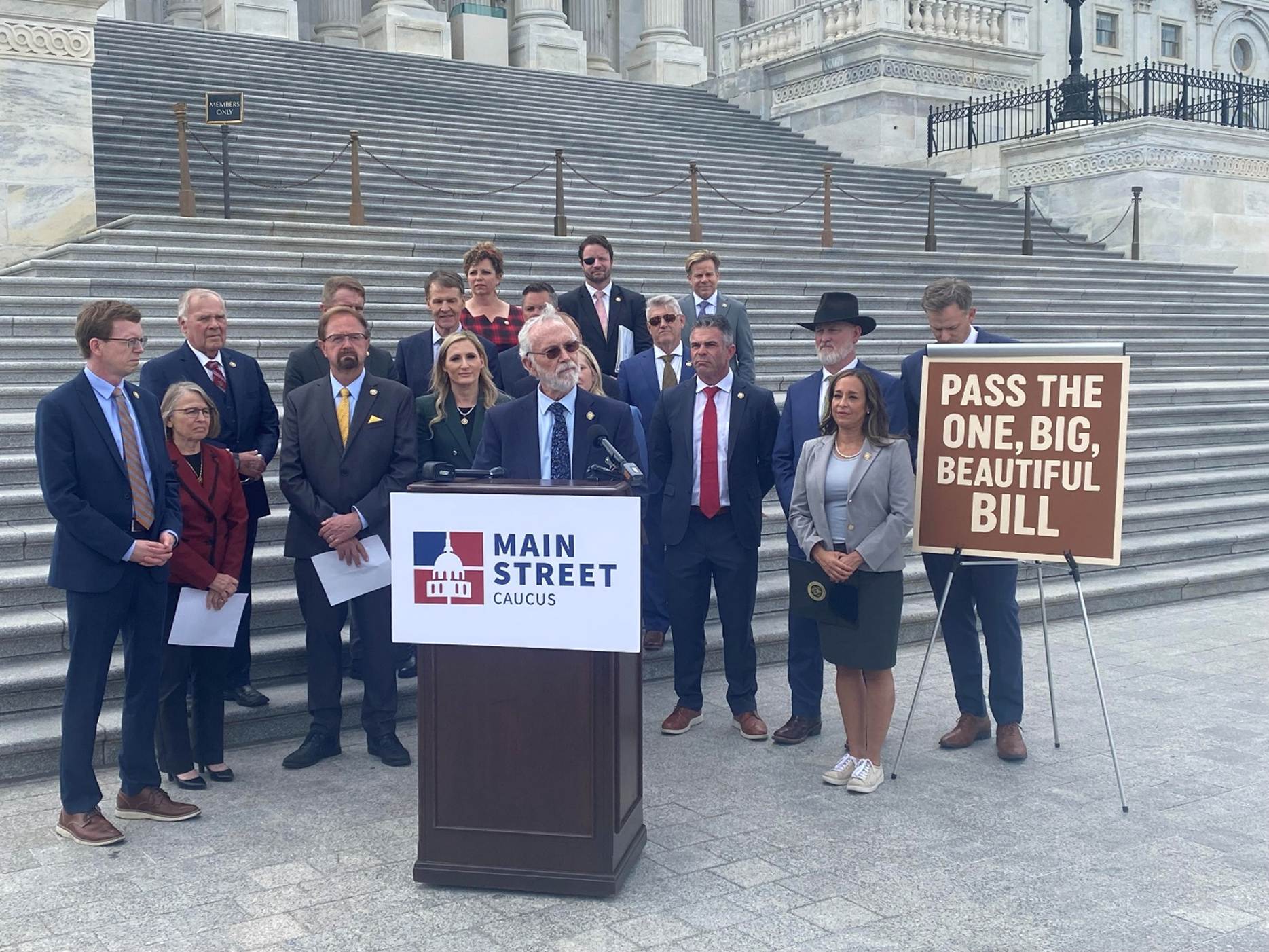
Rep. Dan Newhouse, R-Wash., speaking at the Main Street Caucus press conference on Tuesday (Agri-Pulse photo).
CBPP decries proposed cuts to SNAP, Medicaid
Cuts to Medicaid and the Supplemental Nutrition Assistance Program being considered in the House will hurt people with low and moderate incomes, says the Center on Budget and Policy Priorities, a liberal research and advocacy group.
CBPP President Sharon Parrott told reporters these are “the very people the president and many other Republicans promised during the campaign to serve and protect.”
Criticizing the proposed reductions in food and health assistance, Parrott said the cost savings are “about equal” to the planned tax cuts to households with earnings over $500,000 a year.
Cut through the clutter! We deliver the news you need to stay informed about farm, food and rural issues. Sign up for a FREE month of Agri-Pulse here.
Parrott said the impacts will be felt most acutely by households with the lowest earnings, including “truck drivers, cashiers, food service workers, home health aides, people who work and care for our kids in childcare centers.”
Western ag groups signal support for removing ESA ‘harm’ definition
Leaders of 41 western ag groups want the Trump administration to remove regulations defining “harm” under the Endangered Species Act. They say the definition is “overbroad.”
Rescinding the definition of “harm” would reduce costs, prevent delays and create more certainty for landowners, says a letter from leaders of groups like the National Water Resources Association, California Farm Bureau, Family Farm Alliance, Western Growers Association and the Public Lands Council. But it could also limit enforcement actions affecting certain species’ environments.
The group’s leaders say landowners seeking ESA take permits have been forced "to pay thousands of dollars and wait months or years” to receive them. Those that don’t receive such permits must pay for mitigation activities mandated by the federal government.
"Instead of imposing costly and sometimes burdensome regulatory mandates, the services should be focusing taxpayers’ dollars on actions proven to actually protect and restore species — and which follow the law,” the letter says.
Court of International Trade to hear arguments in second tariff case
The Court of International Trade in New York will hear legal arguments today in a hearing for a case challenging the economic emergency used to impose new tariffs. Twelve states are suing the Trump administration over its tariffs on Canada, Mexico and China, as well as sweeping reciprocal tariffs, and are asking for an injunction while the case is pending.
It is the second such case to have a hearing before the CIT in as many weeks. Expect lawyers to make arguments similar to those made by a group of small businesses that appeared before the court last Wednesday.
The judges, who are the same as those in that case, could wait and rule on both cases together, a lawyer involved in last week’s case said.
Final word:
“Any chink in this inspectorate team, any lapse, could lead to a foodborne outbreak that would be a matter of great public concern. The bottom line is that the firings that left the FDA with not enough people to do the work.” — Former FDA Commissioner Robert Califf, speaking Tuesday at a Senate Democrat forum on Health and Human Services staffing cuts.
Rebekah Alvey, Steve Davies, Oliver Ward and Noah Wicks contributed to today’s Daybreak.
For more news, go to Agri-Pulse.com.


