

Republicans in the House and Senate are closely aligned on the farm bill provisions in their versions of the budget reconciliation bill, although the Senate’s approach is a bit more expensive, and in some respects more favorable for corn and soybean growers.
Some provisions of the Senate Agriculture Committee’s part of the Big Beautiful Bill could change in coming days because of the pending review by the Senate parliamentarian. The process, known as a “Byrd bath,” allows Senate minority staff to challenge other provisions should they be included in the legislation under Senate rules.
The process, named for the late Sen. Robert Byrd, D-W.Va., is intended to prevent the use of budget reconciliation to change policy rather than merely to raise and lower spending and revenues. A decision is expected later this week for ag provisions, according to the committee.
Senate Agriculture Committee Republicans will have a chance to modify, or “cure,” provisions that are flagged by the parliamentarian before the legislation goes to the Senate floor.
The House already made some tweaks to its version of the bills because of problems that came up in preliminary discussions with the Senate parliamentarian. For example, the original version of the House-passed bill originally doubled funding for the Market Access Program and Foreign Market Development Program. However, because of a concern raised by the parliamentarian, the additional funding will have to be routed through a new, third account.
That aside, there are a handful of differences, in most cases relatively small, between House and Senate bills when it comes to farm programs that need to be finalized in negotiations between the two chambers.
Commodity payments. One key difference that will be popular with farmers is that the Senate version would ensure that farmers this year can benefit from either the Price Loss Coverage or Agriculture Risk Coverage program, regardless of which one they signed up for this year. Under the Senate bill, USDA would have to determine which of the two programs would offer the largest payment this year to an individual producer. The producer would then get the greater of the two.
Under the House bill, USDA would have to conduct a new signup this year for PLC and ARC.
It’s easy to be “in the know” about what’s happening in Washington, D.C. Sign up for a FREE month of Agri-Pulse news! Simply click here
The automatic provision in the Senate bill adds about $1 billion to the overall cost of the bill but it’s a “much easier way to go,” said a House aide familiar with development of the legislation.
“A lot of producers are very grateful that that provision is in our bill. That's important to them,” a Senate aide said.
Both Senate and House versions would raise PLC reference prices that trigger payments to farmers when market prices fall below them. But the House bill included a $3.30 per bushel floor under the PLC price for corn. The floor would save about $4 billion over 10 years.
There also are some differences in calculating the PLC reference prices that are in effect each year. Under the House bill, the effective reference could continue to increase up to 85% of the five-year Olympic average of market prices, with a cap of 115% of that average. The Senate bill would increase the floor to 88%.
Reference prices would be increased 0.5% a year under both versions, with a cap of 15% under the House bill and 13% under the Senate version.
Supplemental Coverage Option. Another key difference between the House and Senate that also would benefit Midwest growers is that the Senate version would allow farmers to buy the supplemental coverage option for crop insurance and still enroll in the ARC program, not just PLC.
ARC is similar to SCO in that both are intended to cover drops in county revenue, although ARC pays only on the number of base acres a producer has enrolled. SCO pays on planted acres.
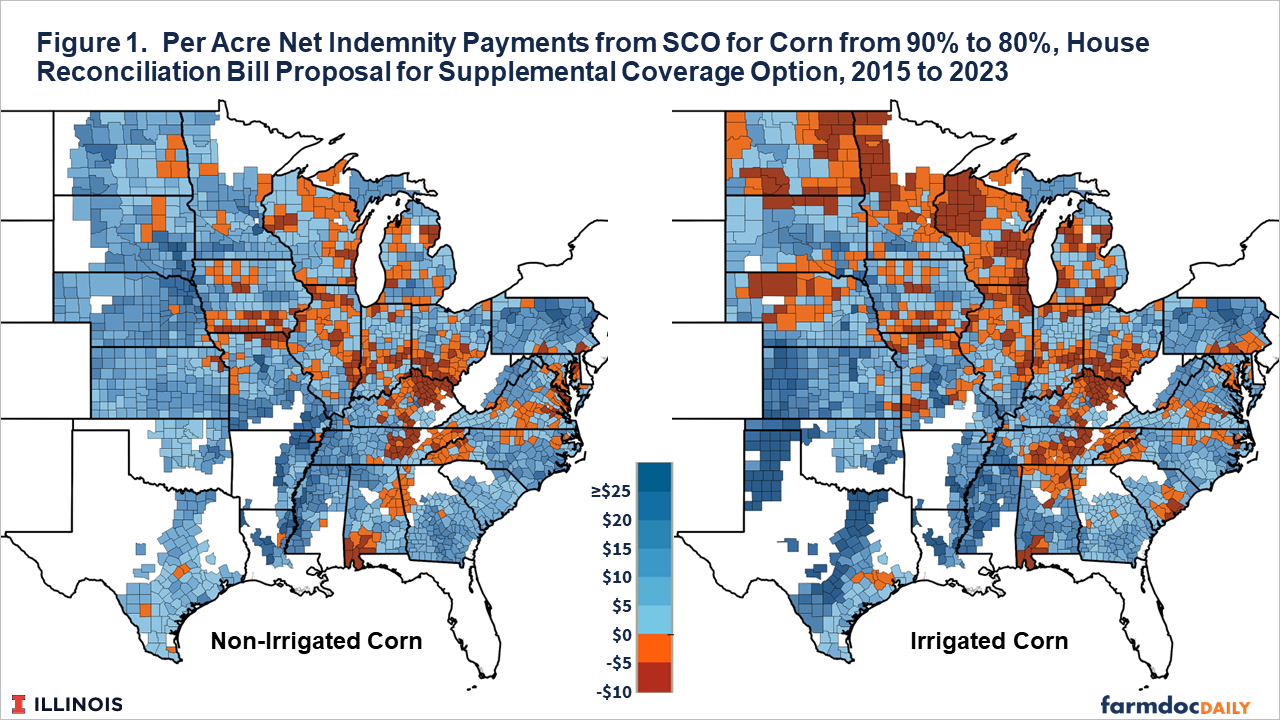
SCO is likely to be more popular with producers no matter how the difference is resolved in the final bill. Under both bills, the premium subsidy for SCO would be increased from 65% to 80% and the coverage level would be raised to 90%.
House Ag kept the ARC prohibition for SCO “because we have to fight back against arguments that Title 1 [the commodity programs] and crop insurance are duplicative,” the House aide said. “ARC and SCO look and smell very, very similar.”
An analysis of the House SCO provision led by University of Illinois economist Gary Schnitkey concluded that the SCO would primarily be purchased by producers in higher-loss areas. A producer in McLean County, Illinois [the Bloomington area], would pay $33.94 per acre for SCO, but from 2015 through 2023 producers there would not have received a single payment under the plan, the analysis found.
 Gary Schnitkey (University of Illinois photo)
“From a historical perspective, the SCO proposal contained in the House Reconciliation Bill would have provided limited benefits to Midwest farmers, particularly those in high-yielding, low-risk areas,” the analysis found.
Insurance industry aid. Both bills seek to help crop insurance companies and agents deal with high-loss states by authorizing a payment for administrative and operating expenses in states that have a loss ratio above 120%.
In 2024 crop insurers struggling with several years of losses in western Texas were blocked by USDA from cancelling contracts with insurance agents and instead cut agent commissions.
Under the House bill, the payments would be limited to two groups of states, including Texas, that are considered high risk. Under the Senate version, any state, including low-risk states such as Iowa and Illinois, could potentially qualify for the A&O support.
CBO says Senate bill increases deficit, even with economic growth
A “dynamic” analysis of the House-passed One Big Beautiful Bill Act finds that it would increase budget deficits by $2.8 billion from 2025 through 2034, even after accounting for the economic growth it would create. The analysis released Tuesday by the Congressional Budget Office could raise concerns with deficit hawks in both chambers.
CBO's earlier conventional analysis estimated the bill would increase deficits by $2.4 billion.
The dynamic analysis released by CBO says the bill would increase interest rates on the federal debt by $441 billion. CBO estimates the bill would cut revenues by more than $3.5 trillion while only cutting spending by $774 billion.
“Because the tax provisions increase the deficit by more than the nontax provisions reduce the deficit (especially in the earlier years of the 2025-2034 period), the tax provisions are an important driver behind the higher interest rates that lead to increased net outlays for interest on the baseline projection of federal debt," it says.
For more news, go to Agri-Pulse.com.

