
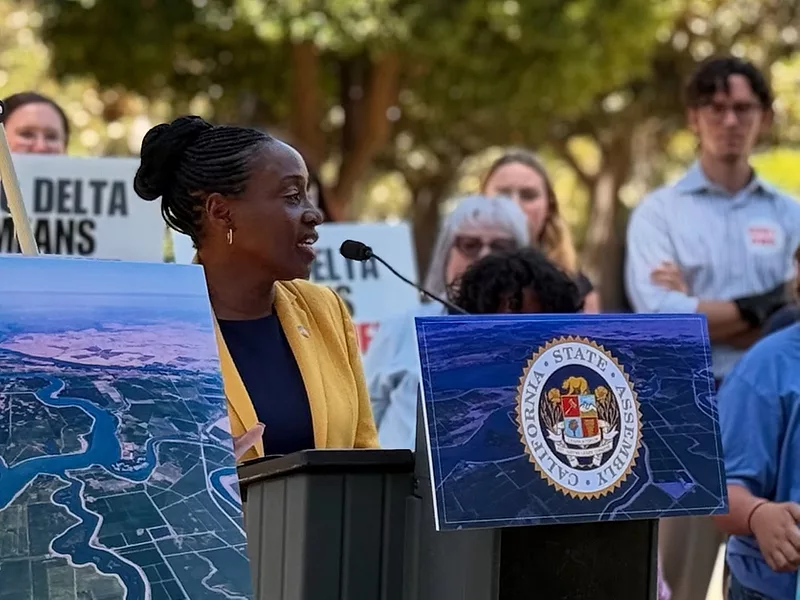
The Legislature’s audit committee has voted down a request to examine state and local spending on the Delta tunnel project. Governor Gavin Newsom had downsized the water project and renamed it the Delta Conveyance Project when he took office in 2019 and has since been one of its most outspoken proponents. The rejection was an abrupt shift from rising resentment among lawmakers over the administration’s approach to the $20 billion project.
While Assemblymember Rhodesia Ransom, D-Tracy, partnered closely with the environmental group Restore the Delta on the request, she did not take up their call to also review the administration’s investments into a set of voluntary agreements for preserving river flows and habitat, now known as the Healthy Rivers and Landscapes Program. She also collaborated with Senator Jerry McNerney, D-Pleasanton, to author the request.
Ransom has been intensely critical of the tunnel and Newsom’s trailer bill to fast-track environmental permits and the litigation process for the project. Earlier this month the Legislature struck that proposal from the main budget bill framework, though it is anticipated to reconsider it as a standalone policy proposal later in the session.
“We are very concerned that if this project moves forward — at a time when we are seeing California struggling with the cost of water — who is going to pay and how much are they going to pay?” asked Ransom in a press conference following the committee hearing last week, claiming that costs are already high for gas, groceries and energy and will likely get worse under looming tariffs. “We deserve answers.”
She reasoned that the tunnel project is due for an audit, since the last one took place nine years ago, when the proposal was for a twin tunnel system. She pointed to California’s notorious reputation for construction delays and skyrocketing costs with major infrastructure projects, exemplified by the High-Speed Rail Project.
“It is not our desire to just arbitrarily stop a project,” said Ransom. “To invest in an audit is a reasonable request that we, as legislators, should honor in order to respect our citizens, the people who sent us here, the people who have asked us to lower the cost for Californians.”
Delta farmers at odds with San Joaquin Valley counterparts
 Jon Rubin, Metropolitan (photo: MWD)
Ransom, along with several of her colleagues in the Delta Caucus, argues the tunnel would deplete the state’s supply of freshwater, exacerbate harmful algal blooms in the Sacramento-San Joaquin Delta and harm endangered salmon that are central to native tribal cultures.
She says constructing the project would destroy Delta farmland while benefiting “huge agricultural interests” in the San Joaquin Valley. That has drawn local farmers to join the decades-long opposition to the tunnel as well.
“Looking at salinity, looking at what this does to water clarity and water quality in the Delta, it would absolutely devastate the small family farms of the Delta,” said Andrew Genasci, executive director of the San Joaquin County Farm Bureau. “You're talking thousands of farmers and farm employees, billions of dollars in products that are made right here in California.”
Ransom’s audit request specifically sought to gain further insights into what she decried as hundreds of millions of dollars the California Department of Water Resources has spent on the proposal. She cited DWR reports estimating the planning and administrative costs have penciled out to about $1.5 million in spending per day on average and called for determining how the costs have been spread to taxpayers and ratepayers, including households, small farms and industrial water users.
Just two weeks earlier, DWR Director Karla Nemeth had debunked many of the caucus’ claims over the project during a budget subcommittee hearing on the streamlining proposal. Nemeth was again in the hotseat last week to respond to the audit request.
“[The State Water Project] provides an enormous public benefit, including economic prosperity and stability to the people of California, and is funded entirely by the state water contractors and their ratepayers,” said Nemeth. “No fewer than 18 different boards of directors, with 18 different financing subcommittees, have been vetting our expenses associated with this project over the years.”
It’s easy to be “in the know” about what’s happening in Washington, D.C. Sign up for a FREE month of Agri-Pulse news! Simply click here
Nemeth said the 2016 audit of the previous iteration of the project found “absolutely no evidence of waste, fraud or abuse.”
Water contractors raise their voice against audit
Also opposing the request was Jon Rubin, executive adviser for water resources and capital improvements at the Metropolitan Water District of Southern California, which Ransom directly targeted in her arguments. Rubin noted that the Los Angeles area water provider hires an independent accounting firm to audit the State Water Project every year and has held 25 public deliberations over the Delta Conveyance Project over the last five years.
“It’s important to note that Metropolitan has not yet agreed to support construction of the DCP,” said Rubin. “The Metropolitan board agreed to fund DCP planning and design work because it thought the results of the additional work would help it decide whether to participate in the project.”
Several other water contractors in Southern California and in the Central Valley also opposed the request. To the daily costs Ransom cited, Jennifer Pierre, general manager for State Water Contractors, said those expenses continue to rise because of delays.
“Every day that goes by and we're not building the project, it costs money,” said Pierre. “That's inflation, and that's a problem.”
Several lawmakers piled onto the concerns. Sen. Dave Cortese, D-Silicon Valley, noted that he had voted to reject the streamlining proposal but said Ransom’s audit would not add any value and that “there's really no remedies in the audit itself.” Sen. Suzette Martinez Valladares, R-Santa Clarita, took issue with the claims against water agencies.
“I would hope that we could come together in recognizing that we are your brothers and sisters in Southern California in need of water,” said Valladares.
Sen. John Laird, D-Santa Cruz, believed the Legislature should instead weigh in later in the construction process if a need for legislative oversight arises or if it clashes with public policies on climate and water.
Ransom acknowledged the broad opposition to her request and the influence campaign behind it, as she explained to her committee colleagues.
“I know many of you are being faced with the lobbying we're seeing,” said Ransom. “Lots of calls are being made, and people are being told to just go ahead and oppose this audit.”
Yet she appeared surprised by the lackluster support for her request and asked for a reconsideration when it failed to gather enough votes to proceed. She noted that several lawmakers had stepped out of the room during the vote. The chair approved the request, and the committee plans to again take up her proposal in the August hearing.
Restore the Delta found it promising that the audit request gained strong support from assemblymembers and was just two Senate votes shy of passing.
For more news, go to Agri-Pulse.com.

