
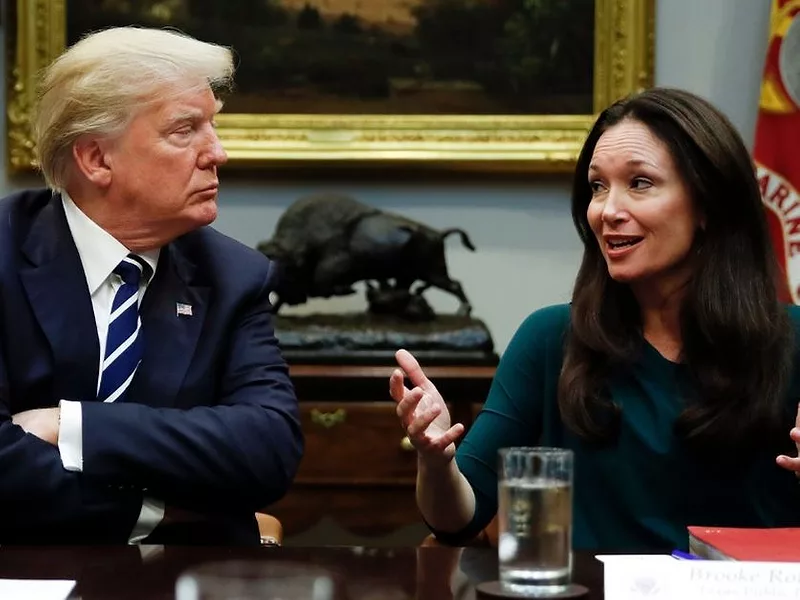
President Donald Trump is facing a backlash from some of his base over his promises to shield farmworkers from mass deportations. So, Trump and Ag Secretary Brooke Rollins stressed at separate events Tuesday that there will be “no amnesty” for farmworkers.
Rollins said the deportations would be done in a “strategic” way. She went on to suggest that people now on Medicaid would provide a source of farm labor as new work requirements kick in under Trump’s budget bill.
Rollins was asked to explain what Trump means by saying he’ll give farms a “temporary pass” from deportations, but she didn’t elaborate.
Bottom line: Uncertainty for agriculture is going to continue. The administration is working on reforms to the H-2A program, but we don’t have a timetable for that.
Don’t miss: Rollins unveiled a plan Tuesday for addressing foreign farmland ownership.
Trump set to open new tariff front
Today was supposed to be deadline for Trump’s tariff deals. But while the tariff deadline has been punted, Trump is pressing ahead with plans to open a new front in his long-running fight to reshore U.S. production with tariffs targeting copper imports.
The president said Tuesday that the administration is planning a 50% tariff on copper, with Commerce Secretary Howard Lutnick telling CNBC that the duty could go into effect before August. Trump also previewed forthcoming duties on pharmaceutical products that he said would land “very soon.”
Why it matters: The last time Trump slapped tariffs on metal imports the European Union assembled a list of proposed retaliatory measures that included a raft of U.S. ag products. The U.S. imports almost half of all copper used domestically, with Chile, Canada and Mexico among the top suppliers.
Chilean officials have been touting the mutual benefits of bilateral trade and the U.S.-Chile free trade agreement in order to secure relief from just such a tariff. The Chilean ambassador to the U.S. highlighted to Agri-Pulse in May the significant growth of U.S. ag exports to the country under the deal.
For Oliver Ward’s report from Brussels on how the European Union is responding to Trump’s tariff threats, check out our weekly newsletter today.
Ag groups call for USTR chief ag negotiator nominee
More than 40 agricultural organizations are urging Trump to swiftly nominate his chief agricultural negotiator in the Office of the U.S. Trade Representative. The administration is currently holding trade talks with more than a dozen U.S. trading partners, according to senior officials.
“A Chief Agricultural Negotiator will optimize the United States’ position to prevent missing time-sensitive opportunities to reduce trade barriers, open new markets, and eradicate unfair trade practices,” the groups say in a letter to the president.
Interested in more news on farm programs, trade and rural issues? Sign up for a four-week free trial to Agri-Pulse. You’ll receive our content - absolutely free - during the trial period.
The American Farm Bureau Federation, Association of Equipment Manufacturers, International Fresh Produce Association, National Association of State Departments of Agriculture and USA Rice are among the signatories.
Key lawmaker: Renewing trade preference programs would offer more leverage
Congress should renew a slate of expiring and expired trade preference programs to give negotiators more leverage in ongoing trade negotiations, says Nebraska GOP Rep. Adrian Smith. He chairs the Ways and Means trade subcommittee, making him one of the top trade legislators on Capitol Hill.
“I think it is important that we empower our trade negotiators to get leverage, and I think that can be done through some of these programs,” Smith told reporters on Tuesday.
Several trade preference programs that allow certain products to enter to U.S. tariff free have expired or are expiring, including a program open to sub-Saharan African nations that is set to end in September.
EPA hears mixed response on proposed RVOs
Biofuel groups have largely backed the Environmental Protection Agency’s proposed renewable volume obligations. But they are calling for certainty on how the administration will handle current and future small refinery exemption requests.
During an all-day public hearing, various groups testified on the EPA’s proposed RVOs for 2026 and 2027. The proposal went above the ask from various industry groups and included a major boost for biomass-based diesel.
Representatives for the National Oilseed Processors Association, Growth Energy, Clean Fuels Alliance America and the Renewable Fuels Association said they supported the proposed volumes. But many also raised lingering concerns about how the administration plans to address the backlog of SREs as well as future waiver requests.
“Congress intended for the SRE program to be short lived and used sparingly for certain obligated parties,” said Devin Mogler, president and CEO of NOPA. He said “SRE applications must face strict, transparent review, and any waived gallons must be accounted for in order to preserve the integrity of the volumes.”
Meanwhile: Environmental groups like the Union of Concerned Scientists argued that the proposed expansion of the RVOs goes too far and would raise fuel and food prices for consumers.
The proposal is still open to a written comment period.
Enviros intervene in Lake Erie pollution case
Three environmental groups have joined a lawsuit challenging EPA’s approval of a nutrient reduction plan for western Lake Erie.
The plan was approved by EPA in 2023. The city of Toledo, Lucas County and the Environmental Law and Policy Center sued the agency last year. Now, Lake Erie Waterkeeper, Food & Water Watch and Waterkeeper Alliance have intervened on their side.
“The TMDL fails to hold factory farms accountable for their discharges and runoff,” the groups say.
The court rejected an attempt by farm groups to intervene in the case, concluding that their interests “are adequately represented by the U.S. EPA.”
First national cover crop variety test report released
Researchers led by the University of Missouri’s Center for Regenerative Agriculture have released the first national cover crop variety test report.
The report is the result of a $10 million effort funded by the USDA National Institute of Food and Agriculture to spur progress in meeting demand for regionally adapted, high quality cover crop seed.
The program tested 25 different varieties from six different cover crop species.
U.S. cover crop acreage has grown significantly in the past decade, reaching about 21 million acres in the fall of 2024 according to the SARE/CTIC National Cover Crop Survey.
Final word:
“The Chinese owning of farmland in our country is a massive national security issue... The states have begun taking a leadership role to ban the purchasing of China farmland. Obviously, Congress needs to step up and catch up.” – Agriculture Secretary Brooke Rollins during a cabinet meeting Tuesday.
Rebekah Alvey, Lydia Johnson and Oliver Ward contributed to today’s Daybreak.
Questions, comments, tips? Email Steve Davies at agri-pulse.com.


