
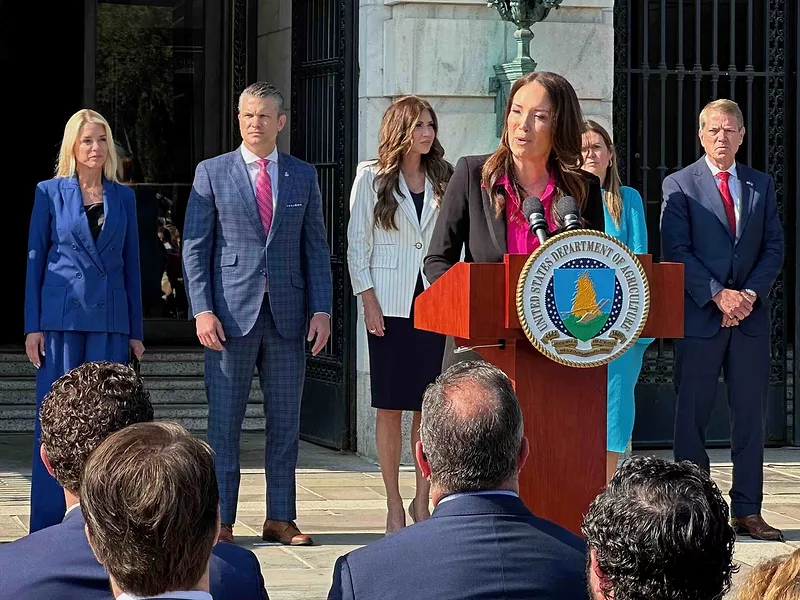
The Trump administration is planning unspecified steps to “claw back” farmland belonging to Chinese-owned agribusiness giants Smithfield Foods and Syngenta, Agriculture Secretary Brooke Rollins said Tuesday.
At a news conference where she announced plans to protect U.S. agriculture from foreign influence, she also announced that she was being added to the Committee on Foreign Investment in the United States, or CFIUS, the government entity that reviews business transactions for national security implications.
Some states, led by Arkansas, have taken steps to restrict or prohibit Chinese entities from owning farmland. An Arkansas law forced Syngenta to sell a small research farm in that state. But the federal government has done nothing to date to force either Syngenta or Smithfield to sell the property they owned before being sold to Chinese interests.
Asked what the administration may do to address Smithfield and Syngenta holdings, Rollins said. “We are looking at every available option. There are multiples of options. You'll likely see an executive order on this very soon from the White House, and we'll be looking at multiple different authorities within the federal government to begin to claw that back.”
Foreign investors owned or leased 45 million acres, or about 3.5% of the nation’s total farm, ranch and forest land, in 2023, according to the most recent USDA data available.. Chinese interests owned 277,336 acres that year, less than 1% of foreign-held agricultural acres.
Rollins was also asked to clarify the administration’s plans for farmworkers who are in the country illegally. President Donald Trump has said repeatedly that farms would get a “temporary pass” for those workers, but he hasn’t elaborated on what that would entail.
Rollins stressed there would be no “amnesty” for farmworkers, but she didn't provide any clarity on how they would be treated as the administration carries out mass deportations.
Trump “has always been of the mindset that at the end of the day, the promise to America to ensure that we have a 100% American workforce stands, but we must be strategic in how we are implementing the mass deportations so as not to compromise our food supply," Rollins said.
Interested in more news on farm programs, trade and rural issues? Sign up for a four-week free trial to Agri-Pulse. You’ll receive our content - absolutely free - during the trial period.
She went on, “Mass deportations continue, but at a strategic and intentional way as we move our workforce toward more automation and toward a 100% American workforce.”
Rollins also suggested that people currently covered by Medicaid could be a source of ag labor. “Ultimately, the answer on this is automation, also some reform within the current governing structure, and then also when you think about it there are 34 million able-bodied adults in our Medicaid program.”
Rollins released a National Farm Security Action Plan that includes restrictions on USDA research and contracting to cut off collaboration with scientists and entities from China and other foreign countries of concern.
USDA also is launching an online portal for people to report false or missing farmland disclosure reports. USDA is required to track foreign farmland ownership.
She said the department has canceled seven active agreements with entities in foreign countries of concern. Some 70 citizens from countries of concern have been removed from their participation in contracts or research agreements with the department.
She said the department also is “working to issue regulatory action to remove over 550 entities from foreign countries of concern.”
Rollins also said she is working on memoranda with the Treasury and Defense departments to “ensure that moving forward, there is a much more intentional look at who is buying what in this country, and from where they are in the world.”
In a statement, Smithfield Foods noted that CFIUS approved its acquisition by WH Group in 2013.
"Our products are produced in the United States, and the vast majority are consumed in the U.S. We primarily export offal to China, cuts of the pig that are not typically consumed in the U.S." the statement said."We are a majority-owned subsidiary of Hong Kong-based WH Group Limited, a publicly traded company with shares listed on the Hong Kong Stock Exchange and investors from around the world, including the United States. WH Group is not a Chinese state-owned enterprise and does not undertake any commercial activities on behalf of the Chinese government."
Syngenta also said that their land holdings and business acquisitions have been examined by the Committee on Foreign Investment in the United States (CFIUS) through several administrations, including the previous Trump administration.
In a statement, the company noted that "Syngenta is one of the world’s oldest and largest global agricultural companies. Our global headquarters are in Switzerland, and we are a multinational company with multiple Americans in leadership positions.
"Syngenta is already in the process of selling its remaining farmland in the U.S. and currently owns less than 1,000 agricultural acres in the U.S., acreage that is the equivalent of roughly 3 Iowa farms. This land has been used to ensure that products are developed and tested locally, meaning American farmers have access to the products best suited to their farm’s needs. For example, testing soybeans in Wisconsin does not guarantee they will be the best option for soybean producers in Georgia - they need to be tested in that location."
Lydia Johnson contributed to this report. This article has been updated with additional information.
For more news, go to Agri-Pulse.com.

