
Agricultural Research Service labs and offices are being told to prepare for a funding shortfall at the end of the fiscal year that amounts to about 10% of the agency’s annual budget, ARS employees are telling Agri-Pulse.
“We are being told by the USDA to plan for being given no money for the last [about] 30 days of the fiscal year,” which ends Sept. 30, said Ethan Roberts, president of American Federation of Government Employees Local 3247. He works as a lab technician at the National Center for Agricultural Utilization Research in Peoria, Illinois.
Another ARS union rep said the shortfall has been caused by payments in annual leave to people who retired or took the voluntary buyouts offered through two deferred resignation programs.
While some labs may be able to absorb the cutoff in funds, Roberts said that “unfortunately for NCAUR this 10% reduction is about $3.4 million. We had already planned and executed to spend that money and now we’ll either end up in the red or we’ll have to start pulling back on previous obligations/canceling orders to try to make up the difference.”
In a response, a USDA spokesperson said “no funding issues or shortfalls [are] anticipated” and that “all critical functions at ARS and across the department continue to operate as normal.”
“USDA leadership continues its comprehensive review across the department to ensure all dollars are being spent on items which are congressionally mandated, mission aligned, and are used in a way in which maximize taxpayer dollars,” the spokesperson said. “USDA will prioritize funding innovative projects which put U.S. farmers and ranchers first and will continue to bring them into the 21st century.”
Oregon Democrat: Deportation uncertainty vexes farmers
Democratic Rep. Andrea Salinas says growers in Oregon’s Willamette Valley are experiencing uncertainty around the Trump administration’s deportation policy.
“They are feeling it right now and they’re nervous about the ICE raids,” she says in an interview for this week’s Agri-Pulse Newsmakers. She notes that she’s in support of deporting illegal immigrants with criminal records.
She suggests Democratic support for ag labor reform is growing in the wake of the GOP budget reconciliation bill that slashed nutrition assistance funding. “I would love to see something, but I don’t know the likelihood,” she says of prospects for an ag labor bill.
Newsmakers will be available today at Agri-Pulse.com.
Ag industries push for swift confirmation of trade negotiator
Ag groups are welcoming the administration’s announcement that it has tapped longtime trade official Julie Callahan to serve as the top U.S. ag negotiator and are calling for a swift nomination process.
“Dr. Callahan is the right choice. Her expertise and leadership in agricultural trade policy is second to none,” said Gregg Doud, president and CEO of the National Milk Producers Federation. Doud held the position during Trump’s first term. “We ask that the Senate move swiftly to advance her confirmation process,” he added.
Ag industry groups had been pushing the administration to fill the position at the Office of the U.S. Trade Representative to ensure ag interests are represented in the slate of ongoing trade talks.
Callahan has been working in USTR’s office of agricultural affairs since 2016, spending the last five years as assistant USTR for agricultural affairs and commodity policy.
Don’t miss a beat! It’s easy to sign up for a FREE month of Agri-Pulse news! For the latest on what’s happening in Washington, D.C. and around the country in agriculture, just click here.
American Farm Bureau Federation President Zippy Duvall said her experience would allow Callahan to “hit the ground running.” Her previous stints at USDA and the Food and Drug Administration would provide “important perspective,” he added.
“Excellent choice by the president,” Devin Mogler at the National Oilseed Processors Association told Agri-Pulse. “Julie is incredible at what she does.”
NCGA presses pesticide concerns ahead of second MAHA report
Corn growers used a briefing on Capitol Hill Thursday to raise concerns about the future of farming without the use of pesticides such as glyphosate.
Their concerns stem from the impending second report from the MAHA Commission, which is projected to be released August 12. The first MAHA Commission report came out May 22 and cited studies that link pesticide exposure to a variety of health problems, to the ire of ag groups.
The event featured Eric Tipton, a corn grower from Ohio, and Addie Yoder, who farms corn with her family in Missouri. Both expressed concerns about the feasibility of their farming operations should key pesticides be taken off the market, especially in the context of multiple years of negative returns for farmers.
In the absence of pesticide use, NCGA estimates crop yields could decline by at least 70%.
NRCS agrees to improve dam safety monitoring
USDA’s Natural Resources Conservation Service says it will try to do a better job monitoring dam safety and distributing rehabilitation funds transparently.
The agency agreed with recommendations in a Government Accountability Office report that found NRCS has failed to ensure the timely completion of dam inspections. As of a year ago, “32% percent of significant- and high-hazard dams within their evaluated lives were past their required inspection due date,” GAO found.
“In addition, key safety information NRCS collects — such as the condition of some dams — is missing or inaccurate,” GAO said. “Without complete and accurate data, NRCS cannot ensure the safe operation and maintenance of dams across the country that help protect communities from flooding.”
NRCS Associate Chief Louis Aspey pledged that the agency would make improvements.
In the agency response to the report, he said that by Jan. 31, NRCS “will develop a quality assurance plan and guidance for state and district offices for collecting and verifying key information in its dams database.”
He also said NRCS would clarify eligibility criteria for projects and issue guidance on its ranking system for funding.
Fast food outlet says it’s moving to cane sugar
Steak ’n Shake plans to offer Coca-Cola made with cane sugar as early as next month, the restaurant said in a social media post.
The chain, which has about 400 locations in the U.S., made its announcement the day after President Donald Trump said on social media that Coca-Cola had agreed to switch from high-fructose corn syrup. The “Make America Healthy Again” movement has singled out HCFS for criticism.
Earlier in the year, Steak ‘n Shake also committed to cooking some of its products with beef tallow rather than seed oils, another move in line with MAHA.
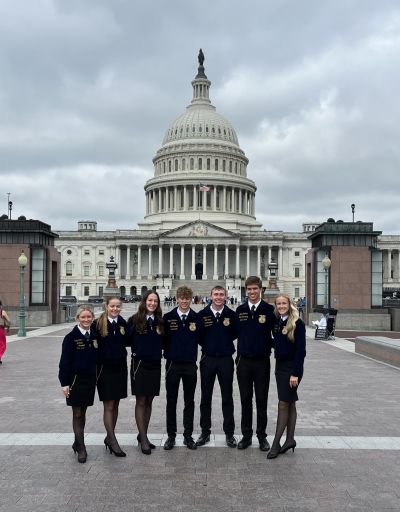 The Iowa FFA state officer team in front of the U.S. Capitol between hill visits during the State Officer Summit. From left to right: Kelsey Greenslade, Nora Pickhinke, Laura Steinkamp, Cooper VanderHeiden, Jagger Ferrie, Adam McCrea, and Chloe Zittergruen (Iowa FFA photo)
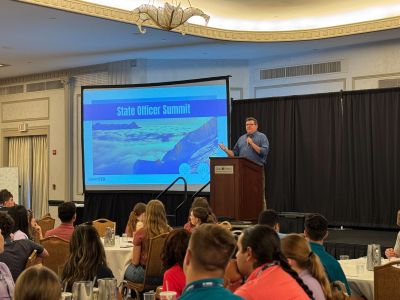 Seth Derner, principal and founder of Vivayic, speaking to attendees (Agri-Pulse photo)
National FFA, Vivayic announce partnership to bring free, virtual leadership labs to students
The more than 1 million National FFA Organization student members will soon have access to a customizable virtual leadership lab curriculum.
In a partnership announcement with Vivayic during the organization’s State Leadership Conference for State Officers, FFA said the free leadership curriculum will be available to students beginning next summer. Teachers will be able to customize the labs so they can be integrated into any school subject to ensure students can develop leadership skills alongside their regular curriculum.
“By combining innovation with real-world insight, we’re giving young leaders the tools they need to grow no matter where they are,” said Christine White, FFA chief program officer.
Development of programs with Vivayic, the nation’s largest learning solution provider for agriculture, will begin this fall.
Final word
“Over the last five years, Julie has actually spent more of her time as the acting chief ag negotiator than not.” — USA Rice President and CEO Peter Bachmann on Julie Callahan, Trump’s pick as ag trade negotiator.
Rebekah Alvey, Lydia Johnson, Oliver Ward and Noah Wicks contributed to today’s Daybreak.


