
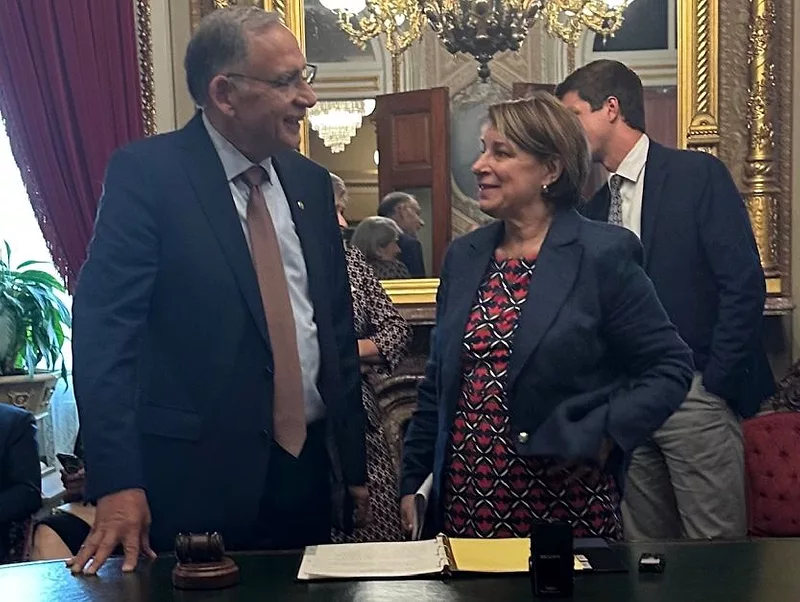
The Senate Ag Committee has sent two more USDA nominations to the floor.
On Monday evening, the committee approved the nominations of Dudley Hoskins to be undersecretary for marketing and regulatory programs and Scott Hutchins to be undersecretary for research, education and economics. Both nominations were approved on bipartisan, 20-3 votes.
Senate Ag Chair John Boozman, R-Ark., delayed action on two more nominees who lacked Democratic support because flight delays prevented one GOP senator, Cindy Hyde-Smith of Mississippi, from being present to cast a potential tie-breaking vote. Those nominees are Michael Boren to be undersecretary for natural resources and environment, and Brian Quintenz to chair the Commodity Futures Trading Commission.
Keep in mind: Senate Ag now has five USDA nominees pending floor action, including Luke Lindberg, President Donald Trump’s pick as under secretary for trade and foreign agricultural affairs. A sixth nominee, Richard Fordyce, Trump’s pick to be under secretary for farm production and conservation, will have his confirmation hearing Wednesday.
Trump, facing sustained Democratic resistance to fast-tracking his nominees, is pressuring Senate Majority Leader John Thune, R-S.D., to cancel the August recess.
“We're working with Sen. Thune to get floor time. It's really important that the secretary has the people that she needs in order to operate effectively,” Boozman told reporters after the committee votes, referring to Ag Secretary Brooke Rollins.
Looking ahead: The House Ag Committee is scheduled today to act on a grain standards reauthorization bill. The Senate Ag Committee will have a hearing on the issue next week.
The goal is to get a final bill through Congress in September.
Philippine president heads to the White House amid trade deal push
Philippine President Ferdinand Marcos Jr. is slated to meet with Trump at the White House today as he tries to avoid a 20% tariff set to kick in Aug. 1.
Marcos has focused on bolstering U.S. trade ties since he took office. He told reporters ahead of the visit that he intends to raise the trade issue with the president and examine ways to prevent a “very severe tariff schedule.
”But former U.S. trade official Mark Linscott told Agri-Pulse that he’s skeptical the two sides would emerge from the meeting with a deal.
The deals Trump has announced with other Southeast Asian countries, Indonesia and Vietnam, have kept tariffs around 20% in place. If the president pushes for a similar deal with the Philippines, Linscott said Marcos will have little incentive to sign.
“Vietnam and Indonesia seem to be the template,” Linscott said. If Trump wants to keep tariffs around 20% but wants major concessions, “what is the value in doing a deal?” Linscott added.
Don’t miss a beat! It’s easy to sign up for a FREE month of Agri-Pulse news! For the latest on what’s happening in Washington, D.C. and around the country in agriculture, just click here.
Linscott also said there is a “real risk” that Trump fails to capitalize on the leverage he has created with tariffs by pushing to retain tariff rates that are too high for allies to swallow.
USDA to provide $676 million in disaster funding to Florida
Rollins on Monday announced $676 million in funding for infrastructure, citrus and timber losses from a series of hurricanes that devastated Florida’s growers in recent years.
The funding is being provided to the state’s Department of Agriculture and Consumer Services through a block grant and is part of $30 billion authorized under the American Relief Act passed last year.
"Florida’s producers have endured back-to-back devastating hurricane seasons, and this funding is a major victory that will help them rebuild, recover, and continue feeding our state and nation,” Florida Ag Commissioner Wilton Simpson said in a press release.
Kellogg's ups its pledge to phase out artificial dyes
The maker of Froot Loops and other popular children’s cereals has upped its commitment to phase out artificial dyes.
WK Kellogg Co. posted on its website that it will remove remaining artificial food dyes from retail products by the end of 2027. This builds on their previous pledge to remove synthetic dyes from products served in school meals by the 2026-2027 school year and to ensure new products do not contain these dyes.
The company noted on its website that 85% of its cereal sales already don’t use artificial dyes.
This follows an increasing wave of company pledges to phase out artificial dyes, after the Trump administration launched a plan to transition to natural dyes. The administration’s plan largely relied on voluntary industry buy-in, however.
Corn, soy crops generally doing well
Most of the nation’s corn crop is in good or excellent condition, according to the latest crop progress report from the National Agricultural Statistics Service.
Seventy-four percent of the crop in the 18 states that planted 92% of the acreage last year is in good or excellent condition, NASS found. The highest percentage was in Iowa, with 86% good-to-excellent, while the lowest was in Michigan, at 50%.
Michigan also led the states with 12% in poor condition and 37% considered fair.
Louisiana led the states with 90% of its soybean crop considered good or excellent, with Iowa at 80%. Michigan again brought up the rear, with 14% of the crop in poor condition.
Overall, in the 18 states responsible for 96% of 2024 acreage, 68% of the crop was in good or excellent condition.
Final word“I think we need to work through the August recess. I think it's important that we get the president his nominees. ... We won't work all four weeks in August, but I think we should work a couple of them.” — Sen. Roger Marshall, R-Kan.
Rebekah Alvey, Oliver Ward and Noah Wicks contributed to today’s Daybreak.
Questions, comments, tips? Email Steve Davies at agri-pulse.com.


