

European Commission President Ursula von der Leyen says the European Union and the U.S. will both reduce duties for certain ag products to zero under the terms of a tariff deal announced Sunday.
The two sides agreed to “zero-for-zero” tariffs on certain strategic products, Von der Leyen told reporters after an approximately hour-long meeting with President Donald Trump. Among the products, she said, are agri-food products, certain chemicals, natural resources and critical raw materials.
But she also suggested that the scope of such an arrangement remains uncertain. “Details have to be sorted out,” Von der Leyen told reporters. Asked whether wines and spirits might be included in the tariff reductions, she said, “There's no decision on that one. This is something which has to be sorted out in the next days.”
Take note: Beverage producers on both sides of the Atlantic have been concerned that a transatlantic trade war could dent their bottom lines. They had been urging the two parties to negotiate a solution to the new trade conflict.
Read Oliver Ward’s report on the EU deal here.
Commerce hikes tariffs on Canadian lumber, again
The Commerce Department says tariffs applied to lumber imports from Canada will rise further. It’s the latest turn in a long-running dispute.
In its sixth administrative review of antidumping duties applied to Canadian lumber, Commerce determined that most Canadian companies will be subject to 20.6% duties – up from 7.7%. Some imports will face tariffs of up to 35.5%, however.
Take note: The president has also directed Commerce to consider applying sector-specific tariffs on lumber for national security reasons. If adopted, these would apply on top of the new antidumping rate. Canadian lumber is also subject to separate countervailing duties.
Don’t miss: Sources have told Agri-Pulse that Trump administration officials are compiling a list of agricultural products that could receive exemptions from Trump’s reciprocal tariffs. The exemptions could soften the impact of the tariffs on U.S. consumers.
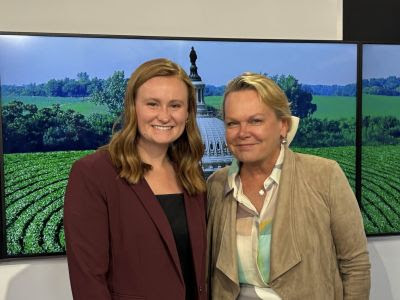
Watch Rep. April McClain Delaney, D-Md., on Agri-Pulse Newsmakers. pictured at right with Newsmakers host Lydia Johnson, discussing the USDA reorganization plan and rural broadband.
Plus, Eric Steiner with OFW Law explains what to expect in the skinny farm bill, and Shirley Bloomfield from NTCA-The Rural Broadband Association discusses what's needed to continue expanding broadband connectivity.
USDA terminates beginning farmer grants
USDA has terminated funding for some grants through the National Institute of Food and Agriculture’s Beginning Farmer and Rancher development program, according to a court filing.
Agroecology Commons, which is suing the Trump administration over withheld funding, was alerted in a letter last week its program award was rescinded, because the agency “does not support programs that promote or take part in diversity, equity and inclusion initiatives or any initiatives that discriminate on the basis of immutable characteristics.”
Lawyers for the group, which helps beginning farmers, wrote in a court filing that they are aware of other beginning farmer grants that were terminated at around the same time.
M&M’s, Skittles without artificial colors on the way
Mars Wrigley says that by next year it will make some of its most iconic brands without using artificial colors. Among the products: M&M’s chocolate, Skittles, Extra Gum Spearmint and Starburst Original fruit chews.
“When we have identified fully effective, scalable solutions across the entire portfolio, we will share additional item commitments and timelines,” Mars Wrigley says.
The company had been one of the loudest industry voices resisting the effort by the Trump administration, including Health and Human Services Secretary Robert F. Kennedy Jr., to get food manufacturers to move away from food dyes.
But in its recent announcement, the privately held company says, “Our experts are exploring alternatives that satisfy scientific safety criteria, technical requirements and consumer preferences.”
Critics: Hog industry can handle state laws
An animal welfare advocacy group, the Center for a Humane Economy, claims the hog industry is diverse enough to address demand created by animal welfare laws in California and Massachusetts.
The group is pushing back against arguments by the National Pork Producers Council (NPPC) and other opponents of Proposition 12 in California and Question 3 in Massachusetts, who say increased compliance costs will drive small and medium-sized producers out of business. The Center for a Humane Economy claims in a report that “the pig industry was sufficiently diversified at the start of implementation of these statewide laws that no pig farmer needs to change their production strategies to meet [their] demands.”
NPPC said last week when its vice president, Pat Hord, testified in Congress, “Though enacted in a single state, Prop. 12 has created sweeping consequences nationwide by fueling market volatility, imposing costly new mandates on producers, and paving the way for a patchwork of inconsistent state regulations. These disruptions have raised pork prices for consumers and continue to push small, multigenerational farms out of business.”
Looking ahead: Allies of the hog industry are trying to get a provision in an upcoming farm bill to block states from imposing animal welfare regulations on producers in other states.
Final word
“It's very possible that we might use pocket rescissions. It's one of our executive tools. It's been used before. The General Accounting Office, which we're not big fans of, has said it was legal in the 1970s” – Office of Management and Budget Director Russell Vought, when asked on CNN’s State of the Union about using a process to effectively cancel spending by waiting until the end of the fiscal year to propose rescissions of congressionally authorized appropriations.
Oliver Ward and Noah Wicks contributed to today’s Daybreak


