
Senate Democrats are already eyeing another opportunity to force a vote on President Donald Trump’s tariff agenda after he issued a new emergency declaration to increase tariffs on Brazilian goods starting Friday.
Trump had threatened to boost the tariff rate on Brazilian exports to 50%, up from 10% imposed under his so-called reciprocal tariffs, in part, over the country’s prosecution of its former president and Trump’s political ally, Jair Bolsonaro. On Wednesday, the president signed an order establishing new 40% duties, bringing the total tariff hikes since April 2 to 50%, arguing the “politically motivated” prosecution of Bolsonaro over his involvement in a coup following his election loss are hurting U.S. interests.
The prosecution of Bolsonaro and his supporters mark “serious human rights abuses that have undermined the rule of law in Brazil,” a White House fact sheet reads. Such actions harm “U.S. companies, the free speech rights of U.S. persons, U.S. foreign policy, and the U.S. economy,” it goes on to argue.
"I may modify this order, including in light of additional information, recommendations from senior officials, or changed circumstances," the executive order reads.
The tariffs are set to take effect next week. A 50% rate would mark the highest reciprocal tariff rate applied to any U.S. trading partner.
The president issued a new emergency declaration under the International Emergency Economic Powers Act to impose the tariff hike – the same powers the president used to impose reciprocal duties and tariffs on Mexico, Canada and China over fentanyl smuggling.
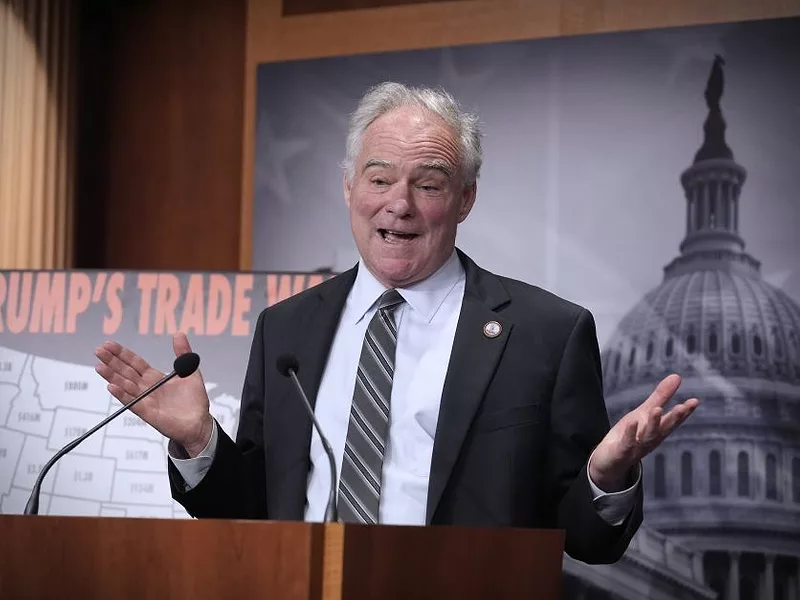
A new emergency declaration, however, provides a fresh opportunity for Democrats to force a Senate vote on the tariffs.
“I will challenge it as soon as I am able to,” Sen. Tim Kaine, D-Va., told Agri-Pulse on Wednesday.
Kaine and other Senate Democrats have already used resolutions to challenge the underlying emergency declarations and force votes on the administration’s application of tariffs on Canada and its 10% baseline tariff. The Canada vote passed, with four Republican senators joining Democrats to rebuke the duties.
Senate Democrats did not challenge the emergency declarations used to adopt tariffs on China and Mexico, however.
A challenge, Kaine said, can only be filed once the administration informs the Senate of its emergency declaration, which has not always been on the same day the tariffs are adopted.
“In some of the emergencies the president's done, they've sent the communication right away, and some it was like a month later,” Kaine said. Once the challenge is filed, it can be discharged from committee after two weeks, teeing up a floor vote.
It’s easy to be “in the know” about what’s happening in Washington, D.C. Sign up for a FREE month of Agri-Pulse news! Simply click here
Accordingly, Kaine said he would expect a September vote on the Brazil tariffs
A Senate vote wouldn’t overturn the tariffs without a similar House vote, however. The House has previously used measures to block votes on Trump’s tariff agenda, and could attempt to do so again.
Brazil is a major exporter of coffee, orange juice, beef, animal fat and wood products to the U.S. Coffee roasters, in particular, have warned of higher consumer prices because of limited alternative suppliers.
Some agricultural products will be exempt from the new duties, however, including orange juice, wood pulp and fertilizer, according to the executive order. Notably, coffee was not included among a list of exempted products.
Trump has threatened dozens of U.S. trade partners with higher tariffs from Aug. 1, but Brazil may be among the few countries that requires a new emergency declaration to actually impose higher duties. That is because the U.S. maintains a goods trade surplus with Brazil, and the reciprocal tariff emergency declaration relies on the premise that long-term trade deficits are creating an economic emergency.
“It has to be an emergency that is unusual and an extraordinary threat to the United States,” a trade lawyer granted anonymity to discuss the legal implications of Trump’s tariff threat told Agri-Pulse.
Asked whether a human rights argument could hold up in court, the lawyer said that the administration “can say whatever they like,” providing it fits “within the bounds of the IEEPA law.”
Peter Harrell, who served as senior director for economics in President Joe Biden’s National Economic Council and National Security Council, pointed out in a post on X on Friday that courts have traditionally given broad deference to presidents on what constitutes an emergency.
The U.S. launched an investigation into Brazil’s unfair trade practices earlier this month, which could lead to new duties. But the probe will take months and couldn’t be used to justify duties by Friday, forcing the administration to pursue action under IEEPA.
Harrel is also skeptical that a Section 301 probe – as the investigation is known – could justify a 50% tariff rate.
There is always the possibility of an eleventh-hour reprieve from the president. After Trump signed executive orders implementing new duties on Canada and Mexico earlier this year, he adjusted them shortly after to delay their implementation.
But U.S. trade talks with Brazil have reportedly stalled and President Luiz Inácio Lula da Silva has struck a more defiant tone than many other U.S. trading partners.
In an interview with the New York Times published Wednesday, he stressed that “at no point will Brazil negotiate as if it were a small country up against a big country.”
Brazil is also a member of the BRICS, which has invoked Trump’s ire for weighing a proposal to start its own currency as an alternative to the U.S. dollar.
Democrats are happy to use the moment as a political opportunity to put Republicans on record defending the steep new duties and any price hikes they could lead to.
As soon as the notification lands in the Senate, “I'll either file it that day or I'll announce that I'm going to file it,” Kaine said of his resolution.
For more news, go to Agri-Pulse.com.

