
Daybreak will not be published on Monday due to the federal holiday.
Senate Dems say they’ll keep forcing tariff votes as they lodge another challenge
A bipartisan group of senators is challenging President Donald Trump’s emergency declaration underpinning his “reciprocal” tariffs on almost every U.S. trading partner.
Senators can force votes on economic emergencies every six months. The last time they voted on the reciprocal tariffs was in April, when the measure failed in a 49-49 vote.
There are other pending votes on U.S. tariffs applied to Canada and Brazil, which could come to the floor as soon as next week. The Canada vote would mark the second such attempt.
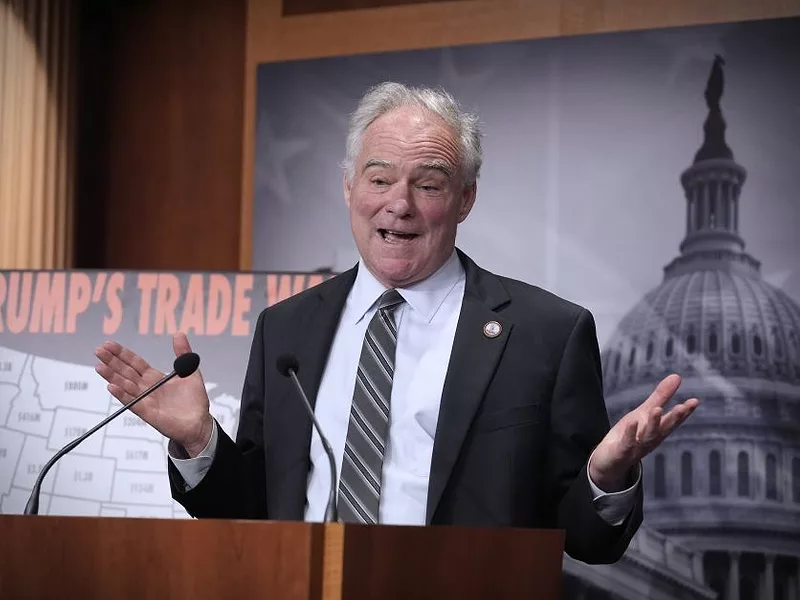
“We're going to keep challenging every six months on all these,” Sen. Tim Kaine, D-Va., said Thursday.
Oregon Democrat Ron Wyden, who is leading the effort with Kaine, Sen. Rand Paul, R-Ky., and others, says he wants the Republicans on-record defending the tariffs.
“What we're doing, in a bipartisan way, is saying, ‘if you're serious about holding down costs, you have to go out and fix these horrible tariffs that are jacking up costs,’” Wyden says. “I think we'll have a lot of interest on both sides of the aisle.”
Bessent presses ahead with Argentina assistance despite ag pushback
The U.S. is buying Argentinian currency to support that country’s economy ahead of its forthcoming elections.
Treasury Secretary Scott Bessent said in a post to X Thursday that his department finalized a swap line with Argentina’s central bank worth $20 billion, allowing an exchange of currencies.
“The U.S. Treasury is prepared, immediately, to take whatever exceptional measures are warranted to provide stability to markets,” Bessent wrote.
Cut through the clutter! We deliver the news you need to stay informed about farm, food and rural issues. Sign up for a FREE month of Agri-Pulse here.
Bessent spoke with his Argentinian counterpart about how the U.S. could support investment in the country.
“The Trump administration is resolute in our support for allies of the United States,” he added.
Take note: U.S. soybean producers and Democrats have criticized the administration giving financial support to Argentina, which is a prominent competitor in global agricultural markets.
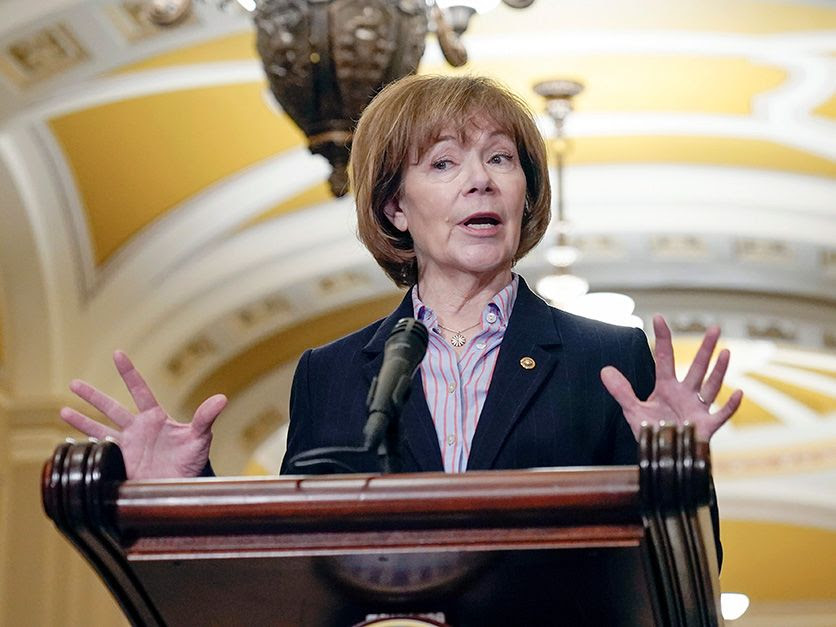 Sen. Tina Smith, D-Minn. (AP photo)
Senate Ag Dem: U.S. exports at long-term risk
Sen. Tina Smith, a Minnesota Democrat on the Senate Ag Committee, says she and farmers in her state are concerned the U.S. is losing export markets because of trade disruptions.
“If the supply seems to be unpredictable because of this on-again and off-again tariff situation, then our foreign markets will just shift to other suppliers, and so I’m quite concerned about that,” Smith says on this week’s Agri-Pulse Newsmakers.
“We know from past history that when we had the Trump tariff wars, trade wars, and the first administration that we never regained all of those markets that we lost. And of course, we'd all remember well what happened when we had the wheat embargo back in the '80s.”
Take note: Ag Secretary Brooke Rollins said at a cabinet meeting Thursday that a trade assistance package for farmers won’t happen until the government shutdown ends.
Rollins calls the payments a “bridge” to get farmers “from the Biden years to the new Trump era.”
This week’s edition of Newsmakers will be available today at Agri-Pulse.com.
NIOSH faces ‘significant operational crisis,’ industrial hygienist group says
The National Institute of Occupational Safety and Health, or NIOSH, is facing a “significant operational crisis,” with approximately 62% it’s staff still impacted by reductions-in-force, the American Industrial Hygiene Association said in court documents Thursday.
In an amicus brief, lawyers for AIHA said staff shortages at NIOSH have “disrupted essential research, observation and training programs, thereby compromising the health and safety of workers nationwide.” They added that uncertainty about future staffing levels “further threatens” the agency’s long-term effectiveness.
What happened: Back in the spring, as many as 873 NIOSH employees received termination notices and many were placed on administrative leave, according to an amended complaint filed by 20 state attorneys general last month. Some of these notices were subsequently rescinded, though the AGs said at least 45% of them, “and likely more,” are still pending.
Why it matters: Agriculture is one of the occupations studied by NIOSH researchers.
EPA pesticide regulators can improve efficiency, report says
EPA’s Office of Pesticide Programs needs a centralized database of past registration decisions and a more customer-friendly workforce, according to a review announced by the agency on Thursday.
Those were just a couple of recommendations in the wide-ranging report. When screening pesticide applications, OPP staff “often spend valuable time reassessing issues that were previously addressed in similar reviews”. A centralized, searchable decision database “could improve consistency, reduce duplication of effort, and speed up review timelines,” the Censeo Consulting report said.
The report also says OPP “should promote a culture in which staff actively support, inform, and engage with applicants, maintaining regulatory rigor while focusing on being responsive, transparent, and helpful.”
OPP “has made meaningful strides in improving core operations, such as replacing its outdated internal systems with a modern internal tracking system,” OPP said in releasing the report. But it added that the assessment “identified challenges and barriers that continue to impact efficiency and predictability.”
Farm Credit System debt issuance ‘muted’
The Farm Credit System has been issuing less debt – mostly in the form of bonds – due in part to higher interest rates, the Farm Credit Administration reported Thursday.
At its monthly meeting, FCA staff briefed the board on current conditions. From 2021 to 2023, the system’s total debt issuance fell from $415 billion to $281 billion.
The amount of debt issued was $299 billion in 2024, and has “remained somewhat muted through Aug. 31, for two reasons,” FCS said in a news release. “Interest rates were significantly higher than they were from 2021 through 2022, and fewer short-term securities were issued, specifically discount notes.”
“Both elevated interest rates and a generally inverted yield curve continued to negatively affect the system’s net interest spread, as well as the market value of its investment portfolio,” FCS said.
An inverted yield curve signals that yields on longer-duration financial instruments are lower than those with short maturities.
Lower interest rates in the latter half of 2024 and during the current year resulted in what FCS called “a marginal decline” in its overall funding costs.
Correction: Yesterday’s Daybreak incorrectly stated the size of U.S. tariff revenues. Treasury says the U.S. received $165 billion from October through August, up from $70 billion in the same period for the previous fiscal year.
Philip Brasher, Oliver Ward and Noah Wicks contributed to today’s Daybreak.


