

A central component of President Donald Trump’s trade policy faces its next legal test today when an appeals court hears oral arguments in a case challenging the legality of recent tariffs.
The U.S. Court of Appeals for the Federal Circuit in Washington will hear arguments in V.O.S. Selections Inc. v. Trump, a consolidated case challenging Trump’s use of emergency powers to levy tariffs on U.S. trade partners. The plaintiffs are a group of small businesses and states that argue the International Emergency Economic Powers Act does not allow the president to impose tariffs.
If the appeals court agrees with the U.S. Court of International Trade ruling that found the tariffs illegal, the case could end up in the Supreme Court.
Sen. Rand Paul, R-Ky., speaking at a Cato Institute event, predicted that the administration will lose. “I think there's a constitutional reason against it, and I think there's, in addition, a statutory reason they may fail,” he said.
But analysts warn that even if the IEEPA tariffs are struck down, the administration could use other, slower-moving trade tools to reinstate many of the duties.
"They have at least four other statutory bases out there,” trade lawyer Robert Kossick told Agri-Pulse.
Two of those would require lengthy investigations periods, though.
Trump sets India tariff rate at 25%
Trump says India will face a 25% tariff, just one percentage point lower than the rate applied under Trump’s April 2 tariff plan.
In a post to Truth Social on Wednesday, the president complained that India’s tariffs have long been “far too high” and its nontariff trade barriers had stymied U.S. exports.
“Also, they have always bought a vast majority of their military equipment from Russia, and are Russia’s largest buyer of ENERGY, along with China, at a time when everyone wants Russia to STOP THE KILLING IN UKRAINE,” the post reads. In addition to the 25% tariff, Trump said India would face an additional “penalty” for its trade ties to Russia, also applicable Aug. 1.
Administration officials have been teasing a U.S.-India deal for weeks and repeatedly hinted that both sides were on the cusp of an announcement.
In comments to reporters at the White House on Wednesday, Trump refused to rule out the possibility of a last-minute deal.
“We're negotiating with India right now,” Trump said. “We'll see what happens.”
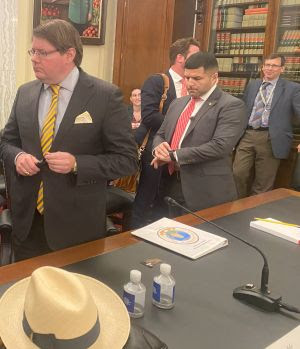 Stephen Vaden following his hearing before the Senate Agriculture Committee (Agri-Pulse photo)
Senate Agriculture Committee members hope to provide more input as USDA moves forward with its reorganization planning. That was the word from senators following their hearing with Deputy Secretary Stephen Vaden.
At the hastily called hearing, Vaden defended the plan’s goal of moving department employees closer to the people they serve. In particular, he touted the affordability of the cities chosen as regional hubs, where D.C.-area employees would be relocated.
Republicans said that overall, they were satisfied with Vaden’s answers but expect to have further conversations.
It’s easy to be “in the know” about what’s happening in Washington, D.C. Sign up for a FREE month of Agri-Pulse news! Simply click here
“The plan is just really an outline at this point, so I want to have input in how that plan is developed and what the outcome is,” said Sen. Jerry Moran, R-Kan. “I’m generally supportive of more opportunities for employees to be hired in places outside Washington, D.C., but I need a lot more detail than what I heard today in the hearing.”
Specifically, Moran said he’s interested in the details of the Kansas City, Missouri, regional hub.
Lawmakers also want USDA to work with Congress more as the plan moves ahead. Sen. Deb Fischer, R-Neb., who sits on both the Agriculture and Appropriations committees, said the reorganization announcement took members by surprise. “I wish we would have had that hearing before the report came out,” Fischer said.
Meanwhile: Democrats remained frustrated and concerned by the plan.
Sen. Cory Booker, D-N.J., said it appears USDA is moving away from supporting specialty crops and favoring large commodities, which would hurt his constituents. He added he’s concerned the reorganization plan could have implications for the forestry world. “I hope that our committee does the right thing and provides oversight and check and balance,” Booker said.
“His answers gave me very little comfort,” said Sen. Raphael Warnock, D-Ga., after the hearing.
Farmers: Herbicides are critical to operations
The majority of corn farmers say weeds are their top pest problem, and glyphosate and atrazine are the herbicides of choice. That’s according to a survey commissioned by the National Corn Growers Association amid the criticism of those pesticides mounted by the Make America Healthy Again movement and its allies in the Trump administration.
According to the survey of 1,000 farmers, 85% said weeds were their biggest pests. Some 49% of farmers said the biggest impact of losing those products would be higher costs weed control. Some 15% of the farmers surveyed said the biggest impact would be increased tillage.
Labor suspends collecting H-2A certification fees
The Labor Department will temporarily suspend the collection of H-2A labor certification fees while it stands up an electronic system.
Currently, employers must send the fees to the Office of Foreign Labor Certification by mail. But OFLC’s Foreign Labor Application Gateway, or FLAG, portal allows for the electronic filing and processing of employer applications.
During the temporary suspension period, the agency said it won’t issue invoices for fees for H-2A applications for temporary certifications, and it also won’t seek retroactive payment of fees for those certifications.
The announcement was made in the Federal Register. The agency said it will announce the end of the temporary suspension of H-2A certification fees in a future Federal Register notice.
Final word
"We had the U.S. trade representative come to our lunch one day, and it's a little bit like being in the Soviet Union. When the commissar comes, do you insult him? No, you beseech him. You tell him how great-looking he is, his clothes are nice, his shoes are good, how much you love him and the president. And then you say very sheepishly, 'and we love the tariffs, and the president's doing such an awesome and amazing job, but we want to manufacture things in our state. But have you ever looked at where the robots that you need for assembly line are made? They're made in Japan. So, if you want us to make stuff in America, we've got to first buy the robots in Japan to make stuff in America.'" — Sen. Rand Paul, R-Ky., at a Cato Institute event.
Rebekah Alvey, Philip Brasher and Oliver Ward contributed to today’s Daybreak.


