
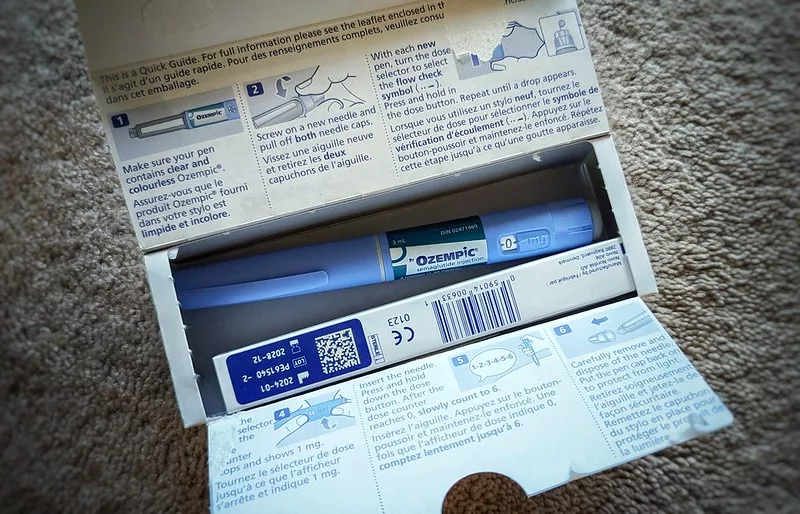
Caley Svensson was always a self-professed “pastry girl,” with a taste for baked goods and other sugary food products. But since she started taking Zepbound, a weight-loss medication similar to Ozempic, her interest in sweet treats is greatly diminished.
“It makes you apathetic to food,” said the 41-year-old from Park Ridge, New Jersey. “As a mom, I would always be taking a kid's snack in the pantry,” she added, but now she rarely eats candy at all.
It’s not a matter of taste, said Svensson, who has been on Zepbound for three years and has no plans to stop.
“Sugar still tastes yummy,” she said, pointing out to Agri-Pulse that she has a cup of coffee and a chocolate-chip muffin to eat during the interview. But “craving has really been erased from my body,” she added.
Svensson is not alone. Many GLP-1 users notice similar reductions in sugar intake. And some develop even stronger aversions to sugar. Svensson’s brother-in-law “can't stand it now,” she said.
As glucagon-like peptide-1 – or GLP-1 – weight loss drugs become more accessible, including Ozempic, Wegovy and Zepbound, U.S. food industries are scrambling to understand how the drugs could reshape consumer demand. The sugar sector, which is already facing a barrage of policy uncertainty, is particularly jittery.
“We're starting to see more and more information coming out regarding purchasing habits and GLP-1 drugs,” Rob Johansson, director of economics and policy analysis at the American Sugar Alliance, said during a panel discussion at the recent International Sweetener Symposium.
GLP-1 refers to the glucagon-like peptide-1 drugs used to treat diabetes, obesity and other illnesses, that include Ozempic, Wegovy and Zepbound.
“It's certainly, I think, fair to say that it's having a negative impact,” added Johansson, a former chief economist at the Agriculture Department.
Interested in more news on farm programs, trade and rural issues? Sign up for a four-week free trial to Agri-Pulse. You’ll receive our content - absolutely free - during the trial period.
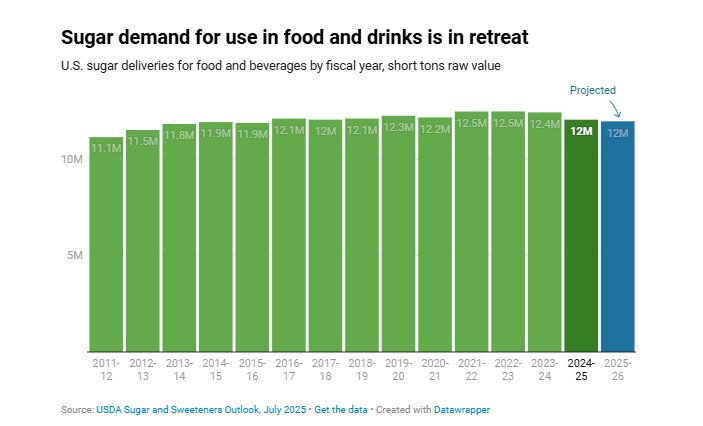
Sugar demand among food and beverage makers has already been declining since 2022 and plateaued for several years before that, according to USDA data. In its latest sugar and sweeteners outlook report, the Economic Research Service attributed some of the decline to the rising popularity of GLP-1 drugs.
The industry already feels under siege from the Make America Healthy Again movement spearheaded by Health and Human Services Secretary Robert F. Kennedy Jr., and the drugs are injecting more uncertainty into market forecasts.
When a spoonful of sugar doesn’t help the medicine go down
The link between GLP-1 use and declining consumption of certain food products is not well understood, with much of the body of research on GLP-1s still focused on drug efficacy. But research published by the University of Arkansas this year found that patients on GLP-1 drugs reported reduced consumption of both sugary and fatty foods.
GLP-1 drugs alter users’ enjoyment of these foods, Brandon McFadden, a professor in food policy and one of the study’s authors, told Agri-Pulse.
“It's not completely clear what the mechanism is,” McFadden said. But he added that users reported consumption of certain product categories fell particularly steeply.
Around 70% of respondents reported eating fewer processed foods and 50% more respondents reported consuming less soda, refined grains and beef than those that said they ate more.
The survey also found users had cut back on starchy vegetables, pork, alcohol, fruit juice and dairy milk, and identified smaller consumption dips for chicken, coffee, fish and seafood, nuts, eggs, plant-based meat, whole grains and plant-based milk.
McFadden says that industries are right to be nervous – particularly those that produce sugary and fatty foods. The popularity of these drugs is showing no signs of abating, he argued, and recent developments suggest they could only become more widespread.
A KFF poll in 2024 found that around 12% of the population had taken GLP-1 drugs at some point in their lives, and around 6% were still taking them. But McFadden said this could soar in the coming years as the drugs become cheaper and more accessible.
In March this year, Novo Nordisk, the maker of Wegovy, slashed prices from $650 to $499 per month for those paying out of pocket for the drug. Eli Lilly has also reduced the price of its Zepbound product.
Since the beginning of 2024, the Food and Drug Administration has also approved GLP-1 drugs to treat more ailments, which means more insurance companies will pay for patients’ prescriptions.
“The market potential is huge,” McFadden said. Patients with obstructive sleep apnea, heart disease and those with a body mass index of 30 or higher can now get a prescription for the drug. That makes most of the U.S. population eligible, McFadden said.
“I wouldn't be shocked if like 10% of adults are on this in the next few years,” he said.
Eli Lilly is also developing a GLP-1 pill to appeal to patients who are uncomfortable with injections. The drug has proven effective in its first clinical trials, according to a press release from the company.
Randy Green, a consultant at Watson-Green LLC, pointed out during the August International Sweetener Symposium in Michigan that the sugar industry will be dealing with GLP-1s for some time to come. U.S. consumption of donuts, cookies and other sugary products are already falling, he argued.
“Product categories seem to be behaving as you would expect them to, if the drugs were having an impact,” Green said.
Beef is less clear-cut
While McFadden’s research also identified beef as another market ripe for disruption from GLP-1 drugs, the outlook here is much more uncertain.
Researchers at Arizona and Kansas state universities have examined the impact of GLP-1 drugs on demand for animal proteins and found evidence that GLP-1 use is actually associated with an increase in beef demand.
Looking at demand rather than consumption allows researchers to incorporate price effects into the analysis, Justin Bina, an assistant professor at the Morrison School of Agribusiness at Arizona State University, told Agri-Pulse.
“We're finding that using GLP-1 medications causes an increase in demand for beef, pork, chicken and seafood products,” Bina said. “Consumers are willing to purchase higher quantities at any given price or are willing to pay more for the same quantity.”
Shalene McNeill, executive director for nutrition and science at the National Cattlemen’s Beef Association, told Agri-Pulse that she sees GLP-1s more as an opportunity than a threat for the U.S. beef industry.
Rapid weight loss comes with risks of losing muscle mass, she said, because patients are eating fewer calories. To mitigate that muscle loss, many GLP-1 users will try to ensure that the foods they are eating are packed with protein – and that means many are turning to animal proteins.
“Consumers see beef as a top source of high-quality protein,” McNeill said. “So, I don't expect to see declining beef consumption because of GLP-1s. If anything, I see people looking to up their protein intake and turning to beef more often.”
McNeill also pointed out that in recent years, customers are increasingly viewing lean beef as a healthy protein source.
Unlike demand for sugar, which is starting to wane, beef continues to see very high levels of U.S. demand and, therefore, high prices.
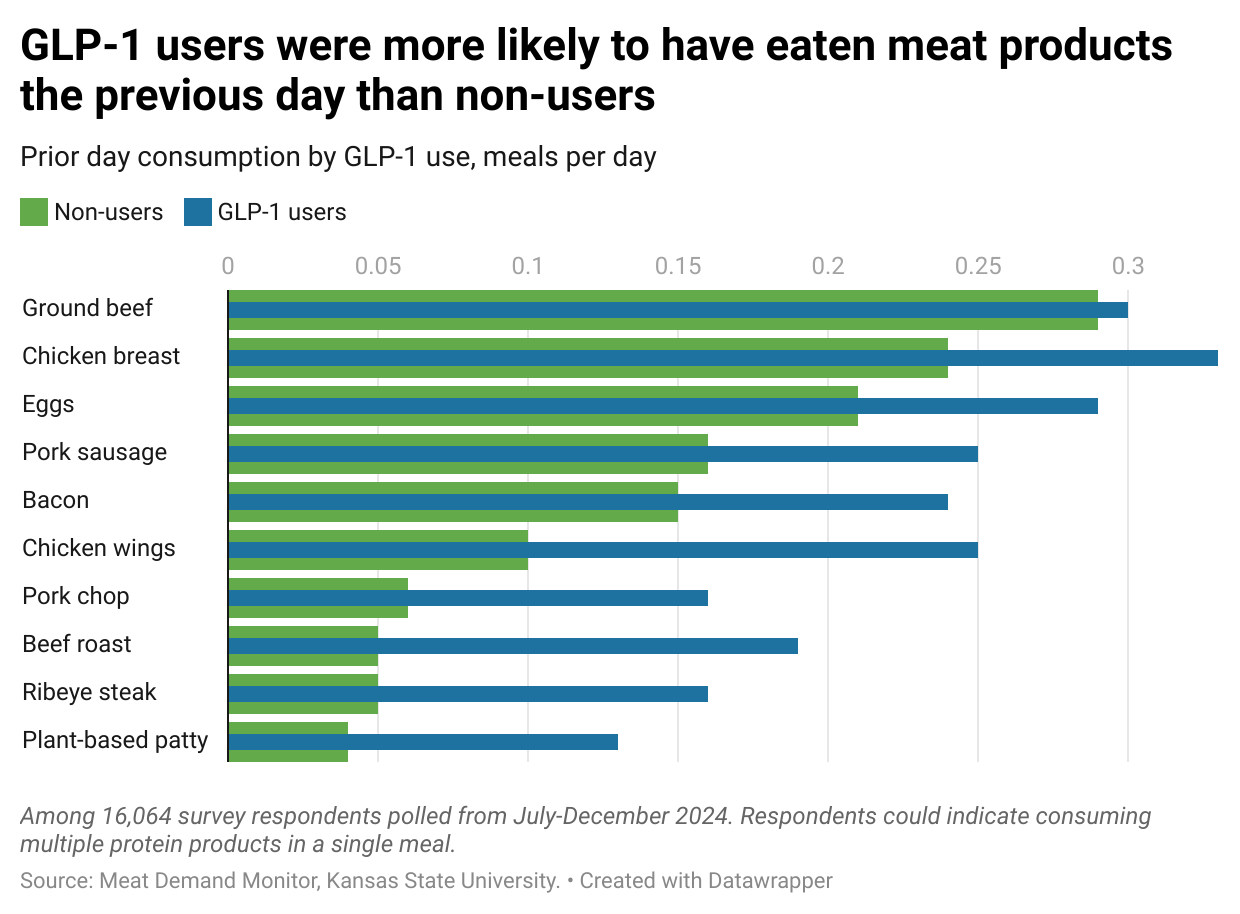
McNeill’s assertions about GLP-1 users increasing animal proteins in their diets are borne out in Bina’s research. While GLP-1 users are more likely to skip meals, they are also more likely to shift consumption away from grain products and sugars to various animal proteins.
A survey of more than 16,000 people last year found Americans were more likely to have eaten a meal containing animal proteins the previous day if they are taking GLP-1s.
The same survey found that respondents were also more likely to buy larger packages of ground beef, bacon, pork chops and sausage, suggesting higher overall volume consumed. But these findings were not statistically significant for roast beef.
Even if consumers do reduce their overall food intake while using GLP-1s, McNeill is still optimistic that the drugs could boost U.S. beef sales. She pointed out that people often only take the drugs in spells of less than a year. But they may keep the eating habits they built while on the drugs for much longer.
“They're going to be even hyper-focused on retaining some of those benefits without the medication. And that's why protein is really going to continue to be a popular nutrient for a while,” McNeill said. “I really do see nothing but opportunity.”
Bina also pointed out that even if McFadden’s findings are accurate and consumers are cutting back on beef, because they are willing to pay more for what they consume, the industry may be able to make up for any shortfall in quantity.
Sugar, however, may find no such solace. Svensson has only eaten part of the top of her muffin by the end of the interview. What are the chances she’ll finish it?
“Zero,” she said. It “is probably going to sit here for the rest of the day, and I'm going to end up feeding it to my chickens.”
For more news, go to Agri-Pulse.com.

