
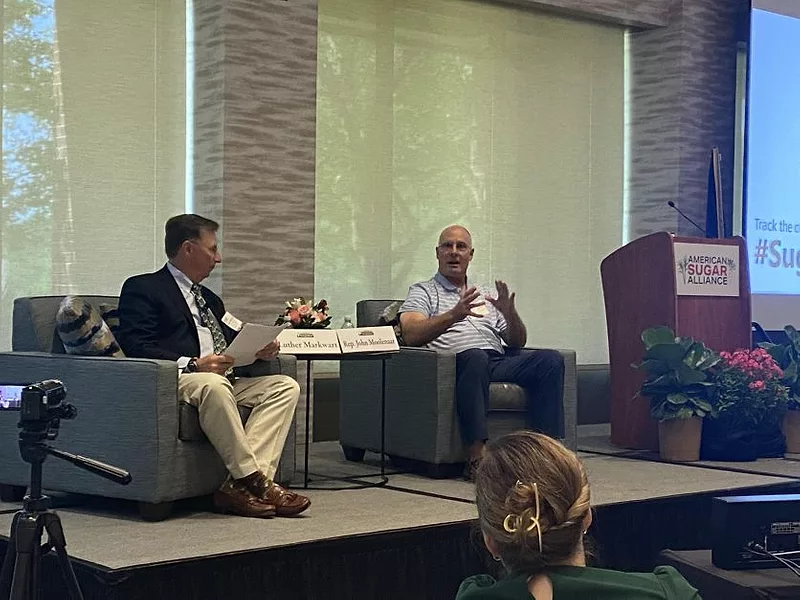
Policymakers from both parties reiterated their support for the U.S. sugar program at the annual International Sweetener Symposium in Traverse City, Michigan, this week, as Republicans highlighted recent provisions in the reconciliation bill to help the industry and weighed in on areas of future reform.
Democrats have been full-throated in their opposition to President Donald Trump’s tariff rollout, but Michigan Sen. Elissa Slotkin used her appearance at the symposium to clarify that she believes tariffs, in certain contexts, are useful economic and job creation tools.
“I'm not inherently anti-tariffs,” Slotkin said in a recorded video played to attendees on Tuesday., adding, “Targeted tariffs like the sugar program have really helped create jobs, grow industries” and saying she is “committed to protecting the sugar program.”
Slotkin’s comments in support of the sugar industry were in lockstep with Republican lawmakers and officials who spoke at the event.
Deputy Agriculture Secretary Stephen Vaden on Monday opened his remarks with a similar sentiment.
“USDA remains committed to operating our sugar program at no cost to the taxpayers, and we're focused on preventing forfeitures at all costs,” he told the representatives from across the sugar industry.
Both Vaden and Rep. Brad Finstad, R-Minn., who sits on the House Agriculture Committee, took the opportunity to champion recent policy adjustments that impact the sugar industry.
Last month, the administration announced it would block imports of specialty sugar, including organic sugar, beyond those required to meet U.S. trade obligations. The move drew criticism from the Organic Trade Association, but Vaden touted the benefits to domestic sugar producers.
“Every action that we're taking is with an 'America first' and 'farmers first' philosophy,” Vaden said. “We're going to set the tariff rate quota for specialty sugar at the minimum required by our trade agreements, and not one gram more.”
Republican lawmakers and administration officials are fanning out across the country during Congress’ August recess to promote the “One Big Beautiful Bill Act” – the sweeping legislation to enact the president’s policy agenda – in their home districts and states. On Monday, Vaden touted the bill’s provisions to permanently adjust the federal estate tax exemption and adjust the 45Z clean fuels tax credit to incentivize the use of domestic feedstocks.
It’s easy to be “in the know” about what’s happening in Washington, D.C. Sign up for a FREE month of Agri-Pulse news! Simply click here
Finstad, however, offered a more caveated endorsement.
“Typically, I'm a small government guy,” Finstad said, adding that “big” and “beautiful” legislation “sounds a little counterintuitive to what I think government should be.”
But he applauded congressional Republicans’ efforts to impose new conditions on nutrition assistance, the inclusion of parts of the farm bill in the legislation and the allocation of more funding for ag trade promotion programs. Sugar producers, he argued, will particularly benefit from the added tax certainty and extended support.
The OBBB includes targeted relief for the sugar sector by boosting the loan rates on cane and beet sugar by 4.25 cents and 7.39 cents through 2031, respectively. The bumps mark the first significant increase in around 40 years.
Sugar users also welcomed an effort to streamline imports. The bill included language ensuring unused sugar tariff-rate quotas are swiftly reassigned to countries that can fill them.
Multiple economists at the symposium said that the provisions should provide a much-needed boost to the industry.
“What we saw in the One Big, Beautiful Bill, that's going to provide some economic relief,” John Newton, executive head of Terrain and former chief economist for Senate Ag Committee Republicans, said during a session on Tuesday.
Jeff Dobrydney, head of futures and options at Jenkins Sugar Group Commodities, said the administration’s recent actions should spur the domestic industry. He noted that the reduced quota on specialty sugar would be particularly valuable for Florida Crystals, the sole organic sugar supplier in the U.S.
But speakers also argued that the industry faces several uncertainties in the coming year, and pressed lawmakers on their plans to address long-running and emerging challenges.
Courtney Gaine, president and CEO of the Sugar Association, pointed to uncertainty around the forthcoming Make America Healthy Again Commission report. The report will issue recommendations for improving children’s health, and many in the industry will be closely watching how the report will treat sugar, after an earlier report on the causes of childhood obesity put the commodity in the crosshairs.
The Agriculture and Health and Human Services departments are also working together on new dietary guidelines due before the end of the year. The guidelines, Gaine said, are the “backbone” of federal nutrition policies and are used to shape school lunches, military meals and SNAP benefits, among other programs.
Kristi Boswell, an immigration lawyer at Alston and Bird and a former adviser at the White House and USDA during Trump’s first term, also pointed to uncertainty over farm labor, amid the president’s immigration crackdown and climbing labor costs due to Adverse Effect Wage Rate (AEWR) requirements for H-2A workers.
Rep. John Moolenaar, R-Mich., outlined his vision for delivering the agricultural sector more labor certainty and for reforming the H-2A program to deliver greater benefits for U.S. growers.
In the short term, he said, Congress needs to freeze the AEWR. This rate, which determines wages for most workers entering the U.S. under the temporary H-2A program, is set by the Department of Labor and has been climbing in recent years.
“That's like a band-aid,” said Moolenaar, who has introduced legislation to freeze the rate at 2022 levels.
In the longer term, he said, Congress and the administration need to design policy to ensure it incentivizes legal migration and discourages illegal entry.
“Our visa programs are workable, and they allow both the user of the program as well as the beneficiary of the program to do what they do best,” Moolenaar said.
But ultimately, Moolenaar argued, immigration reform will need a president driving the issue through Congress. The committees of jurisdiction, including the judiciary committees, he said, do not approach the issue from an agricultural perspective, with many of the members representing more urban districts.
“They don't understand the issue,” Moolenaar said. “But if President Trump leads on it, I think that helps us make the case even more that this is a benefit.”
For more news, go to Agri-Pulse.com.

