
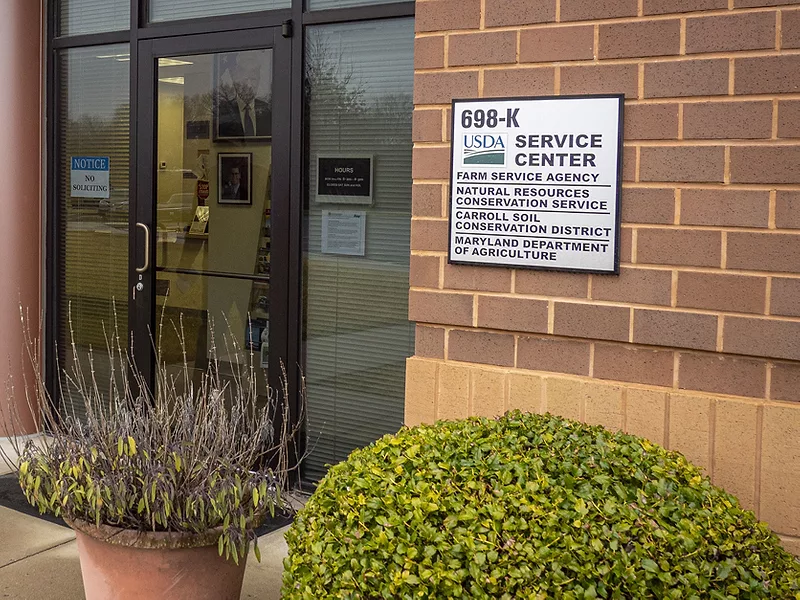
Leaders of an association representing Farm Service Agency (FSA) committee members are raising concerns that staff reductions have left “many offices without the necessary employee resources to adequately” handle farm programs.
National Association of Farmer Elected Committees President Jim Zumbrink and nine other members of the organization’s executive committee are sending a letter to Ag Secretary Brooke Rollins dated today on the proposed reorganization of the agency.
The group “is very concerned that without adequate staff our farmers and ranchers could experience great delays in the receipt of program funds, conservation funds and emergency funds.”
They note that since 2002, FSA permanent county staffing has declined 40%, going from 9,413 employees to fewer than 6,000 employees. They say current staffing levels are “at an all-time low,” and they want their organization to have “a seat at the table” during any future FSA reorganization plans.
Soy growers warn of ‘extreme’ financial distress as China market vanishes
The soybean industry is warning the Trump administration about the financial challenges facing growers this fall as sales to China dry up. The American Soybean Association (ASA) on Tuesday released a letter to President Donald Trump on the issue, and an accompanying white paper laying out the state of soybean exports.
The letter and white paper note that the Chinese duty on U.S. soybeans is 20% higher than the tariff on South American soybeans, keeping the U.S. crop “prohibitively expensive.” China has put in no orders for U.S. soybeans being harvested this fall, and growers in the northern Plains have no new export orders at all, the white paper says.
“U.S. soybean farmers are standing at a trade and financial precipice. As you and your team negotiate with China, we urge you to prioritize soybeans and reach a deal that includes the removal of China’s retaliatory duties and, if possible, significant soybean purchase commitments,” ASA says in the letter to the White House.
Don’t miss: Oliver Ward reports in this week’s Agri-Pulse newsletter that pesticides and other agricultural inputs could be particularly hard hit by new tariffs. We also have reports on the draft MAHA strategy, beef prices, bee losses, and NASCAR and ethanol (see pictures below).
Photos from Iowa Corn 350
 Photos: Iowa Corn

Agriculture Secretary Brooke Rollins will be in Mitchell, South Dakota, today to hold an ag policy roundtable with the state’s congressional delegation at Dakotafest. Rollins will appear with Senate Majority Leader John Thune, R-S.D., as well as GOP Sen. Mike Rounds and Rep. Dusty Johnson.
Take note: The conservation group Invest in Our Land also is holding a reception at Dakotafest today. On Thursday, the group plans to unveil an art installation at the Corn Palace honoring producers who have used federal conservation programs.
Small farms decrease in number, NASS finds
The number of family farms fell by 8% between 2017 and 2022, the National Agricultural Statistics Service says in a new report. The decrease amounts to nearly 159,000 farms.
Large farms increased by 40% and very large farms by 65%, NASS said. Large farms are defined as having gross cash farm income between $1 million and $4.99 million. Very large farms have gross cash farm income of $5 million and over.
Small farms, those with a GCFI under $35,000, account for 85% of the United States’ 1.9 million farms.
Take note: Family farms still make up 95% of all U.S. farms, according to the report.
Cut through the clutter! We deliver the news you need to stay informed about farm, food and rural issues. Sign up for a FREE month of Agri-Pulse here.
The typology report is available from NASS.Report: Over half of 2024 Farm Credit loans went to young, beginning or small producers
More than half of all loans made by Farm Credit lenders in 2024 went to young, beginning or small producers, according to a new report from the Farm Credit Administration (FCA), which oversees the system.
FCA says Farm Credit System institutions provided $348 million in services to young, beginning and small producers.
The report says more institutions reported having young, beginning and small farmer advisory committees, board members and staff training compared to 2023.
The report says total non-lending dollars for young, beginning and small farmers decreased by 2.7%, “mostly due to decreases in grants and in non-lending capital commitments."
USDA trade undersecretary leads U.S. delegation to Korea
USDA trade officials met with their counterparts to discuss ag trade at the Asia-Pacific Economic
Cooperation Food Security Ministerial Meeting last week, USDA says.
Michelle Bekkering, deputy undersecretary for trade and foreign agricultural affairs, led the U.S. delegation. She met with the Korean Ministry of Agriculture, Food and Rural Affairs to discuss non-tariff trade barriers during the visit. Those barriers, according to a U.S. Trade Representative report released in March, include “onerous” biotechnology requirements and a 16-year-old “transitional” measure restricting U.S. beef exports.
Bekkering also met with representatives of the U.S. Grains Council, the U.S. Meat Export Federation, the U.S. Soybean Export Council, and U.S. Wheat Associates.
Final word
“With rural America on the verge of financial crises due to low commodity prices, the failure to deliver timely program funds could have a long and lasting impact on all of America.” – Letter from National Association of Farmer Elected Committees to Ag Secretary Brooke Rollins today.
Noah Wicks and Philip Brasher contributed to today’s Daybreak.


